
Welcome & Activation
Turn Counter Customers into Loyalty Members
How can the cashier make joining worth doing now?
A worked example
- RM5
- Contribution per incremental action
- 24
- Break-even actions
- 36
- Minimum target
additional paid lunches
additional paid lunches, rounded up
At a glance
The business problem
Hakim has customer traffic without a corresponding member base. A regular like Jason can keep buying lunch without ever learning what membership offers.
The leak is missed enrolment, not necessarily missed meals. Hakim should count sign-ups against bills for each shift, because a busy day can hide a counter team that rarely asks.
Why the usual promotion falls short
A poster asks Jason to notice, remember and act later. A short invitation during payment gives him an immediate reason to finish joining while someone can help.
A bigger discount would add cost without fixing that timing gap. Start with one modest kopi and a clear staff sentence; the first question is whether more customers complete sign-up.
What you set up in Pixalink
Opening scenario
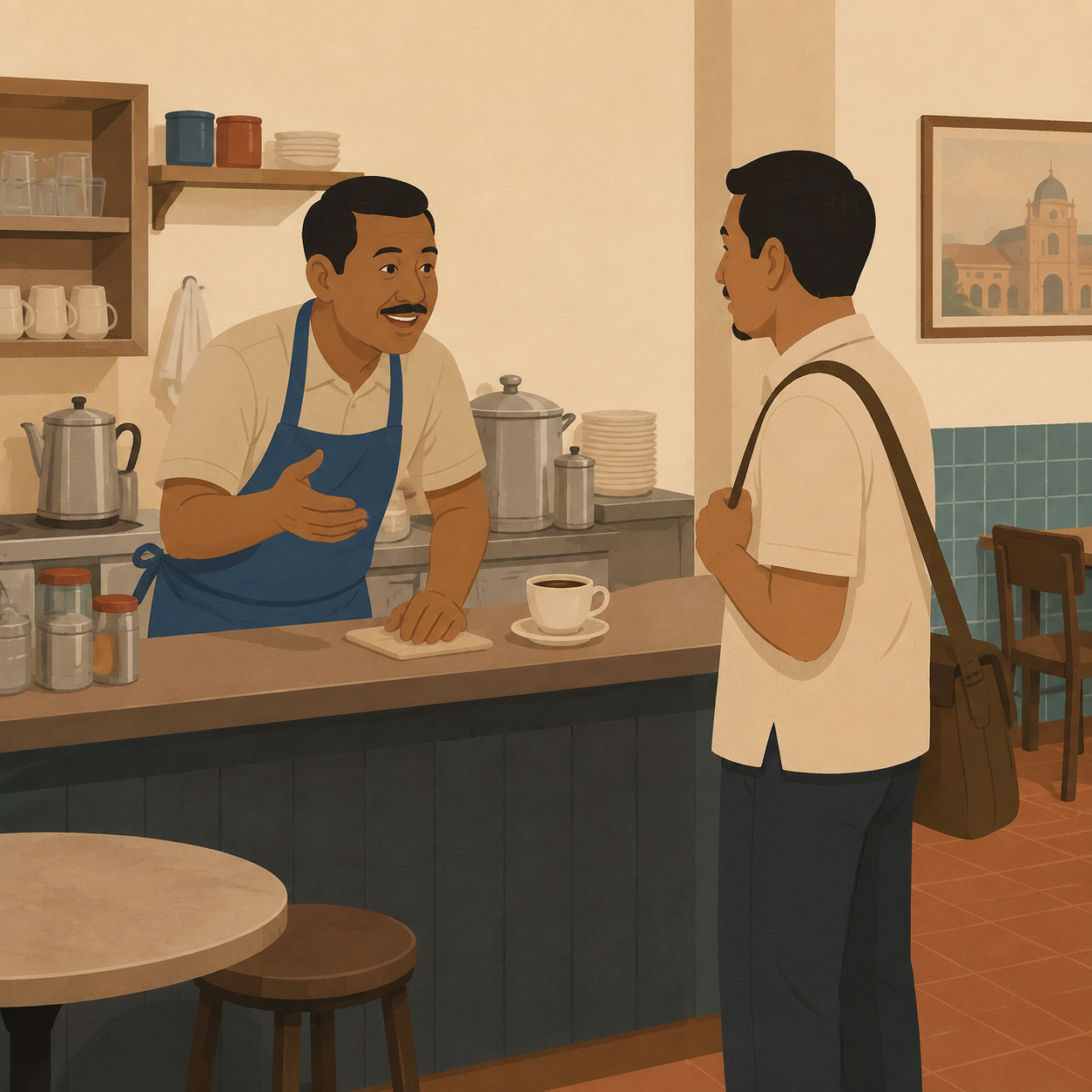
Hakim recognises Jason as he settles his lunch bill at the kopitiam in Ipoh. Jason has eaten here weekly for two years, yet has never joined the loyalty programme. Hakim serves around 300 people a day but has only 200 members after a year; joining usually means going home and finding a link.
Hakim, Jason and the kopitiam are fictional, and all figures in this article are illustrative. Today, Hakim wants to replace “join later” with a small benefit before Jason leaves. The lunch is already sold; the chance to enrol a regular is slipping away. How can the cashier make joining worth doing now?
The recipe
The campaign recipe
The Counter QR Sign-Up Drop uses individual Scan Codes handed out at the till. These are starting assumptions for Hakim's pilot, with staff controlling participation and gift collection terms.
| Recipe element | Recommended starting point |
|---|---|
| Suitable industries | Kopitiams, cafés and other frequent-visit food outlets |
| Primary goal | Enrol customers before they leave |
| Customer segment | Paying lunch customers who are not members, including regulars |
| Offer | Join and collect one stamp that completes a welcome card for one regular kopi |
| Validity | Collect kopi on the joining visit or by closing the next day; staff enforce |
| Minimum spend | Any paid lunch bill to receive a code; no extra purchase for kopi; staff check |
| Quantity or budget limit | 50 individual codes; RM60 gift reserve plus RM60 operating allowance; staff cap distribution |
| Main success metric | New sign-ups per 100 bills, recorded separately by shift |
The message your customer receives
This message is fictional, like the merchant and customer. All figures are illustrative.
From Hakim's kopitiam via WhatsApp
Jason, join our loyalty programme and claim one stamp to complete your welcome card for one regular kopi. Collect your kopi on your joining visit or by closing the next day.
Any paid lunch bill qualifies. No extra purchase needed for kopi.
The journey
Follow the customer
- Hear the invitation. Paying for lunch, Jason hears: “Scan this, your kopi tomorrow is on us.” The cashier explains that today is also possible and gives him his own code.
- Join at the counter. Jason scans, enters his number and completes sign-up and the stamp claim. In this illustration he joins in under thirty seconds; that is not a promised processing time.
- See the benefit. His stamp completes the welcome card, and the configured free-kopi reward appears in his portal before he leaves. The cashier checks it has arrived and explains the collection deadline.
- Return as a member. Jason comes tomorrow for kopi, as he was going to anyway. Hakim now has a member relationship to build on, but this planned visit is not extra campaign revenue.
flowchart TD
    A[Hear the kopi invitation] --> B[Scan and finish joining]
    B --> C[Check the free kopi has arrived]
    C --> D[Enjoy kopi and continue as a member]
Use case: how the merchant applies it
Hakim tests across matched lunch shifts for one week, randomly choosing offer shifts and comparison shifts with the usual service. Staff ask every paying customer on offer shifts whether they are already a member. Only non-members receive a code, and distribution ends after 50 codes across the pilot.
Jason's lunch costs RM12; the regular kopi normally sells for RM3 and costs RM1.20 to fulfil. Joining and claiming the stamp unlock the gift without another purchase. Hakim promises collection today or by closing tomorrow, then ordinary membership continues without another joining gift.
Hakim chooses a welcome card requiring one stamp, with one completion and a free-kopi completion reward. Staff explain and enforce the collection deadline and keep a manual issue-and-collection record. Before launch, Hakim checks the reward is usable within the promised window; the Scan Code alone does not define those gift terms.
How the platform helps
How Pixalink supports the strategy
Pixalink's Scan Codes redeem once per printed code and award a stamp or points. An unregistered scanner goes through sign-up first; staff still control the invitation, non-member eligibility and one code per person.
A one-stamp card and configured completion reward connect the stamp to Hakim's kopi offer. Completion reward processing is queued, so staff must check arrival; instant delivery is not guaranteed. A points-awarding code alone does not promise a kopi voucher.
Use Scan Codes, not QR Rewards / Scan & Share: the latter is a social-review landing page and grants nothing on its own. Neither the 50-person pilot cap nor one-code-per-person distribution should be assumed from a code's single-use rule.
Configure this in Pixalink
Start with How to Set Up a Stamp Card Campaign for the prerequisite card and completion reward. Step-by-step Scan Code setup is not documented in the KB yet; ask support to confirm the complete flow before printing.
The economics
ROI taste test
Membership alone collects no extra cash. Hakim measures additional paid lunches over 30 days against matched comparison shifts, excluding the joining bill and allowing for different customer counts. Regulars may cross between offer and comparison shifts, so treat this small test as directional evidence. Jason's planned return and a free-kopi-only collection do not count as incremental actions.
Cost the whole pilot
Assume each additional lunch collects RM12 with RM7 variable fulfilment cost. Reserve all RM60 for 50 kopis, including gifts to people who would return anyway, plus RM60 for printing and staff time.
The formulas are contribution = cash collected - variable fulfilment cost - reward cost; break-even = campaign operating cost / contribution; minimum target = break-even x 1.5, rounded up.
- Contribution per incremental action = RM12 - RM7 - RM0 = RM5.
- Break-even actions = RM120 / RM5 = 24 additional paid lunches.
- Minimum target = 24 x 1.5 = 36 additional paid lunches, rounded up.
Reward cost is RM0 per additional lunch because the full RM60 gift reserve is already in the RM120 campaign cost. At 36 extra lunches, RM180 contribution less RM120 leaves RM60; sign-ups and scans alone prove none of that. Replace every assumption with actual prices, costs and behaviour, including displaced paid kopi sales; results are not guaranteed.
Measure it
What to watch
- Sign-ups per 100 bills by shift: new members divided by bills, multiplied by 100, compared with matched shifts.
- Invitation coverage: paying customers asked about membership divided by paying customers served on offer shifts.
- Incremental paid lunches: additional lunches within 30 days above the adjusted comparison baseline.
Common mistake: counting Jason's already-planned return as new revenue. Record it as member activity without crediting the campaign for creating the visit.
Safeguard: reconcile one staff-controlled record of codes issued, recipients, collection deadlines and gifts served after every shift. Stop distribution at 50 and keep the RM60 gift reserve for promises already made.
Keep when sign-ups per 100 bills beat comparison shifts, at least 36 additional lunches cover the minimum target and the safeguard holds. Improve a promising signal in a separate capped test by changing only the staff sentence. Stop expansion if contribution is non-positive, the safeguard fails or the completed test misses either threshold.
Your first test
Try this first
- Define non-member lunch customers and matched comparison shifts; record baseline bills and sign-ups.
- Cap distribution at 50 individual codes and reserve RM120 for the whole pilot.
- Fix one kopi offer, one week of enrolment and 30 days of paid-lunch measurement.
- Record actual economics and reconcile the issue-and-collection safeguard each shift.
- Apply the preset keep, improve or stop rule before offering codes more widely.
Questions
Frequently asked questions
Can an existing member use a code?
The single-use rule is per code, not a new-member eligibility check. Hakim's staff must restrict this pilot to non-members.
Can everyone scan the same printed code?
No: that code redeems once. Hand each eligible person a distinct code and control distribution yourself.
Is free kopi automatic after any scan?
No: the code awards its configured stamp or points. Hakim's kopi requires the connected completion reward, and staff should check it arrives before the customer leaves.
Does joining guarantee a profitable return?
No: Jason already intended to return. Value the membership opportunity separately and use observed additional paid lunches to judge the economics.
Share this recipe
A card you can post
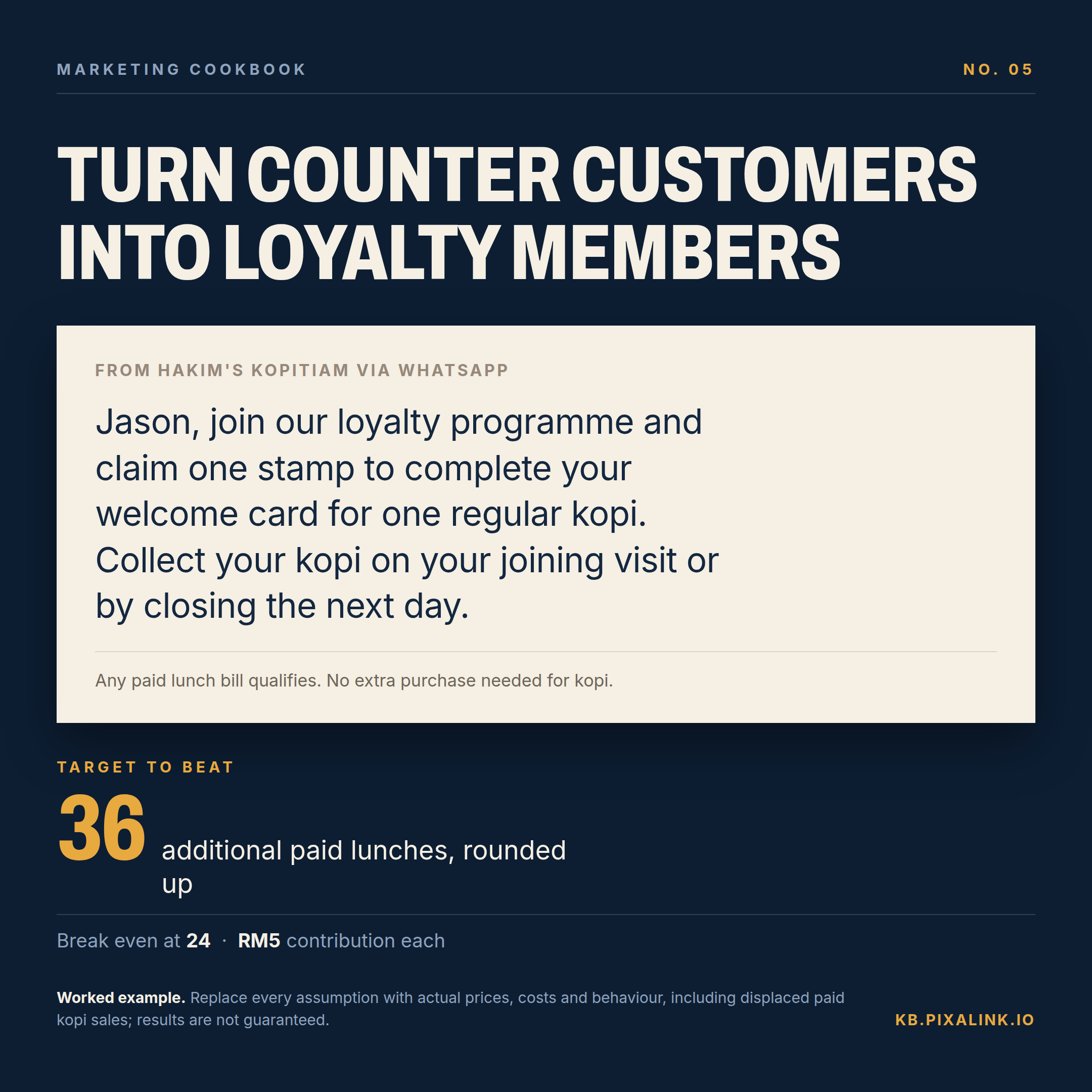
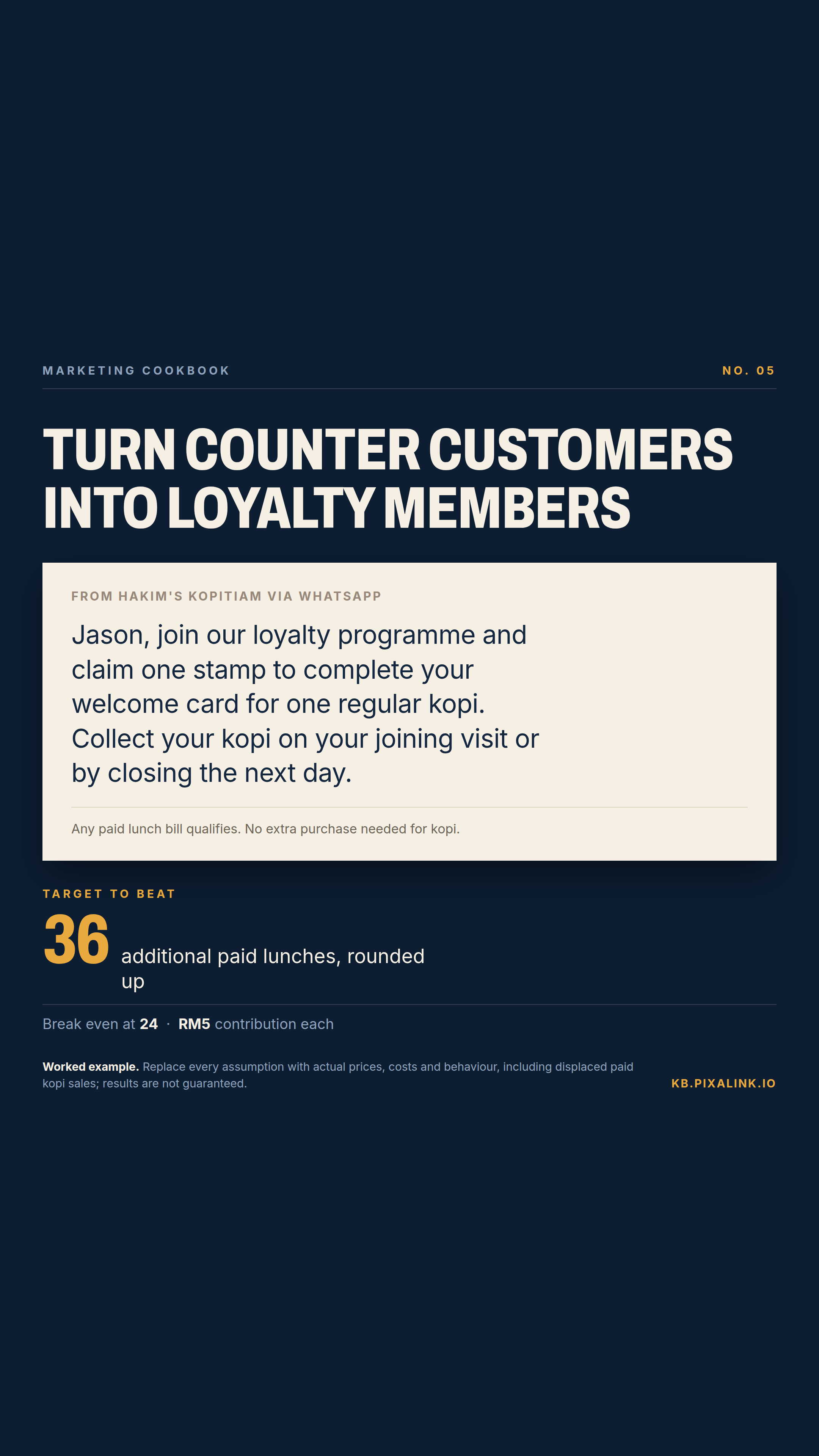
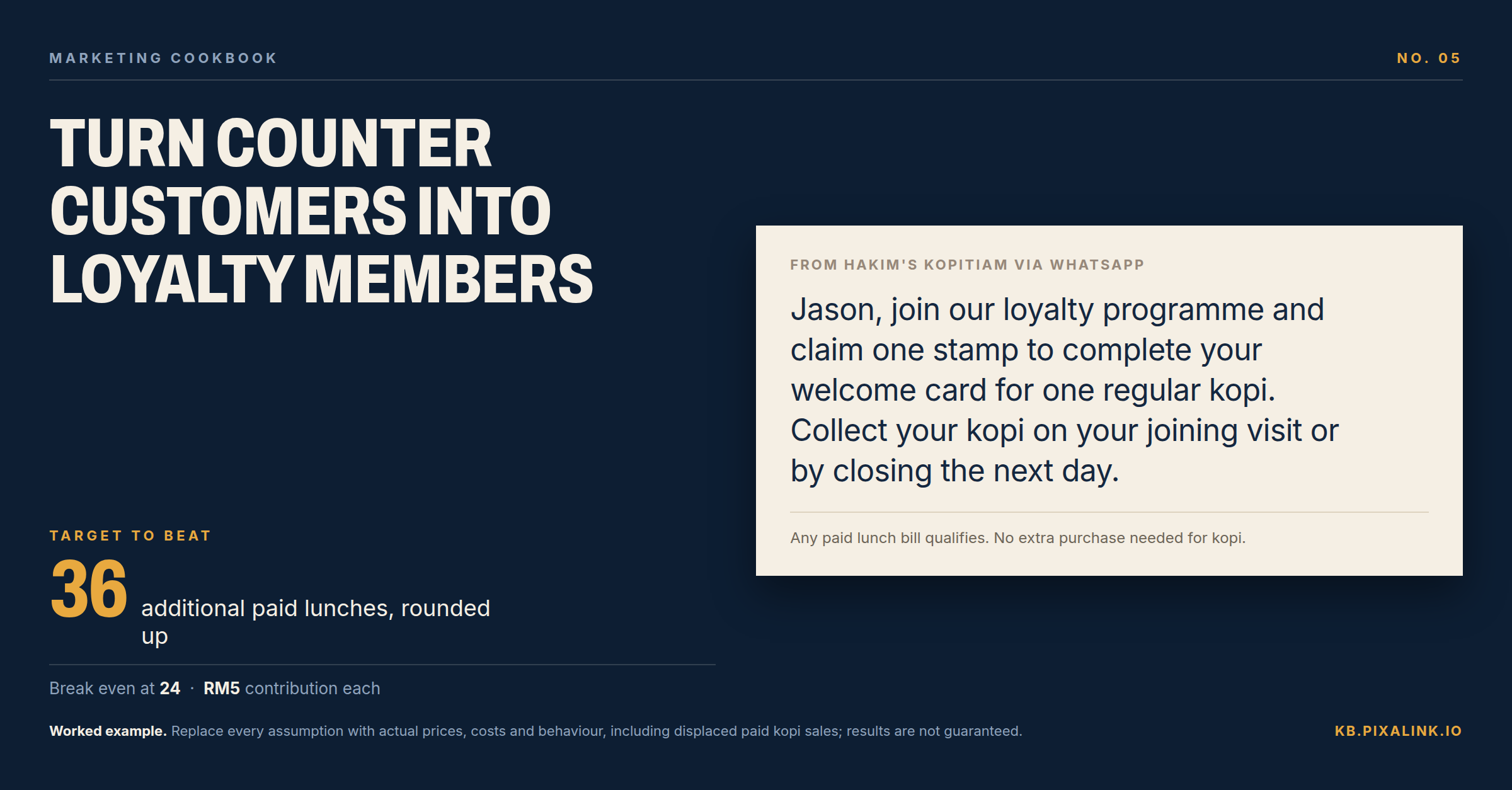
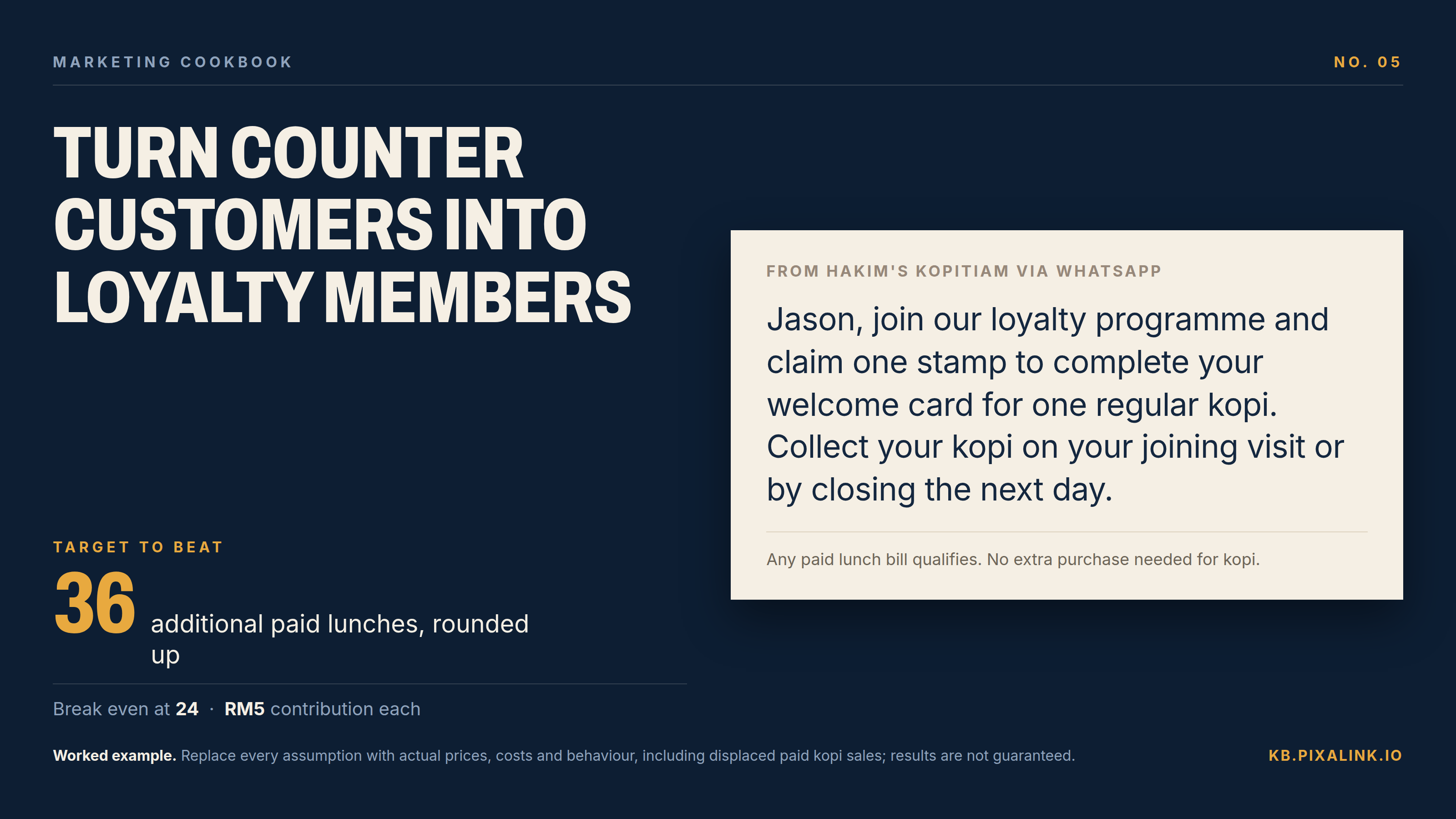
The same card at four sizes. Every figure on it comes from this article, and the message is the one written above — nothing on the card is generated.
Alt text for your post
Turn Counter Customers into Loyalty Members. Marketing Cookbook recipe card. Replace every assumption with actual prices, costs and behaviour, including displaced paid kopi sales; results are not guaranteed.
Closing invitation
Choose one counter offer and test it with a manageable number of customers. Let Hakim's question guide you: can the invitation help someone like Jason join now, at a cost that later customer value can justify?