
Welcome & Activation
Spread Your Welcome Budget Across Three Visits
How could Aina spread the same RM15 across three visits instead of spending it all at once?

A worked example
- RM8
- Contribution per incremental action
- 30
- Break-even actions
- 45
- Minimum target
additional paid returns
additional paid returns, rounded up
At a glance
The business problem
Aina is paying for a first transaction without knowing whether the discount changed it. At 40 new members, RM15 off each purchase gives away RM600 before anyone returns.
The leak is visible when she compares signups with later purchases. A birthday cake is an occasional need; the campaign must introduce a more frequent reason to visit, such as buying bread.
Why the usual promotion falls short
The whole discount arrives before Wei Ling has any reason to form a routine. Splitting the budget makes the next benefit depend on using the previous one on a separate visit.
A free product can feel more appealing than an equivalent small discount. Dropping a price to zero shifts choice far more than the same size of cut anywhere else on the scale — Shampanier, Mazar & Ariely (2007), Marketing Science 26(6). That supports testing a free item; it does not establish that Aina will gain repeat customers.
What you set up in Pixalink
Opening scenario
Aina watches another cake box leave her Shah Alam bakery. Her RM15 discount brings new members to the Saturday queue, but it buys no reason to return for everyday bread. Wei Ling joined in March, used her RM15 on a birthday cake, and has not returned.
Aina, Wei Ling and this bakery are fictional; all figures in this article are illustrative. Imagine rewinding Wei Ling’s first visit to try a different welcome: a small gift today, followed by two reasons to come back. How could Aina spread the same RM15 across three visits instead of spending it all at once?
The recipe
The campaign recipe
Use these assumptions for a small bakery test. The limits below are Aina’s operating rules, not automatic campaign controls.
The message your customer receives
This message is fictional, like the merchant and customer. All figures are illustrative.
From Aina's bakery via WhatsApp
Wei Ling, enjoy a free premium pastry on your next visit. Valid for 14 days from today.
Minimum spend RM25 on paid goods. One pastry per member.
| Recipe element | Recommended starting point |
|---|---|
| Suitable industries | Bakeries, cafés and breakfast shops with frequent purchase needs |
| Primary goal | Encourage a second and third purchase visit |
| Customer segment | 40 genuinely new members enrolled at Aina’s counter |
| Offer | Free kuih, then coffee, then a premium pastry; issued sequentially |
| Validity | 14 days from each issue; later benefits for separate return visits |
| Minimum spend | None for kuih; any purchase for coffee; RM25 for pastry, checked by staff |
| Quantity or budget limit | One of each benefit per member; 40 members; RM600 reward-cost ceiling, manually controlled |
| Main success metric | Share of enrolled members reaching visit three |
The journey
Follow the customer
- Join and discover. In the replay, Wei Ling joins at the counter and sees one free kuih in her portal, usable today. Staff explain the later benefits before she decides.
- Use the first gift. Wei Ling takes her kuih. That evening, after staff check its use and issue the next voucher, a free coffee with any purchase appears, valid for 14 days.
- Return for coffee. Wei Ling comes back and buys a loaf while collecting her coffee. Staff confirm this separate visit before issuing the premium-pastry benefit.
- Make the third visit. Wei Ling returns, spends RM25 and enjoys her pastry. Aina now has a chance to become her bread stop; the next purchase has no extra welcome gift.
flowchart TD
    A[Join and see a kuih gift] --> B[Enjoy kuih and receive coffee offer]
    B --> C[Return for coffee and buy bread]
    C --> D[Return for pastry and choose bread again]
Use case: how the merchant applies it
Aina allocates reward costs of RM3 for kuih, RM5 for coffee and RM7 for pastry: RM15 if all three are used. Their illustrative menu prices are RM4, RM6 and RM8, so the gifts rise in customer value while keeping the original cost ceiling. These are product costs, not three cash discounts.
She enrols 40 members over seven days and reserves enough items to honour their offers. Each voucher lasts 14 days from issue; staff issue the next one that evening only after checking the previous use. Terms require separate visit dates, any purchase for coffee and RM25 of paid goods for pastry, excluding the gift’s value.
Aina observes each member for 42 days, allowing all three windows to run. She checks whether Wei Ling’s fourth purchase happens without another welcome incentive.
How the platform helps
How Pixalink supports the strategy
Pixalink supports new-customer reward automation, voucher expiry, one-time use and portal display. To honour 14 days from each issue, Aina must avoid an earlier reward end date that would shorten that window. Staff can also issue a voucher to a selected customer for later use. For this capped pilot, Aina uses manual issue from her enrolment list, including the first gift, so broad signup automation cannot extend the offer beyond her test group.
Automatic unlocking after the previous voucher is used is not verified for this recipe. Aina manages that sequence herself; elapsed time after signup does not prove a visit occurred. She also checks purchase conditions, every ringgit minimum, separate visit dates and the overall budget manually.
Configure this in Pixalink
Use What Are Rewards and How to Create Them for reward setup and manual assignment. See New Customer Reward — Automatically Welcome New Members with a Reward for the first-gift automation when ready for a wider rollout.
The economics
ROI taste test
For Aina’s test, an incremental action means an additional paid return visit beyond the baseline. Assume RM25 cash collected, RM10 variable cost for purchased goods, and conservatively RM7 reward cost per additional return.
The formulas are cash collected minus variable fulfilment cost minus reward cost; campaign operating cost divided by contribution; then break-even actions multiplied by 1.5, rounded up. Aina’s working sums are:
- Contribution per incremental action = RM25 - RM10 - RM7 = RM8.
- Break-even actions = RM240 / RM8 = 30 additional paid returns.
- Minimum target = 30 x 1.5 = 45 additional paid returns, rounded up.
RM240 comprises RM120 for all first gifts, RM70 reserved for rewards on ten baseline returns, and RM50 staff administration. A comparable previous cohort of 40 members made ten paid returns within 42 days; therefore 55 observed returns would suggest 45 additional returns, subject to differences between cohorts.
Count actual reward costs on purchases that would have happened anyway, increasing operating cost and recalculating when needed. Claims and redemptions alone are not profit, and cheaper coffee baskets may contribute less than RM8. Replace every assumption with your own figures; results are not guaranteed.
Measure it
What to watch
- Third-visit completion: members using all three gifts on separate visits divided by the 40 enrolled; only the return gifts require purchases.
- Incremental paid returns: observed return purchases minus the comparable cohort’s baseline.
- Net campaign contribution: contribution from additional returns minus campaign operating cost, using actual baskets and reward costs.
Common mistake: issuing all three benefits upfront loses the link between returning and receiving the next gift. A signup delay alone does not repair that link.
Safeguard: maintain one staff reconciliation log covering eligibility, prior use, visit date, spend checks and reserved reward cost. Stop new enrolment at 40 and reserve the full RM600 so existing promises remain covered.
Keep when Aina reaches the recalculated minimum target and the safeguard holds. Improve during the test only if returns look promising and one bounded change, such as clearer coffee wording, needs testing separately. Stop expansion if contribution is non-positive, the safeguard fails or the completed test misses its preset threshold.
Your first test
Try this first
- Define 40 new members and a comparable 42-day return baseline.
- Cap enrolment manually; reserve RM600 for gifts and RM50 for administration.
- Fix one three-benefit offer and observe each member for 42 days.
- Record receipts, actual costs and the staff reconciliation safeguard.
- Apply the preset keep, improve or stop rule before expanding.
Questions
Frequently asked questions
Can existing members join?
This pilot targets new members. Wei Ling’s journey is a fictional replay, not a claim that her March signup qualifies again.
Can I run the ladder in seven days?
For daily coffee or breakfast customers, test all three visits within seven days instead. State that shorter deadline clearly and keep staff checks between stages.
Will Pixalink check my RM25 minimum?
For this recipe, staff enforce the ringgit minimum printed in the terms. Do not assume entering those terms creates a checkout rule.
What if a voucher expires unused?
Under Aina’s offer, the member does not progress to the next benefit. Staff stop issuing further gifts rather than treating an unused voucher as a completed visit.
Share this recipe
A card you can post
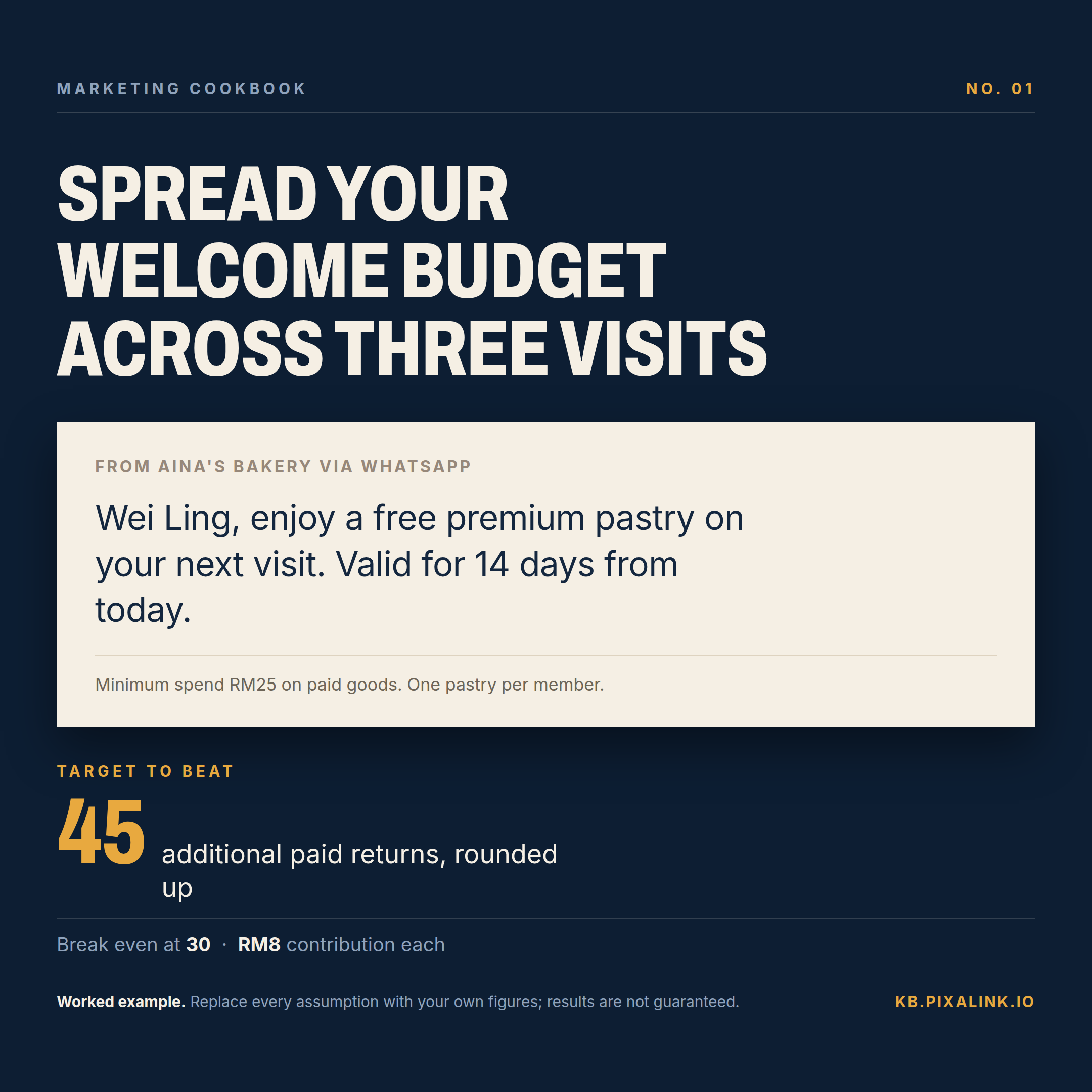
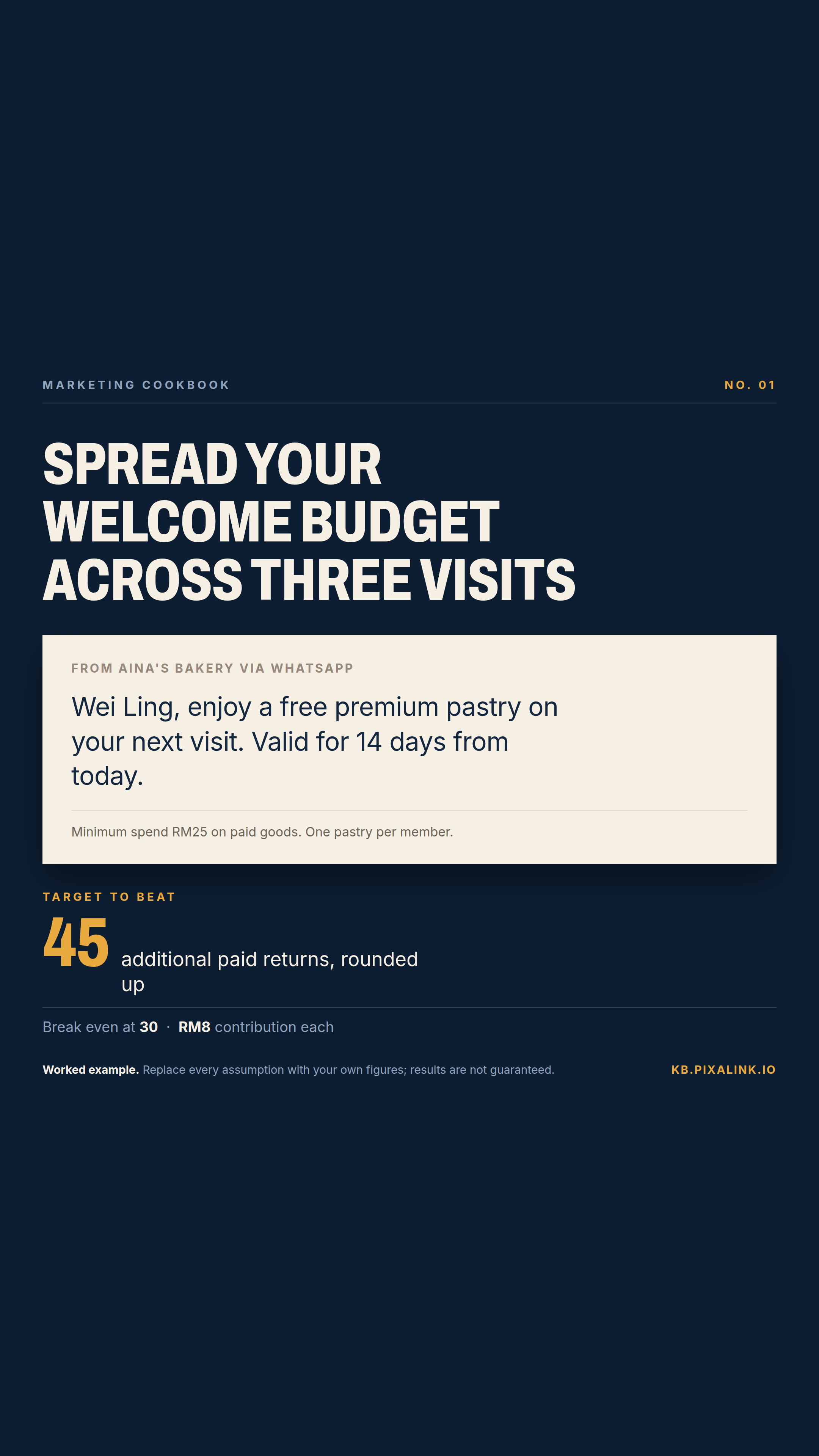
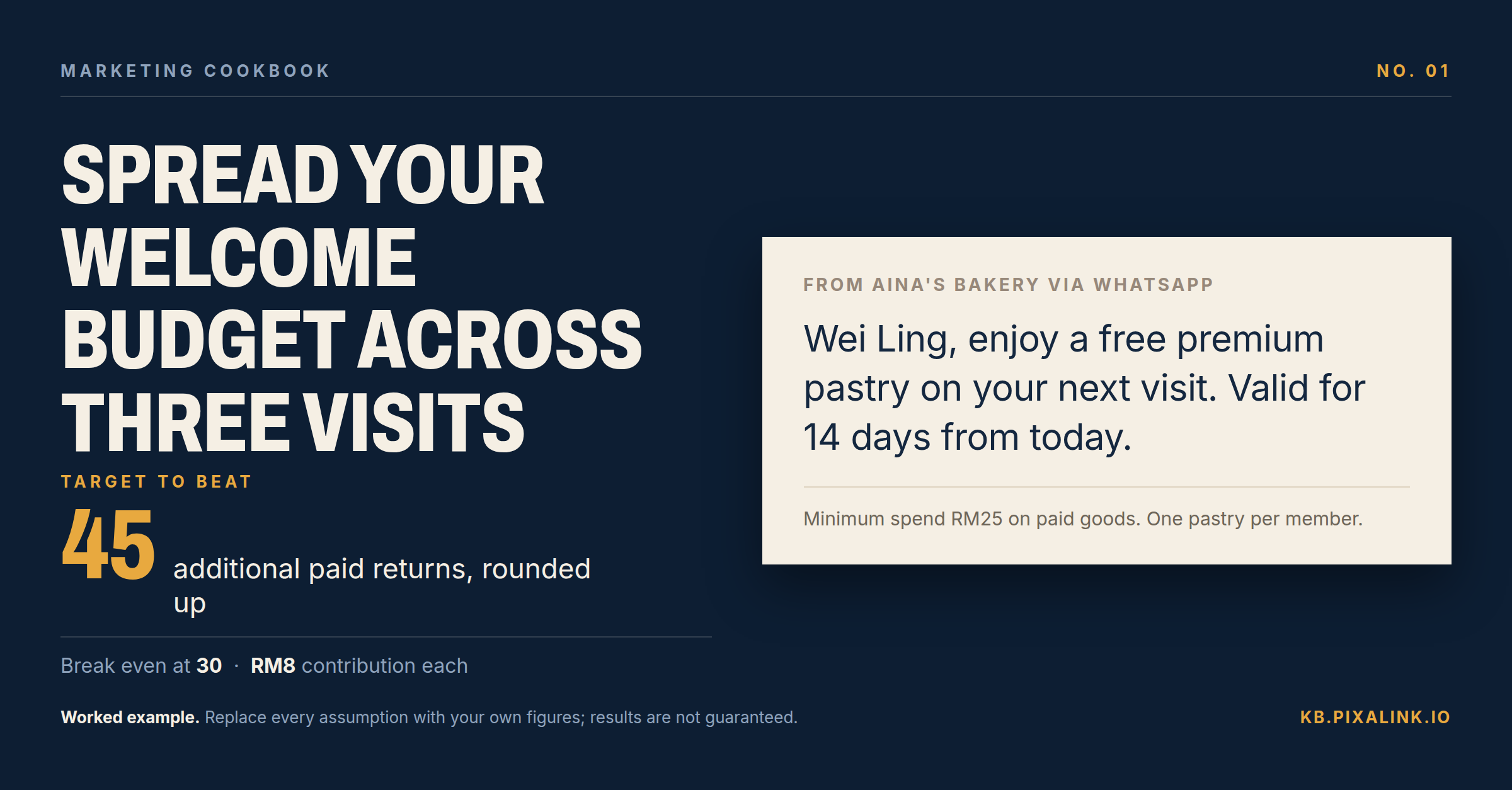
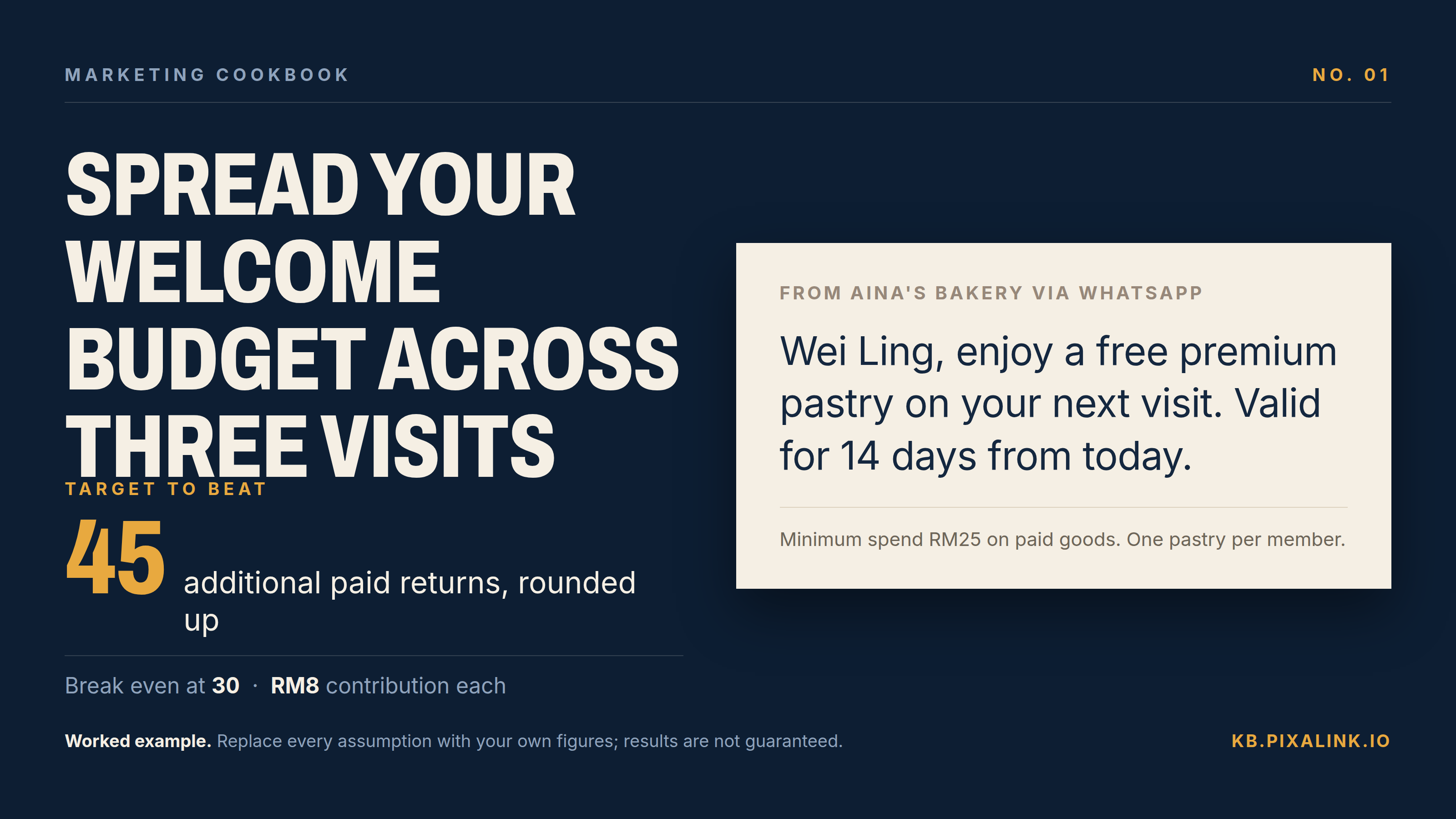
The same card at four sizes. Every figure on it comes from this article, and the message is the one written above — nothing on the card is generated.
Alt text for your post
Spread Your Welcome Budget Across Three Visits. The welcome budget split across three visits: a free kuih costing RM3 on joining, a free coffee costing RM5 after the first visit with any purchase, and a premium pastry costing RM7 after the second visit with a RM25 minimum spend. RM15 in total. Replace every assumption with your own figures; results are not guaranteed.
Closing invitation
Choose one welcome offer and test whether it gives customers like Wei Ling a useful reason to return. Keep the version that earns additional customer value at a cost your shop can sustain.