
Welcome & Activation
Bring First-Time Diners Back for a Second Meal
Which single visit should he be paying for?
A worked example
- RM8
- Contribution per incremental action
- 5
- Break-even actions
- 8
- Minimum target
additional second meals
additional second meals, rounded up
At a glance
The business problem
Kumar needs a second paid meal, not merely another membership record. Counting signups hides whether first-time diners ever return, so he starts by comparing first purchases with second purchases within 14 days.
His recurring cost is staff time spent enrolling people who may disappear. For the pilot below, he allows RM30 for enrolment, checks and measurement, then asks whether a small drink benefit can earn enough additional meals to cover it.
Why the usual promotion falls short
A discount on Farah’s first lunch would reduce cash collected on a meal she had already chosen. It leaves no benefit waiting when she next decides where to eat.
A drink with her next paid meal moves the incentive to the behaviour Kumar wants. This is a testable commercial idea: the extra meal must contribute more than the drink and the campaign cost.
What you set up in Pixalink
Opening scenario
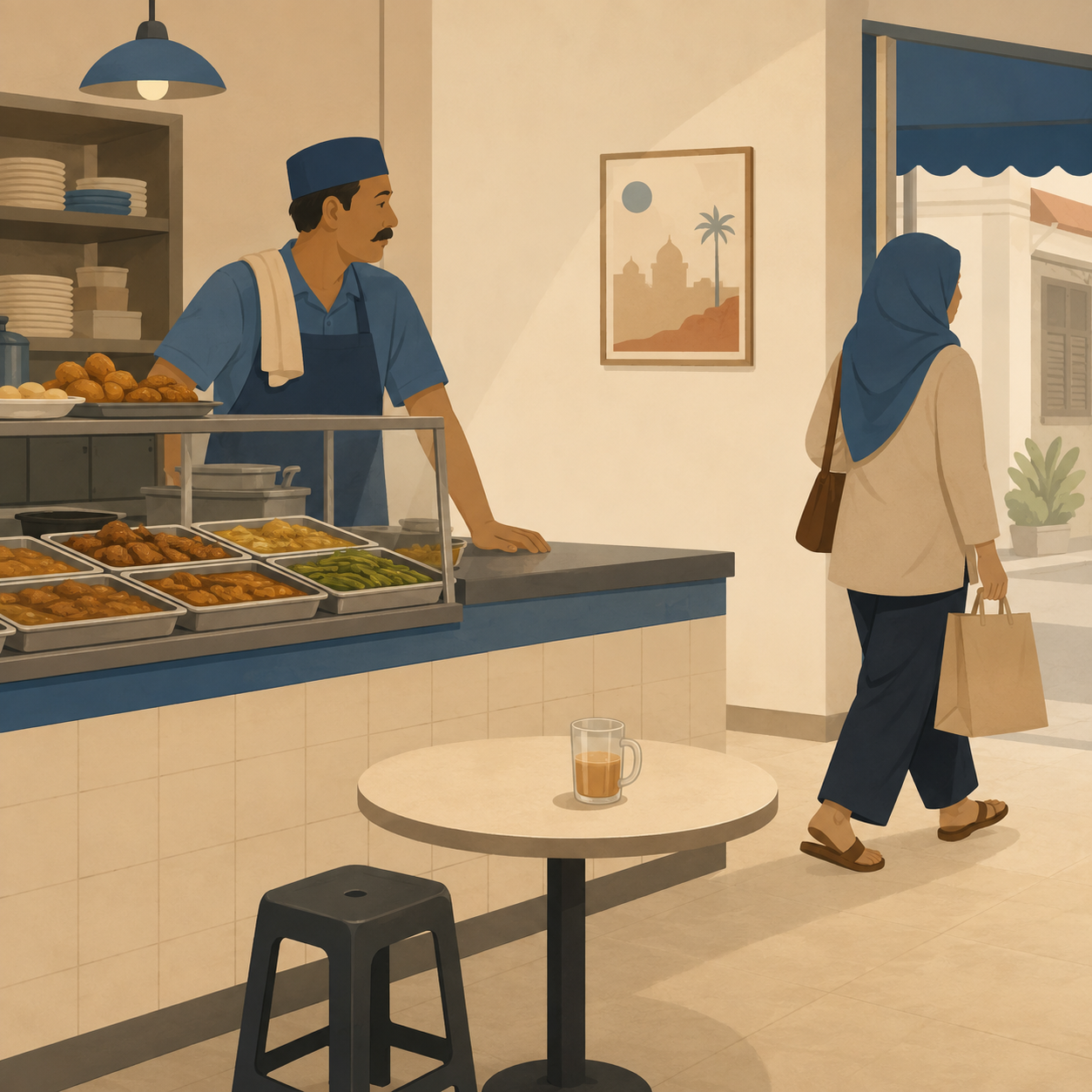
Kumar watches Farah leave his Penang nasi kandar shop after lunch. She enjoyed her January meal and joined because the cashier asked, but she never thought about the shop again. Kumar has 1,800 members; more than half have exactly one transaction.
Kumar, Farah and the shop are fictional; all figures in this article are illustrative. Imagine replaying Farah’s first visit with a drink waiting for her next meal. Kumar already pays staff to enrol members, yet the growing list gives him no reason to expect another purchase. Which single visit should he be paying for?
The recipe
The campaign recipe
Start with one easy-to-explain benefit. These are operating assumptions for Kumar’s test, including limits his team must enforce.
| Recipe element | Recommended starting point |
|---|---|
| Suitable industries | Nasi kandar shops, cafés and casual eateries with frequent meal occasions |
| Primary goal | Earn a second paid visit |
| Customer segment | Newly joined members making their first recorded purchase |
| Offer | One free teh tarik with the next meal after completing a one-stamp card |
| Validity | 14 days from the qualifying first purchase; issue on that day |
| Minimum spend | RM15 qualifying first spend; RM15 paid return-meal basket, excluding the drink, checked at the counter |
| Quantity or budget limit | 50 offered members; one drink each; RM50 drink-cost reserve plus RM30 administration, manually capped |
| Main success metric | First-to-second conversion within 14 days compared with untreated members |
The message your customer receives
This message is fictional, like the merchant and customer. All figures are illustrative.
From Kumar's nasi kandar shop via WhatsApp
Farah, your one-stamp card is complete. Enjoy a free teh tarik with your next meal. Valid for 14 days from your qualifying first purchase.
Minimum spend RM15 on your qualifying first purchase; RM15 on your paid return meal, excluding the drink, checked at the counter. One drink per customer.
The journey
Follow the customer
- Pay for the first meal. In the replay, Farah pays RM18 and her membership records the purchase. It qualifies for Kumar’s one-stamp card.
- Find the next-visit benefit. That evening, Farah sees a free teh tarik benefit in her portal. It is for her next meal within 14 days, with RM15 of paid food.
- Choose to return. Nearby the following week, Farah remembers the drink waiting for her. She chooses Kumar’s shop for lunch.
- Enjoy the second meal. Farah orders as normal, staff check her basket and she uses her drink benefit. Her next visit has no further booster gift; Kumar has a chance to become her regular lunch stop.
flowchart TD
    A[Pay for the first meal] --> B[Find a drink for the next meal]
    B --> C[Return before the offer expires]
    C --> D[Enjoy lunch and use the drink benefit]
Use case: how the merchant applies it
Kumar enrols 100 first-purchase members over the same weeks, randomly assigning 50 to the offer and 50 to receive nothing. Both groups keep their usual service and prices; each member is observed for 14 days after their first purchase. Farah represents an offered member, not someone retrospectively eligible because she ate there in January.
The teh tarik normally sells for RM3 and costs RM1 to fulfil. Kumar reserves RM50 to honour all 50 offers, plus RM30 for staff work, and permits one benefit per offered member on a later visit date. Staff explain the RM15 return basket before enrolment and check it before serving the free drink.
For this capped pilot, staff check first-purchase eligibility and the RM15 receipt, then issue the single stamp manually that day. Automatic spend stamping stays off so the comparison group receives nothing. Completing the card issues the reward; the evening is when Farah notices it, not a promised delivery schedule.
How the platform helps
How Pixalink supports the strategy
Pixalink supports a one-stamp card that issues a voucher after qualifying spend, expiry and one claim. There is no direct “after first purchase” reward trigger: a spend threshold does not establish that this was the customer’s first-ever purchase.
Manual stamp issue and turning off automatic stamping support Kumar’s controlled pilot. Here staff verify the qualifying spend; the return-meal basket minimum remains a counter check, not an automatic Pixalink rule. Staff also enforce first-purchase eligibility, separate visit dates and the overall test cap.
Configure this in Pixalink
Use How to Set Up a Stamp Card Campaign for the card and completion reward. Confirm a test voucher shows the intended deadline before offering 14 days from purchase; the setup link does not turn staff-enforced conditions into automated rules.
The economics
ROI taste test
For Kumar, an incremental action means one second paid meal above the untreated group’s return rate. Assume RM18 cash collected, RM9 variable fulfilment cost for paid food and RM1 drink cost; replace these with actual baskets and costs.
The formulas are contribution = cash collected - variable fulfilment cost - reward cost; break-even = campaign operating cost / contribution; minimum target = break-even x 1.5, rounded up. Kumar’s arithmetic is:
- Contribution per incremental action = RM18 - RM9 - RM1 = RM8.
- Break-even actions = RM40 / RM8 = 5 additional second meals.
- Minimum target = 5 x 1.5 = 8 additional second meals, rounded up.
RM40 covers RM30 staff administration and RM10 for drinks on ten returns expected anyway. If ten of 50 untreated members return, Kumar needs at least 18 of 50 offered members to return: eight additional second meals. That suggests RM64 minus RM40 = RM24 campaign contribution under these assumptions.
Recalculate if the comparison rate, baskets or drink costs differ. Count drink costs on ordinary returns too; portal views, claims and redemptions alone are not campaign profit. This small comparison offers a direction for another test, not guaranteed results.
Measure it
What to watch
- First-to-second conversion: members making a second paid visit within 14 days divided by enrolled members, separately for each group.
- Incremental second meals: offered-group second purchasers minus the number expected from the untreated group’s conversion rate.
- Net campaign contribution: additional-meal contribution less administration and drink costs on returns expected anyway, using actual costs.
Common mistake: counting every voucher user as an extra customer. Farah might have returned without the offer, which is why Kumar needs the comparison group.
Safeguard: use one staff reconciliation log for enrolment, group assignment, first receipt, later visit date, basket checks and drink costs. Stop offering at 50 and reserve enough drinks to honour every issued benefit.
Keep when Kumar reaches the recalculated minimum target and the safeguard holds. Improve a promising result through a separate small test changing only the offer wording. Stop expansion if contribution is non-positive, the safeguard fails or the completed test misses its preset minimum target.
Your first test
Try this first
- Define first-purchase members; randomly split 100 same-week joiners into equal offered and untreated groups for a current baseline.
- Cap the offer at 50 members manually and reserve RM80 for drinks and administration.
- Fix one drink offer, the RM15 conditions and a 14-day window per member.
- Record actual meal economics and complete the staff reconciliation log.
- Apply the preset keep, improve or stop rule before expanding.
Questions
Frequently asked questions
Can Kumar include his old one-visit members?
Keep them out of this first-purchase pilot. Farah’s January visit is replayed to explain the idea; approaching long-inactive members would be a separate test.
Does joining alone earn the drink?
No: Kumar’s offer requires the qualifying first purchase. The one-stamp card connects the benefit to that spend, with staff verifying eligibility in this pilot.
Will Pixalink check the RM15 return basket?
Staff enforce it at the counter. Writing a minimum in the terms does not make it an automatic checkout restriction.
Does the benefit arrive at a fixed evening time?
No fixed evening schedule is promised here. Farah sees it that evening after same-day stamp completion; Kumar must verify issue and expiry before starting.
Share this recipe
A card you can post
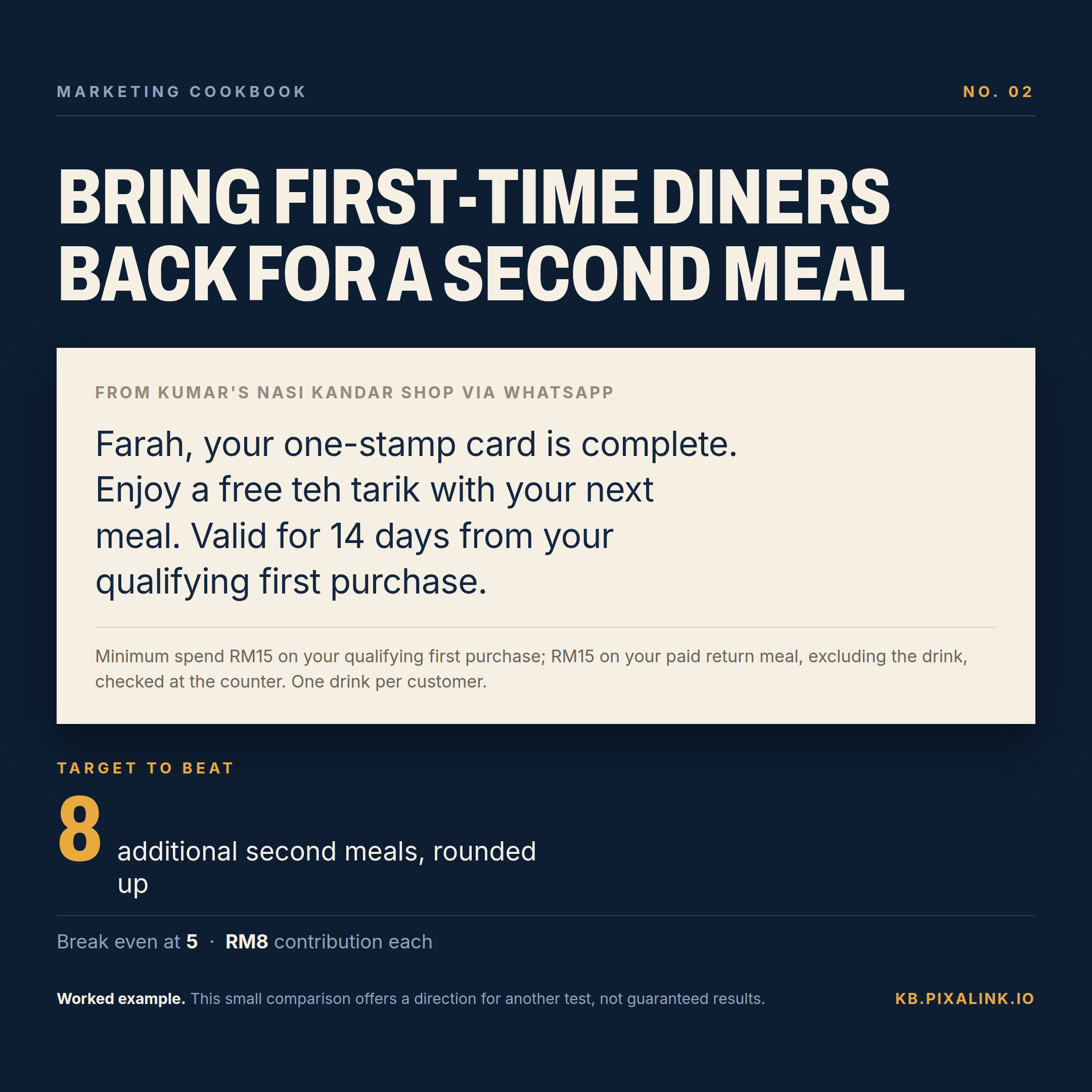
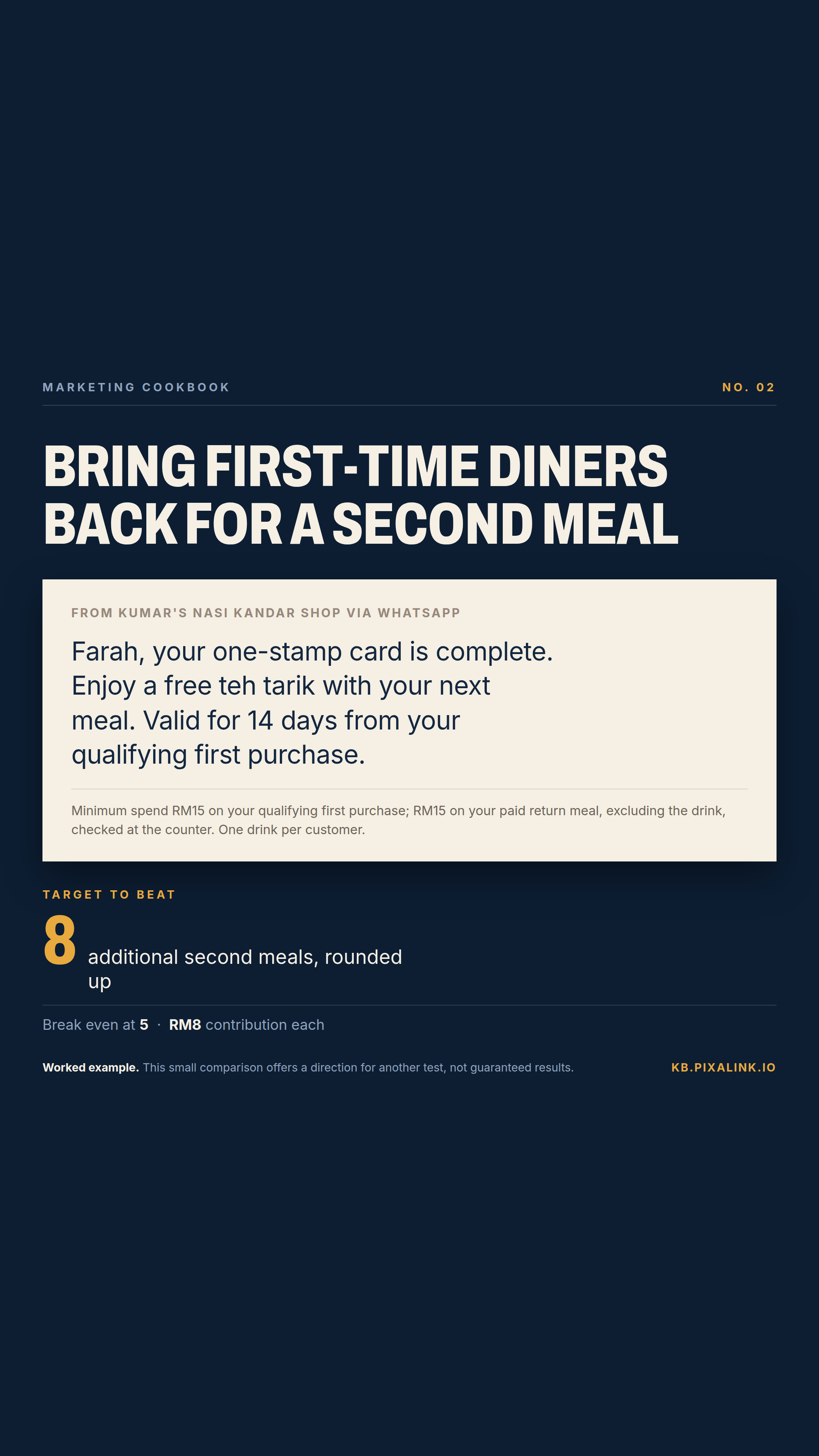
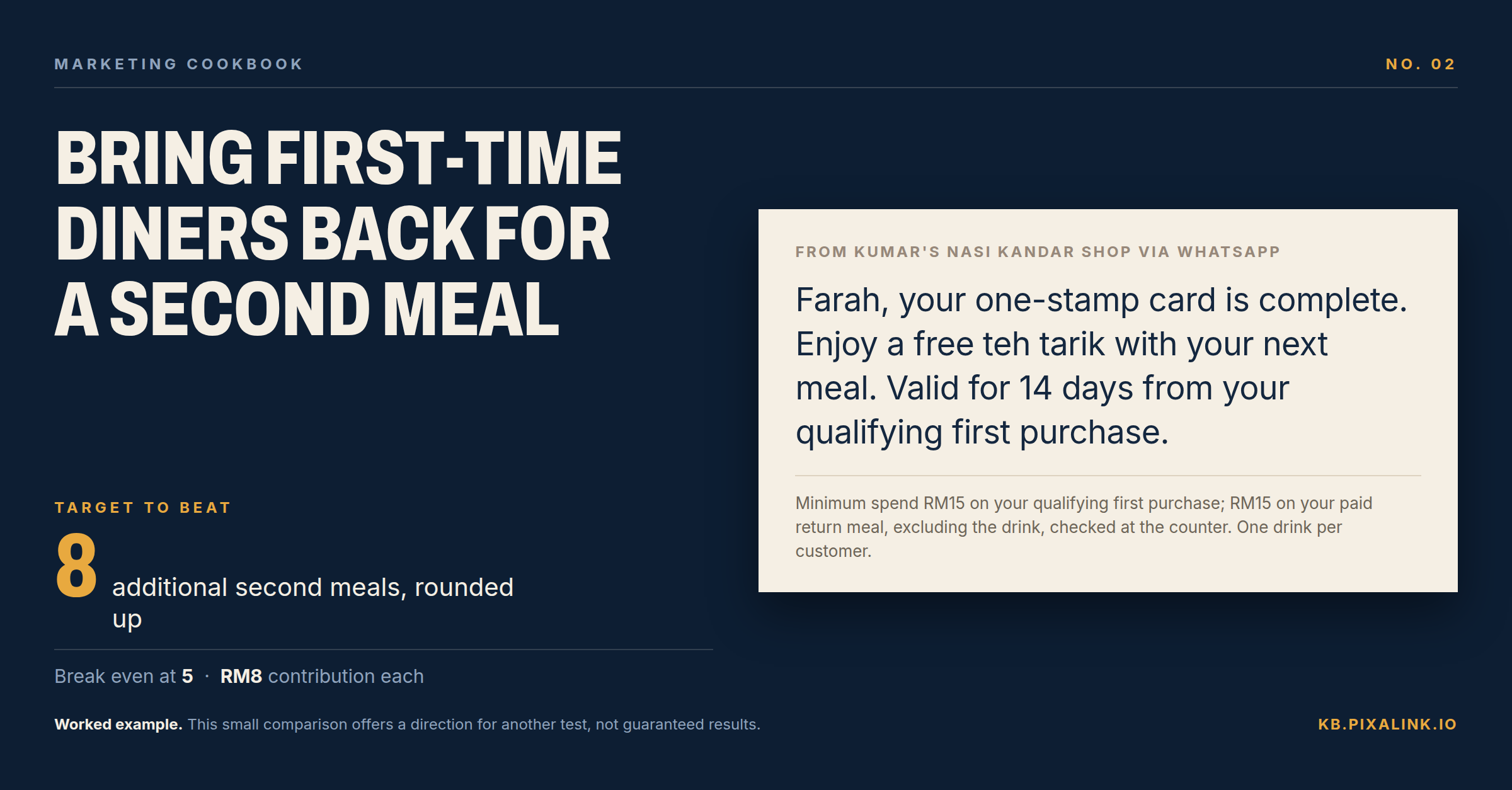
The same card at four sizes. Every figure on it comes from this article, and the message is the one written above — nothing on the card is generated.
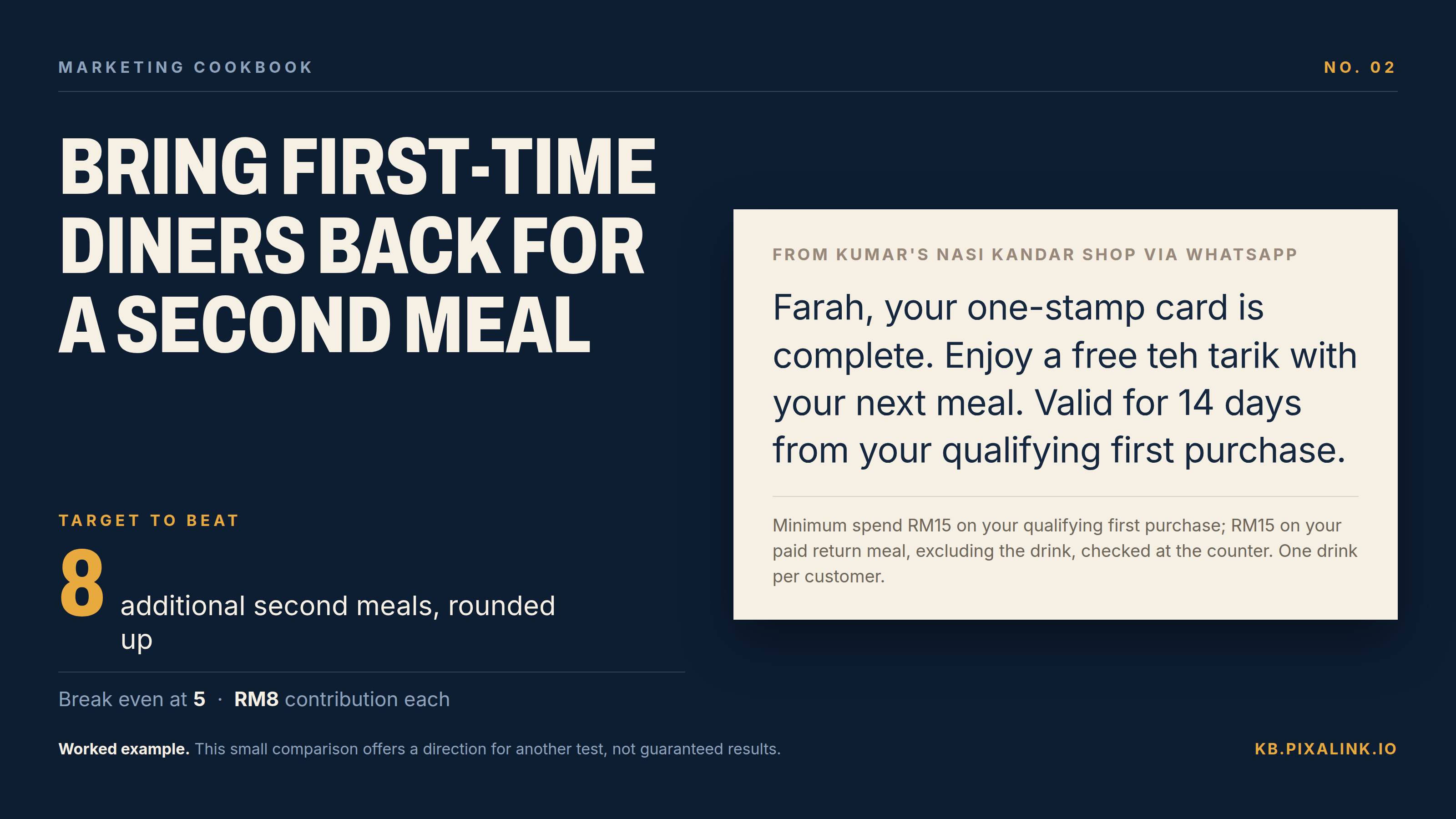
Alt text for your post
Bring First-Time Diners Back for a Second Meal. Marketing Cookbook recipe card. This small comparison offers a direction for another test, not guaranteed results.
Closing invitation
Try one second-visit benefit with a small group and a fair comparison. Let the extra paid meals and their contribution decide whether customers like Farah are worth reaching with this offer again.