
Welcome & Activation
Turn Launch-Day Visitors into Repeat Customers
How could that same gift earn a place in his routine?

A worked example
- RM6
- Contribution per incremental action
- 40
- Break-even actions
- 60
- Minimum target
additional paid visits
additional paid visits, rounded up
At a glance
The business problem
Opening traffic measures curiosity, while month-two paid visits show whether the outlet remains useful. Giving 50 opening visitors a free cup costs RM150 before Mei Ling knows which customers will return.
Moving a regular customer from one of her other shops is not automatically extra business. She needs to measure both the new outlet's retention and additional purchases across all three shops.
Why the usual promotion falls short
An immediate giveaway finishes the bargain on day one. Danish has received the whole benefit before deciding whether the shop fits his week.
A three-stamp passport leaves a small, visible task unfinished. Completion earns the cup; later paid visits reveal whether the attraction lasts after the reward is gone.
What you set up in Pixalink
Opening scenario
Mei Ling looks across the empty stools at her newest bubble tea shop in Johor Bahru. Her third outlet opened to a queue down the street; six weeks later, it is the quietest of the three. Danish came for the novelty and the free cup, then returned to his usual shop.
Mei Ling, Danish and this business are fictional; all figures are illustrative. Imagine replaying opening day with a passport that rewards three visits instead of arrival alone. The free cup costs Mei Ling RM3 to make, whether Danish returns or disappears. How could that same gift earn a place in his routine?
The recipe
The campaign recipe
The New Outlet Launch Passport uses stamps collected across Mei Ling's three shops. These starting terms are a small test, with staff controlling eligibility and exposure.
| Recipe element | Recommended starting point |
|---|---|
| Suitable industries | Bubble tea shops, cafés and bakeries with frequent visits |
| Primary goal | Turn launch visitors into returning customers |
| Customer segment | 50 opening-day purchasers in the offered test group |
| Offer | One free regular milk tea after three qualifying visits |
| Validity | Collect stamps during days 1–21 from opening; collect the reward by day 28 |
| Minimum spend | RM10 paid drink purchase per visit; no extra purchase for the reward; staff checks |
| Quantity or budget limit | 50 members, one completion each; RM150 reward reserve plus RM90 administration; enrolment and budget capped manually |
| Main success metric | Paid visits at the new outlet during month two, days 31–60 |
The message your customer receives
This message is fictional, like the merchant and customer. All figures are illustrative.
From Mei Ling's bubble tea shop via WhatsApp
Danish, earn one free regular milk tea with paid drink purchases on three separate visit dates. Collect stamps during days 1–21 from opening and collect your reward at our new outlet by day 28.
Minimum spend RM10 on paid drinks per visit. No extra purchase needed for the reward. One completion per customer.
The journey
Follow the customer
- Join with a drink. In the opening-day replay, Danish buys an RM10 drink and receives his first stamp. Staff explain the three-visit offer.
- See the remaining steps. His phone shows one of three stamps filled and the completion gift. He can see what two more visits will earn.
- Return twice. Danish buys drinks on two further dates within the 21-day launch window. The visible gap gives him a reason to choose Mei Ling's shops again.
- Complete and continue. His third stamp releases the reward, collected at the new outlet by day 28. After enjoying it, his next paid drink has no further passport gift; month two tests whether he returns anyway.
flowchart TD
    A[Buy a drink and join] --> B[See two visits still to go]
    B --> C[Return twice before the deadline]
    C --> D[Enjoy the gift and choose another paid visit]
Use case: how the merchant applies it
Mei Ling replays the launch with 100 opening-day purchasers, randomly assigning 50 to the passport and 50 to an untreated comparison group. Both groups receive usual service and prices; this test replaces the opening freebie. Staff record purchases for both groups through day 60.
Danish earns one stamp per separate visit date with at least RM10 spent on paid drinks. Buying three drinks together earns one stamp, and the free reward earns none. Staff check these conditions across all three shops before manually issuing stamps; automatic spend stamping stays off for this pilot.
The gift is a regular milk tea, normally RM10, costing RM3 to fulfil. Stamps end on day 21 for everyone; reward collection at the new outlet ends on day 28, a separate term staff enforce. Mei Ling reserves 50 cups, permits one completion per member and promises no renewal.
How the platform helps
How Pixalink supports the strategy
Pixalink enforces the stamp count, campaign window, completion reward and repeat limit. Mei Ling uses three stamps and one completion; staff enforce which purchases qualify, separate dates and the 50-person test list. A spend threshold alone does not prove a separate visit.
Stamps can span branches; a single reward voucher belongs to one outlet. Mei Ling therefore names the new shop as the gift collection outlet before enrolment. The passport does not mean customers must visit every branch, and it does not make the gift redeemable everywhere.
Manual stamp issue and disabling automatic spend stamping are supported. The overall participant cap, reward budget and staff checks are operating controls, not promised automatic restrictions.
Configure this in Pixalink
Use How to Set Up a Stamp Card Campaign for the stamp card and completion reward. Check the displayed terms and deadlines against the offer before enrolling customers.
The economics
ROI taste test
For Mei Ling, an incremental action is an additional paid visit across her three shops through day 60, beyond the comparison baseline. Assume RM10 cash collected and RM4 variable fulfilment cost per paid drink visit.
The formulas are contribution = cash collected - variable fulfilment cost - reward cost; break-even = campaign operating cost / contribution; minimum target = break-even x 1.5, rounded up.
- Contribution per incremental action = RM10 - RM4 - RM0 = RM6.
- Break-even actions = RM240 / RM6 = 40 additional paid visits.
- Minimum target = 40 x 1.5 = 60 additional paid visits, rounded up.
RM240 includes RM90 administration plus the full RM150 reward reserve, assuming every offered member collects the cup. Reward cost is therefore RM0 in the per-visit calculation because all gift costs are already charged to the campaign; never subtract them twice.
Compare paid returns
If the 50 untreated members make 30 paid returns, the offered group needs 90 to suggest 60 additional returns. That yields RM360 contribution less RM240 campaign cost = RM120, under these assumptions.
Exclude opening purchases and reward-only collections; moving visits between branches creates no chain-wide increment. Claims and completed cards are not profit. Replace every price, cost and baseline with actual figures; a small comparison is uncertain and results are not guaranteed.
Measure it
What to watch
- Month-two retained visits: paid visits at the new outlet on days 31–60, per enrolled member in each group.
- Three-visit completion: offered members completing three qualifying visit dates by day 21 divided by 50.
- Incremental contribution: additional paid visits across the chain, valued at actual margins, less total campaign costs.
Common mistake: treating three stamps as proof of a lasting habit. Danish's paid visits after the gift provide the stronger signal.
Safeguard: maintain one shared reconciliation log for group assignment, receipts, visit dates, outlet, gift collection and reserved costs. Stop enrolment at 50 and preserve the reserve for promises already made.
Keep when Mei Ling reaches the recalculated minimum target, month-two visits per member beat the comparison group and the safeguard holds. Improve a promising signal in a separate bounded test changing only offer wording. Stop expansion if contribution is non-positive, the safeguard fails or the completed test misses either preset threshold.
Your first test
Try this first
- Define opening-day purchasers and randomly split 100 into equal offer and comparison groups.
- Cap the offer at 50 manually and reserve RM240 for rewards and administration.
- Fix one gift, a 21-day stamp window, day-28 collection deadline and day-60 measurement end.
- Record actual economics and use the shared reconciliation safeguard at every outlet.
- Apply the preset keep, improve or stop rule before expanding.
Questions
Frequently asked questions
Does Danish qualify now, six weeks after opening?
This example replays opening day. A campaign starting now needs a clearly announced new window; the original 21 days have passed.
Must customers visit all three outlets?
No: three qualifying visits can include the same shop. Stamps may span branches, but this gift is collected only at the new outlet.
Can one large order complete the passport?
Not under Mei Ling's terms. Staff enforce one stamp per separate visit date, regardless of how many drinks the customer buys.
Do late joiners get a fresh 21 days?
No: the window runs from opening, not each signup. This pilot enrols on opening day so everyone receives the same opportunity.
Share this recipe
A card you can post
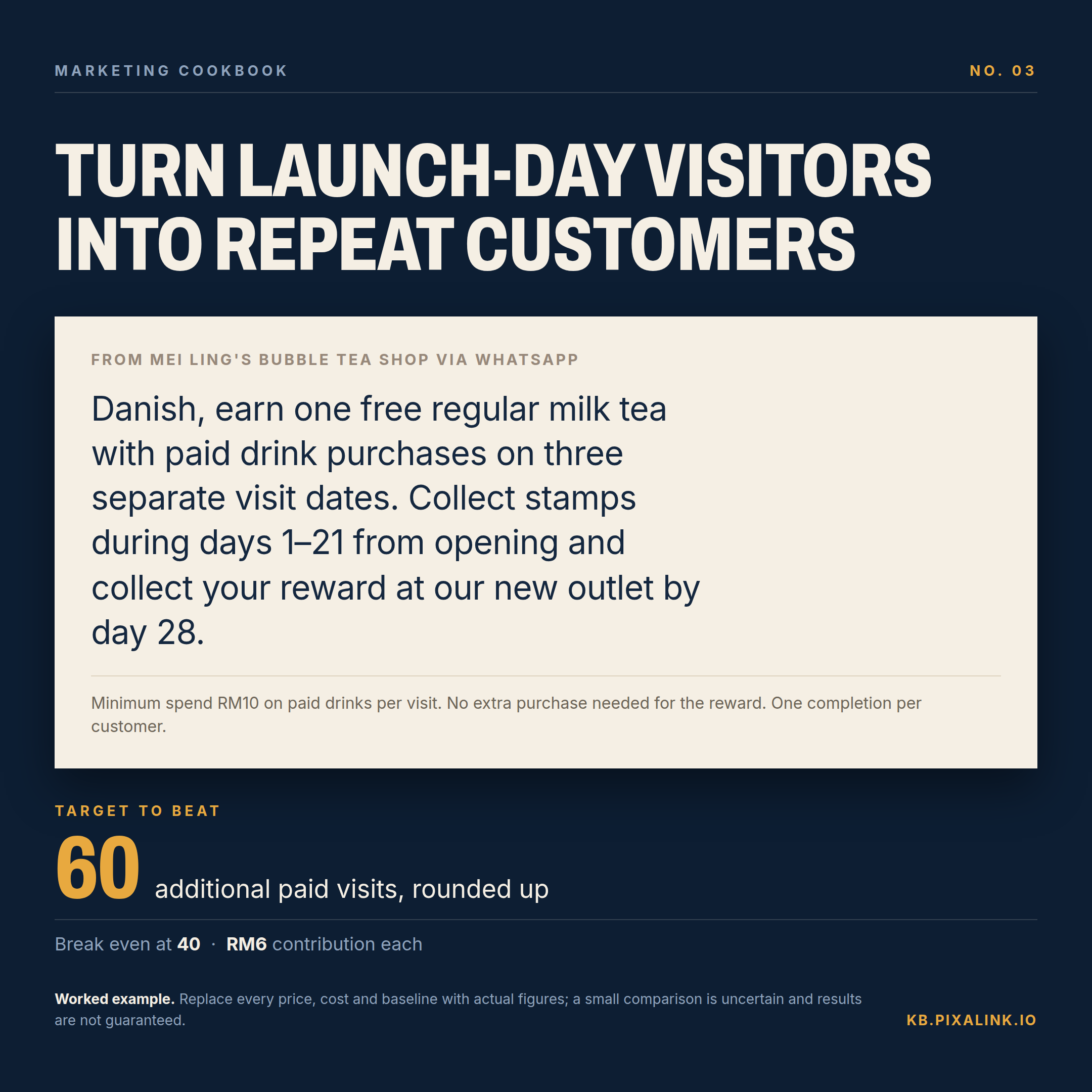
The same card at four sizes. Every figure on it comes from this article, and the message is the one written above — nothing on the card is generated.
Alt text for your post
Turn Launch-Day Visitors into Repeat Customers. Marketing Cookbook recipe card. Replace every price, cost and baseline with actual figures; a small comparison is uncertain and results are not guaranteed.
Closing invitation
Choose one launch passport and test it with a manageable group. Let later paid visits from customers like Danish show whether the offer deserves a place in your next opening budget.