
Welcome & Activation
Turn an Ignored Welcome Gift into a Salon Visit
How could Sarah make the welcome feel meant for Priya without spending more on each gift?

A worked example
- RM12
- Contribution per incremental action
- 10
- Break-even actions
- 15
- Minimum target
additional paid returns
additional paid returns, rounded up
At a glance
The business problem
An unclaimed gift costs Sarah no treatment supplies, but it creates no return visit either. She still spends staff time explaining an offer that many clients do not want.
Her current treatment costs an illustrative RM8 to deliver when used. Before increasing that budget, Sarah needs to learn whether the problem is relevance: clients may value a fringe tidy more than a treatment with a higher menu price.
Why the usual promotion falls short
Making the same treatment bigger leaves Priya with the same mismatch. Offering a long menu can also turn a quick welcome into a decision she postpones.
Whether choice helps or hurts turns on how comparable the options are, not on set size alone — Chernev, Böckenholt & Goodman (2015). Three is our own operating rule, not a number from the research. Sarah will therefore test three short salon services with matching terms, without assuming choice guarantees a visit.
What you set up in Pixalink
Opening scenario
Sarah puts away the treatment bowl at her Bangsar hair salon while Priya checks her fringe. Sarah offers every new member a free hair treatment, yet half her new clients came for a men's cut and have no use for it. Priya joined for a fringe trim and quietly ignored her treatment voucher for three months.
Sarah, Priya and the salon are fictional; all figures in this article are illustrative. Imagine replaying Priya's first visit with a choice of small gifts instead. How could Sarah make the welcome feel meant for Priya without spending more on each gift?
The recipe
The campaign recipe
These are starting assumptions for Sarah's pilot. The same approach suits businesses that can offer genuinely comparable benefits.
| Recipe element | Recommended starting point |
|---|---|
| Suitable industries | Hair salons, barbers and beauty studios with short service options |
| Primary goal | Turn an ignored welcome benefit into a paid return visit |
| Customer segment | 30 newly joined clients selected by staff for one pilot |
| Offer | Pick one: fringe trim, mini conditioning treatment or short scalp massage; about RM8 fulfilment cost each |
| Validity | One shared 14-day pilot window; show the exact expiry date |
| Minimum spend | RM40 on other services at the return visit, checked by staff |
| Quantity or budget limit | 30 clients; one gift each; RM240 gift reserve plus RM80 administration, controlled manually |
| Main success metric | Unique clients claiming a gift, then completing their first redemption |
The message your customer receives
This message is fictional, like the merchant and customer. All figures are illustrative.
From Sarah's salon via WhatsApp
Priya, choose a free fringe trim, mini conditioning treatment or short scalp massage for your return visit. Valid during our shared 14-day pilot window.
Minimum spend RM40 on other services at your return visit. One gift per customer.
The journey
Follow the customer
- See a relevant welcome. Rewind Priya's first visit: she joins at the start of the pilot and sees three welcome gifts. Each costs Sarah roughly the same to provide.
- Pick one gift. Priya chooses the fringe trim instead of the treatment. Staff record her choice and explain the shared RM40 spend condition and expiry date.
- Make time to use it. Choosing makes the gift feel like hers, so Priya books with the salon inside the fortnight. In this example, she buys a RM40 service and receives her fringe trim free.
- Leave with a reason to remember Sarah. Sarah spends the same RM8 reward cost and gets a visit instead of an ignored voucher. Priya's next ordinary booking carries no further welcome gift.
flowchart TD
    A[Join and see three gifts] --> B[Choose the fringe trim]
    B --> C[Book and use it within the fortnight]
    C --> D[Enjoy the visit and consider returning]
Use case: how the merchant applies it
Sarah offers each enrolled client one short service alongside RM40 of other paid services. Each gift takes about ten minutes and costs roughly RM8, including variable staff time and supplies. Clients choose for personal usefulness, with the same deadline and purchase terms across all options.
She starts with 30 newly joined clients, a shared 14-day window and capacity for 30 gift appointments. Staff confirm eligibility, record the selected gift and check spending at the return visit. Sarah reserves RM240 for gifts and RM80 for administration before inviting anyone.
Priya's journey is a replay of joining, not an invitation to revive her old voucher. After redemption, staff ask about her next normal appointment without promising another incentive. Sarah compares paid returns with a similar group under the old offer.
How the platform helps
How Pixalink supports the strategy
Pixalink supports portal visibility, expiry and one claim per gift. That last control applies separately to each gift: nothing stops a customer claiming all three. Choosing one does not automatically remove the other two.
Sarah enforces one gift overall, comparable costs, the pilot list, appointment capacity and the RM40 condition herself. Those combined controls are not supported as an automatic rule for this recipe. Portal visibility alone is not proof that a client qualifies for her pilot.
Configure this in Pixalink
Use What Are Rewards and How to Create Them for reward setup. Keep the three gift descriptions consistent and brief staff on the manual checks before launch.
The economics
ROI taste test
For Sarah, an incremental action is an extra paid return beyond the baseline. Assume RM40 cash collected, RM20 variable fulfilment cost for the paid service, and RM8 gift cost, including its labour; do not count that labour twice.
The formulas are cash collected minus variable fulfilment cost minus reward cost; campaign operating cost divided by contribution per incremental action; then break-even actions multiplied by 1.5, rounded up.
- Contribution per incremental action = RM40 - RM20 - RM8 = RM12.
- Break-even actions = RM120 / RM12 = 10 additional paid returns.
- Minimum target = 10 x 1.5 = 15 additional paid returns, rounded up.
RM120 covers RM80 administration and RM40 for gifts on five expected baseline returns. If a comparable previous group of 30 clients made five paid returns in 14 days, Sarah needs 20 observed returns to suggest 15 additional ones. That would leave RM60 after campaign operating cost under these assumptions.
Claims and redemptions are not automatically profit; purchases that would have happened anyway are not incremental. Include reward costs on those visits and recalculate if baseline use or actual costs differ. Replace every assumption with your own prices, costs and behaviour; cohort differences can distort the estimate and results are not guaranteed.
Measure it
What to watch
- Claim rate: unique enrolled clients claiming any gift divided by 30; count Priya once even if she claims several.
- First-redemption rate: enrolled clients using their first welcome gift within 14 days divided by 30.
- Incremental paid returns: paid return visits from enrolled clients minus the comparable baseline, excluding repeat visits by the same client for this pilot.
Common mistake: treating three vouchers as three free services per client. That can triple the intended gift cost.
Safeguard: keep one staff-controlled pilot register for eligibility, chosen gift, spend, redemption and reserved capacity. Check it before providing any gift so extra claims cannot become extra services or exceed the reserve.
Keep when Sarah reaches the recalculated minimum target and the safeguard holds. Improve a promising offer through one bounded change, such as clearer gift descriptions, in a separate test. Stop expansion if contribution is non-positive, the safeguard fails or the completed pilot misses its preset threshold.
Your first test
Try this first
- Define 30 newly joined clients and a comparable baseline of unique paid returns.
- Cap enrolment manually; reserve RM240 for gifts, RM80 for administration and 30 appointments.
- Fix one three-choice offer, RM40 spend condition and shared 14-day measurement window.
- Record actual receipts and costs; reconcile the staff register before providing gifts.
- Apply the preset keep, improve or stop rule before enrolling more clients.
Questions
Frequently asked questions
Can clients claim all three gifts?
Yes: the one-claim control applies per gift. Sarah must explain and enforce the one-gift campaign rule herself.
Do all three gifts need the same menu price?
No, but keep their cost to Sarah similar and their terms easy to compare. A short service should not compete with a complicated package requiring a different purchase.
Can Priya use her old treatment voucher instead?
This pilot is for newly joined clients. Her example rewinds the first visit; it does not renew or replace an old entitlement automatically.
What happens if a booking moves beyond expiry?
Sarah's pilot requires the gift to be used within the stated window. Booking alone does not extend that deadline; staff should explain this before confirming an appointment.
Share this recipe
A card you can post
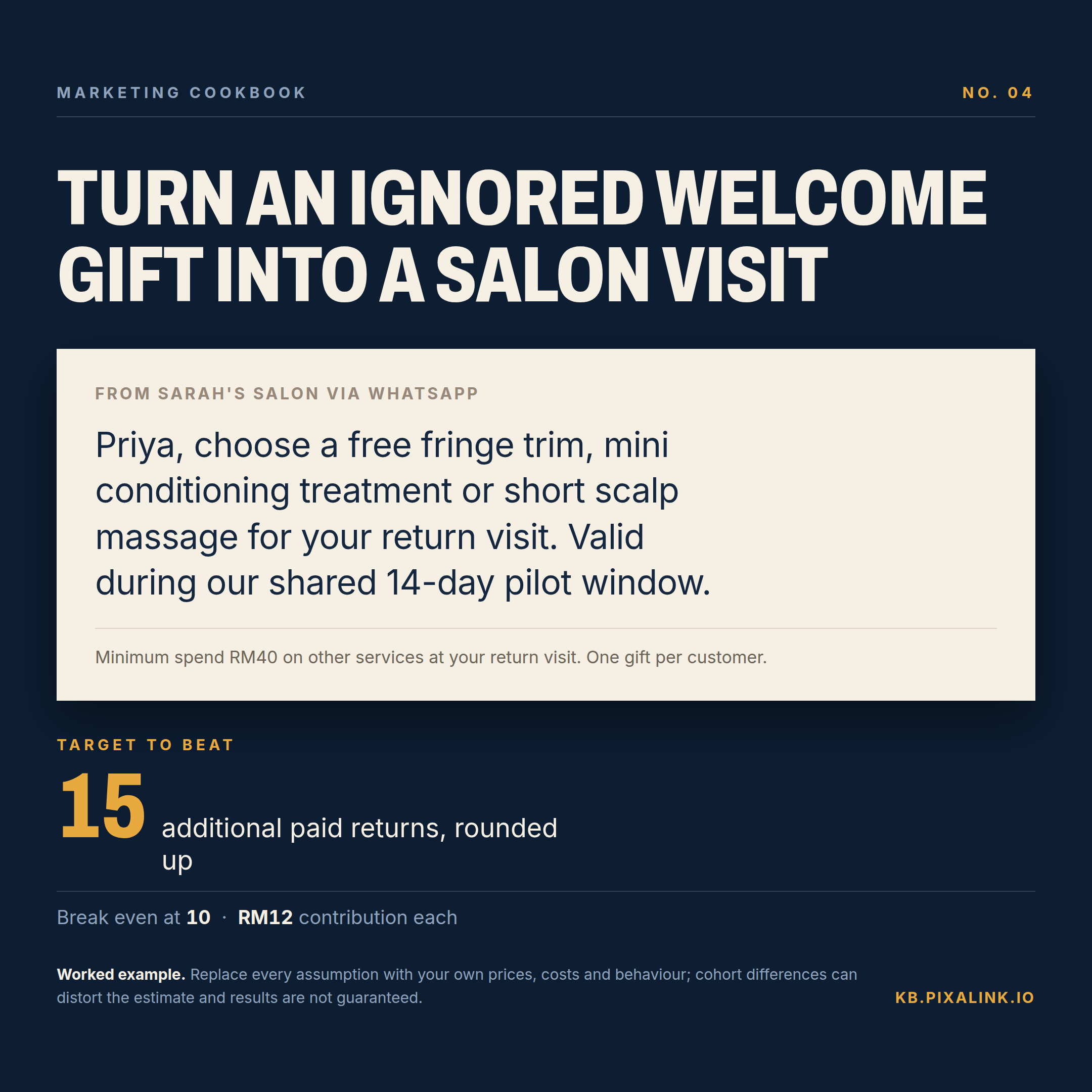
The same card at four sizes. Every figure on it comes from this article, and the message is the one written above — nothing on the card is generated.
Alt text for your post
Turn an Ignored Welcome Gift into a Salon Visit. Marketing Cookbook recipe card. Replace every assumption with your own prices, costs and behaviour; cohort differences can distort the estimate and results are not guaranteed.
Closing invitation
Choose one welcome offer and give clients like Priya a small, understandable choice. Run the capped test, then keep only what produces additional customer value at a sustainable cost.