
Moments That Matter
Find Out Whether Your Birthday Reward Pays Its Way
Is Daniel celebrating a relationship, buying an extra visit, or paying for something that would have happened anyway?

A worked example
- RM60
- Contribution per incremental action
- 5
- Break-even actions
- 8
- Minimum target
actions, or RM960 extra sales
At a glance
The business problem
Attention and redemptions cannot tell Daniel how much extra customers spent. The leak is rewarding existing behaviour while counting the whole dinner bill as campaign revenue.
Nurul's usual meal belongs in the baseline. To estimate extra spending, Daniel needs a comparable group whose birthday month passes without the reward.
Why the usual promotion falls short
A larger birthday discount could increase claims while making that leak more expensive. Engaged members may respond because they already like the restaurant, without changing their plans.
Nishio & Hoshino (2024), Journal of Retailing and Consumer Services 81 — no lifetime-value gain from birthday incentives. Use that finding to test Daniel's campaign, not predict his results. Keep the gesture modest and compare spending against a random holdout: eligible members deliberately given no birthday reward.
What you set up in Pixalink
Opening scenario
Daniel places a birthday dessert beside Nurul's plate at his Kuala Lumpur steakhouse. She smiles; she gets one every August, and she eats here most months anyway. For two years, Daniel has pointed to his birthday campaign's 68% open rate and 22% redemption rate as proof that loyalty works.
Daniel, Nurul and the steakhouse are fictional; all figures in this article are illustrative. Suppose each dessert costs RM6 to serve: every happy redemption has a cost, even when dinner was already planned. Is Daniel celebrating a relationship, buying an extra visit, or paying for something that would have happened anyway?
The recipe
The campaign recipe
| Recipe element | Recommended starting point |
|---|---|
| Suitable industries | Steakhouses and other sit-down restaurants with repeat members |
| Primary goal | Test whether birthday spending covers the gesture's cost |
| Customer segment | 100 existing members with birthdays next quarter; randomly hold back 10%, leaving 90 offered the reward |
| Offer | One free dessert costing RM6 to serve; holdout receives no birthday reward, costing RM0 |
| Validity | The customer's birthday month only |
| Minimum spend | Any paid main course; no additional table minimum in this test |
| Quantity or budget limit | One dessert per offered member; reserve 90 desserts and RM540, plus RM120 operating cost; merchant controls exposure |
| Main success metric | Difference in average birthday-month spend per eligible member between groups |
The message your customer receives
This message is fictional, like the merchant and customer. All figures are illustrative.
From Daniel's steakhouse via WhatsApp
Nurul, enjoy a free birthday dessert from us. Valid during your birthday month only.
With any paid main course. No additional table minimum. One dessert per member.
The journey
Follow the customer
- Enter the comparison. Daniel randomly selects and tags 10% of next quarter's birthday members as the holdout. They receive no birthday reward; Nurul happens to enter the reward group.
- Enjoy the usual gesture. Everyone outside the holdout receives the dessert offer as usual. Nurul uses hers with a paid main course during August.
- Let the month finish. At quarter end, Daniel compares total birthday-month spend in each group, divided by its member count. Nurul's ordinary purchases stay in the calculation, alongside zero spenders.
- Decide what follows. If the spending gap is smaller than dessert costs, Daniel has learned why claims alone misled him. Nurul returns to ordinary dining; no next reward is promised.
Use case: how the merchant applies it
Daniel fixes the eligible list before the quarter and randomly assigns members within each birthday month. He keeps both groups' ordinary service and other offers unchanged, then records their earlier spending to check for obvious imbalance.
Nurul's offer is one free dessert with any paid main course, valid only during August. Daniel reserves stock and RM540 for all 90 offers, including unexpectedly busy weeks. The offer carries no extra table minimum, and staff check the main-course condition.
A holdout label alone does not prevent delivery. Before launch, Daniel must confirm a workable process that keeps these members out of every birthday reward route; if he cannot, this test must wait.
How the platform helps
How Pixalink supports the strategy
Pixalink supports birthday automation, expiry and one-time use. Daniel must enforce the holdout and any table minimum himself; automatic random allocation, holdout exclusion and experiment reporting are not supported controls established for this recipe.
Daniel keeps his own allocation and spending records. Confirm expiry and exclusions before issuing rewards; a holdout tag alone is insufficient.
Configure this in Pixalink
Use Birthday Rewards — Automatically Reward Customers on Their Birthday for the birthday automation setup. It is not a holdout-testing guide.
The economics
ROI taste test
Define one incremental action as RM120 of extra birthday-month sales, not a claimed dessert or a proven extra visit. Assume RM60 variable meal cost per action and 30 desserts redeemed at RM6 each: RM180 total reward cost, including desserts for regulars.
For this holdout test, put all RM180 of desserts into the campaign operating budget alongside RM120 for staff time and administration: RM300 total. The separate reward charge per incremental action is therefore RM0, because every dessert is already counted in that budget.
- Contribution per incremental action = cash collected - variable fulfilment cost - reward cost. Contribution per incremental action = RM120 - RM60 - RM0 = RM60.
- Break-even actions = campaign operating cost / contribution per incremental action. Break-even actions = RM300 / RM60 = 5.
- Minimum target = break-even actions x 1.5, rounded up. Minimum target = 5 x 1.5 = 8 actions, or RM960 extra sales.
Check the whole dessert bill
If reward-group average spend is RM132 and holdout average spend is RM120, estimated extra sales are (RM132 - RM120) x 90 = RM1,080. That RM1,080 sales lift exceeds the RM960 target. At the assumed costs, RM1,080 - RM540 - RM180 - RM120 leaves RM240 after campaign costs.
If all 90 desserts are used, reward cost reaches RM540 and that same spending result loses RM120. Recalculate the budget and target using all actual redemptions; never treat the RM0 marginal charge as a free dessert. Replace every assumption with your own figures, and treat this small holdout as a noisy estimate, not guaranteed ROI.
Measure it
What to watch
- KPI 1: Spend lift. Compare average birthday-month spend across all assigned members, including non-buyers.
- KPI 2: Total dessert cost. Count every dessert, including Nurul's if she would have visited anyway.
- KPI 3: Net incremental contribution. Subtract extra meal costs, all desserts and operating costs from estimated spend lift.
Common mistake: calling 22% redemption proof of extra demand. Nurul's regular dinner explains why that shortcut fails.
Safeguard: protect the holdout's integrity through a pre-launch exclusion check and an issuance reconciliation. If anyone held back receives a birthday reward, flag the comparison as compromised.
Keep when Daniel reaches the recalculated minimum target and the safeguard holds. Improve a promising result by testing one bounded change, such as a cheaper dessert, in a fresh cohort. Stop the tested offer if contribution is non-positive, the safeguard fails or the pre-set target is missed; do not scale an inconclusive result.
Your first test
Try this first
- Fix the birthday cohort, baseline spending and random 10% holdout before launch.
- Limit exposure to 90 offers and reserve RM540 for desserts plus RM120 operating cost.
- Use one dessert offer, birthday-month validity and a quarter-end comparison.
- Record all costs, zero spenders and the holdout-integrity check.
- Apply the pre-set keep/improve/stop rule using actual economics before another test.
Questions
Frequently asked questions
Should regulars such as Nurul be excluded?
No; randomly allocate eligible regulars too. Excluding them would test a different campaign.
Does tagging the holdout stop birthday rewards?
Do not assume so. Daniel must verify exclusion himself; the setup guide establishes no automatic holdout control.
Is a small spending difference convincing?
A few large tables can distort a small sample. Repeat an uncertain test before expanding the offer.
Can Daniel add another reward later in the month?
Consider a second, smaller reward only after the holdout shows the first worked. Test it separately and verify delivery before promising it.
Share this recipe
A card you can post
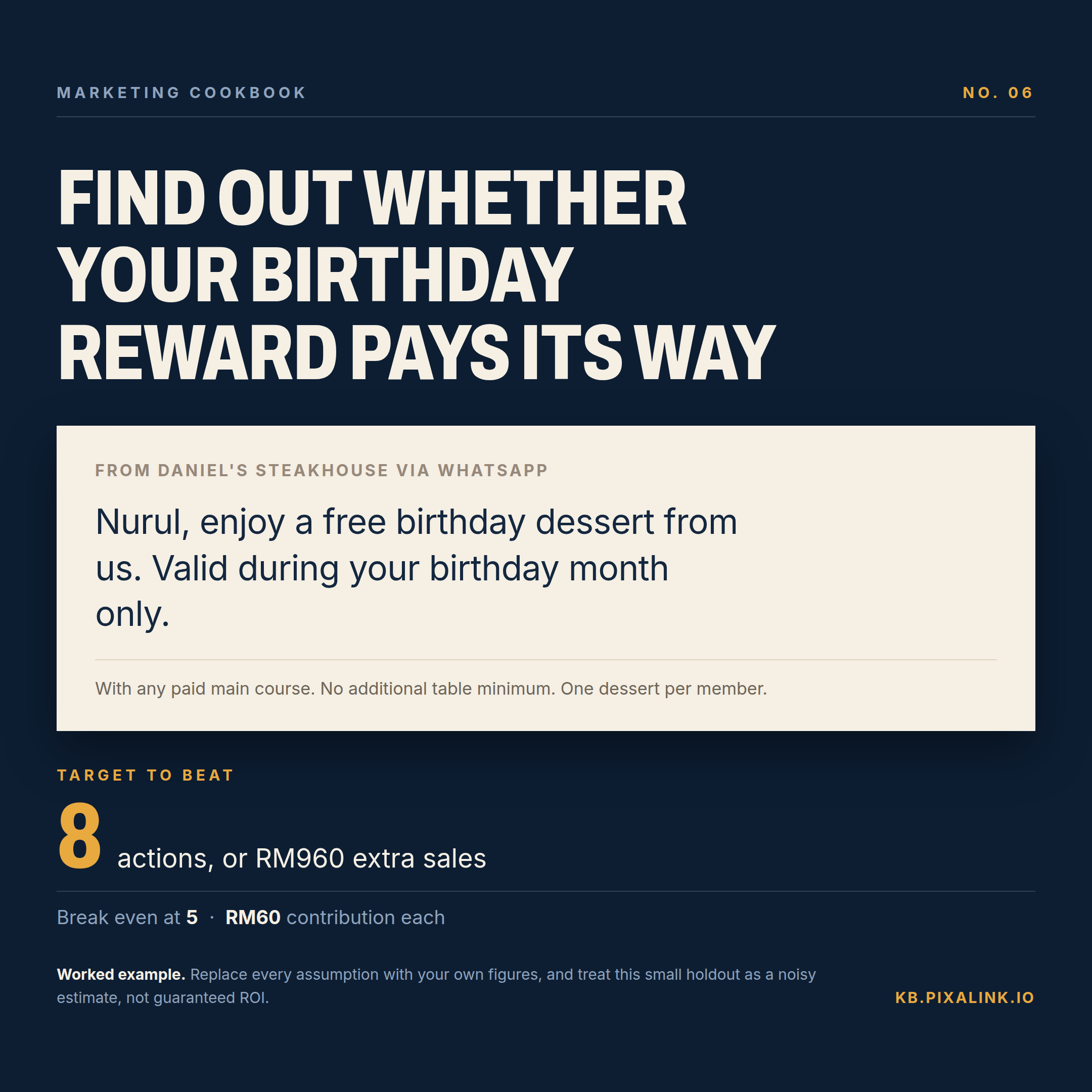
The same card at four sizes. Every figure on it comes from this article, and the message is the one written above — nothing on the card is generated.
Alt text for your post
Find Out Whether Your Birthday Reward Pays Its Way. Randomly split 100 birthday members: 90 receive one free dessert with a paid main course during their birthday month, costing RM6 each; 10 percent receive no birthday reward, costing RM0. Replace every assumption with your own figures, and treat this small holdout as a noisy estimate, not guaranteed ROI.
Closing invitation
Choose one birthday offer with a modest budget. Like Daniel, measure extra spending before expanding it.