
Moments That Matter
Make Payday Weekend Orders Worth More
Should Chloe keep pushing against the cycle, or test an offer that rides it?

A worked example
- RM12
- Contribution per incremental action
- 10
- Break-even actions
- 15
- Minimum target
per raised table order
raised table orders
raised table orders, rounded up
At a glance
The business problem
Chloe has two different problems: empty tables before payday and missed basket opportunities afterwards. A RM10 discount costs RM200 across 20 bills, even if those diners would have visited anyway.
This recipe tackles the second problem. The goal is more contribution from a weekend table, so Chloe must measure order growth after food and reward costs, not celebrate a full room she usually gets already.
Why the usual promotion falls short
A cheaper meal cannot always overcome a customer's wish to wait until salary arrives. Meanwhile, a blanket payday discount can subsidise demand that already exists.
Spending is reliably sensitive to pay arriving even though the date is known well in advance — Stephens (2006), The Economic Journal 116(513). That supports testing the timing; it does not prove that Chloe's offer will be profitable or that every customer is paid on the same day.
What you set up in Pixalink
Opening scenario
Chloe straightens an empty table in her casual dining restaurant in Mont Kiara. The third week is quiet again, despite a RM10 discount that eats into every qualifying bill. At month end, the same room fills without much encouragement.
Azman follows that rhythm: he eats out most weekends after payday and rarely just before it. Chloe wonders whether another quiet-week discount is solving the wrong problem. Could the coming busy weekend bring larger orders instead?
Chloe, Azman and this restaurant are fictional; all figures and dates are illustrative. Should Chloe keep pushing against the cycle, or test an offer that rides it?
The recipe
The campaign recipe
Use one benefit behind a modestly higher basket, available for one dated weekend. These are starting assumptions for Chloe's test, not promised results.
| Recipe element | Recommended starting point |
|---|---|
| Suitable industries | Casual dining restaurants with group orders and a visible payday pattern |
| Primary goal | Raise contribution from weekend table orders |
| Customer segment | Existing weekend diners such as Azman; a small audience who welcome marketing messages |
| Offer | One free sharing dessert per qualifying table bill; no extra charge; RM6 fulfilment cost |
| Validity | 26–27 September 2026 inclusive, whole days; announce once on the evening of 25 September |
| Minimum spend | RM120 paid food-and-drink subtotal, excluding service charge, tax and the free dessert; staff check at the till |
| Quantity or budget limit | 30 benefits total; RM180 maximum dessert cost plus RM120 campaign operating cost; table-bill rule is manual |
| Main success metric | Weekend contribution versus a normal comparable weekend, adjusted for payday demand |
The message your customer receives
This message is fictional, like the merchant and customer. All figures are illustrative.
From Chloe's restaurant via WhatsApp
Azman, enjoy a free sharing dessert with your table's meal on 26–27 September 2026.
Minimum spend RM120 on paid food and drinks, excluding service charge, tax and the free dessert. One free dessert per qualifying table bill.
The journey
Follow the customer
- Payday brings the invitation. Azman's pay lands on the 25th. That evening, he receives the message naming the coming weekend's sharing dessert.
- A larger order unlocks it. He sees the RM120 threshold against his usual RM90 table order. The dessert is free only with the qualifying paid basket.
- He makes a group plan. Azman books Saturday through the restaurant's usual booking channel. He brings two friends to clear the threshold.
- The table spends more. Staff verify the bill and serve the dessert; Chloe gains a larger basket on an already busy weekend. Azman finishes the meal without another reward promised, while Chloe checks whether the extra spend covered its cost.
Use case: how the merchant applies it
Chloe announces the offer once on 25 September, with the dates, minimum spend and limited availability together. She reserves ingredients for 30 desserts and briefs staff that separate diners at one table do not each earn a benefit.
Azman's RM120 order qualifies during 26–27 September, provided availability remains. Staff check the subtotal before serving the free dessert; the dessert itself cannot help clear the threshold. Chloe records the paid basket and benefit against the table bill, then closes the test after Sunday rather than extending it to use up stock.
How the platform helps
How Pixalink supports the strategy
Pixalink enforces whole-day start and end dates and total availability, and supports a scheduled broadcast. Chloe enforces the basket threshold and one-benefit-per-table-bill rule at the till; do not assume the platform checks them for this recipe.
A recurring payday rule is not supported here. To repeat the idea, Chloe schedules next month's dated window separately after reviewing the test.
Configure this in Pixalink
Use What Are Rewards and How to Create Them for reward setup and How to Send a Broadcast Campaign for the announcement. Keep the manual till checks in the staff briefing alongside that setup.
The economics
ROI taste test
Azman's normal RM90 order has RM36 variable fulfilment cost. A RM120 order costs RM48 before the dessert, so the incremental cash is RM30 and incremental fulfilment cost RM12. Count that uplift, not the whole bill.
Calculate the extra contribution
The formulas are cash collected minus variable fulfilment cost minus reward cost; campaign operating cost divided by contribution; then break-even actions multiplied by 1.5, rounded up. Here, “cash collected” and fulfilment cost mean only the extra amount above the expected order.
- Contribution per incremental action = RM30 - RM12 - RM6 = RM12 per raised table order.
- Break-even actions = RM120 / RM12 = 10 raised table orders.
- Minimum target = 10 × 1.5 = 15 raised table orders, rounded up.
Allow for orders that would happen anyway
Those calculations assume every rewarded order produces the modelled uplift. Add dessert costs from unchanged orders to campaign operating cost and recalculate: five such desserts add RM30, making cost RM150, break-even 12.5 and the minimum target 19 raised orders, rounded up.
Nineteen raised orders plus five unchanged orders fit within the 30-benefit cap. Replace every assumption with actual prices, costs and behaviour; compare with similar payday weekends and an unmessaged group. Delivered messages and redemptions are not automatically incremental profit, and results are not guaranteed.
Measure it
What to watch
- Weekend contribution lift: compare cash less variable costs, all desserts and campaign costs with the adjusted normal-weekend baseline.
- Incremental raised orders: estimate how many baskets grew because of the offer, using the comparison group and prior payday behaviour.
- Reward cost per raised order: divide all dessert costs by estimated incremental raised orders, including desserts on unchanged baskets.
Common mistake: counting Azman's entire RM120 bill as campaign-created revenue. Safeguard: respect marketing preferences; use Why Some Tagged Customers Don't Get Your Broadcasts to check exclusions, and never override an opt-out to fill the test audience.
Keep when Chloe reaches the recalculated minimum target with positive contribution lift and the safeguard holds. Improve only for a fresh, capped test when the signal is promising and one assumption needs changing. Stop this offer when contribution is non-positive, the safeguard fails or the test misses its preset threshold.
Your first test
Try this first
- Choose a small eligible group and comparable unmessaged group; record prior payday baskets and weekend contribution.
- Cap exposure at 30 benefits, RM180 dessert cost and RM120 operating cost.
- Use the single RM120 offer, one announcement and the 26–27 September measurement window.
- Log paid subtotals, fulfilment and dessert costs, manual eligibility checks and marketing-preference compliance.
- Recalculate for unchanged orders, then apply the keep/improve/stop rule before scheduling another window.
Questions
Frequently asked questions
What if customers are paid on different dates?
Choose a dated window based on your own trading pattern. The 25th is Azman's example, not a salary date Pixalink detects.
Can I make the offer repeat monthly?
Not as a recurring payday rule in this recipe. Schedule each month's exact window separately.
Does Pixalink check the RM120 bill?
No, the basket threshold is a till responsibility here. Staff also enforce the one-benefit-per-table-bill rule.
What if the restaurant is already full?
Test only if the larger order adds contribution without displacing better-paying tables or adding uncosted labour. A busy room alone is not evidence to repeat the offer.
Share this recipe
A card you can post
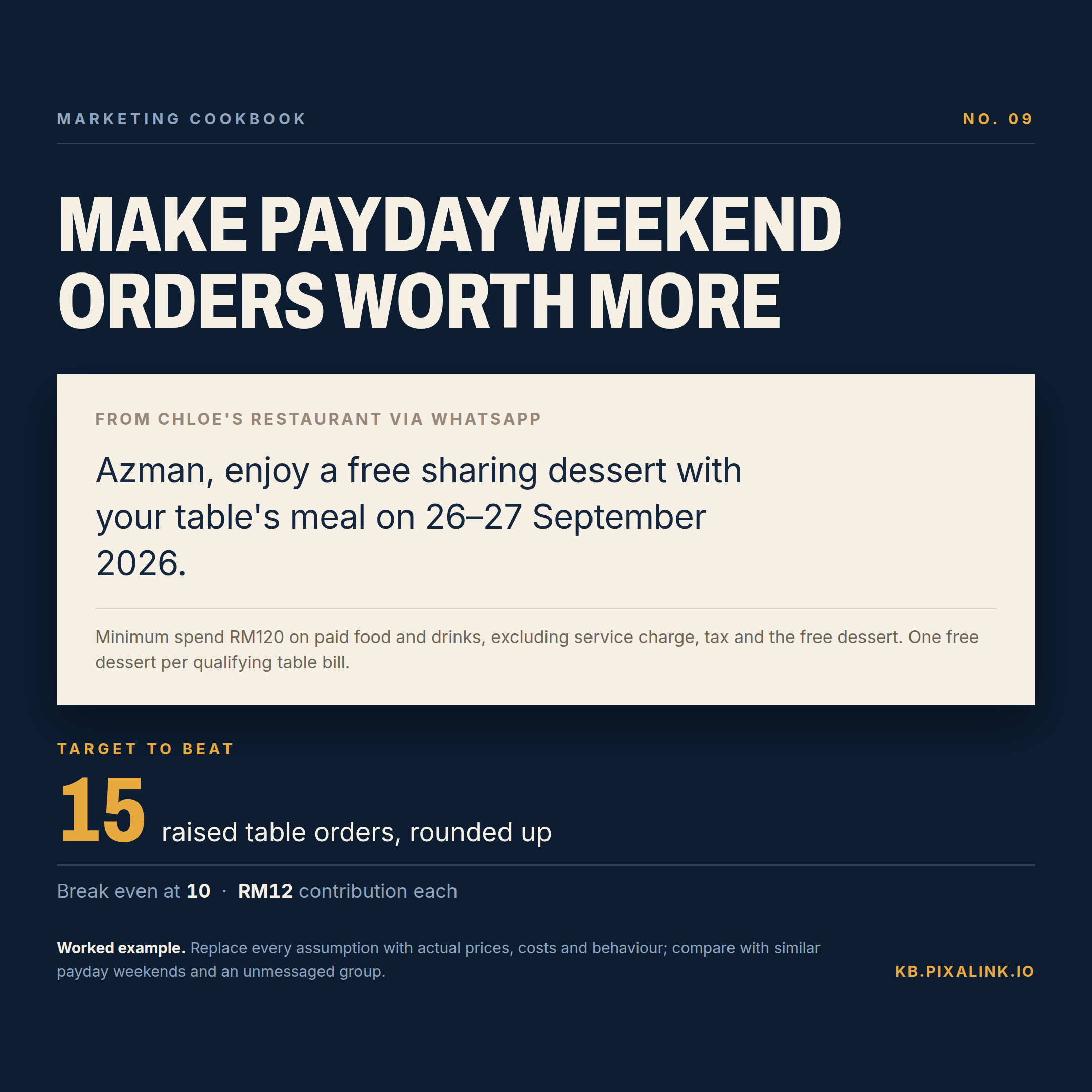
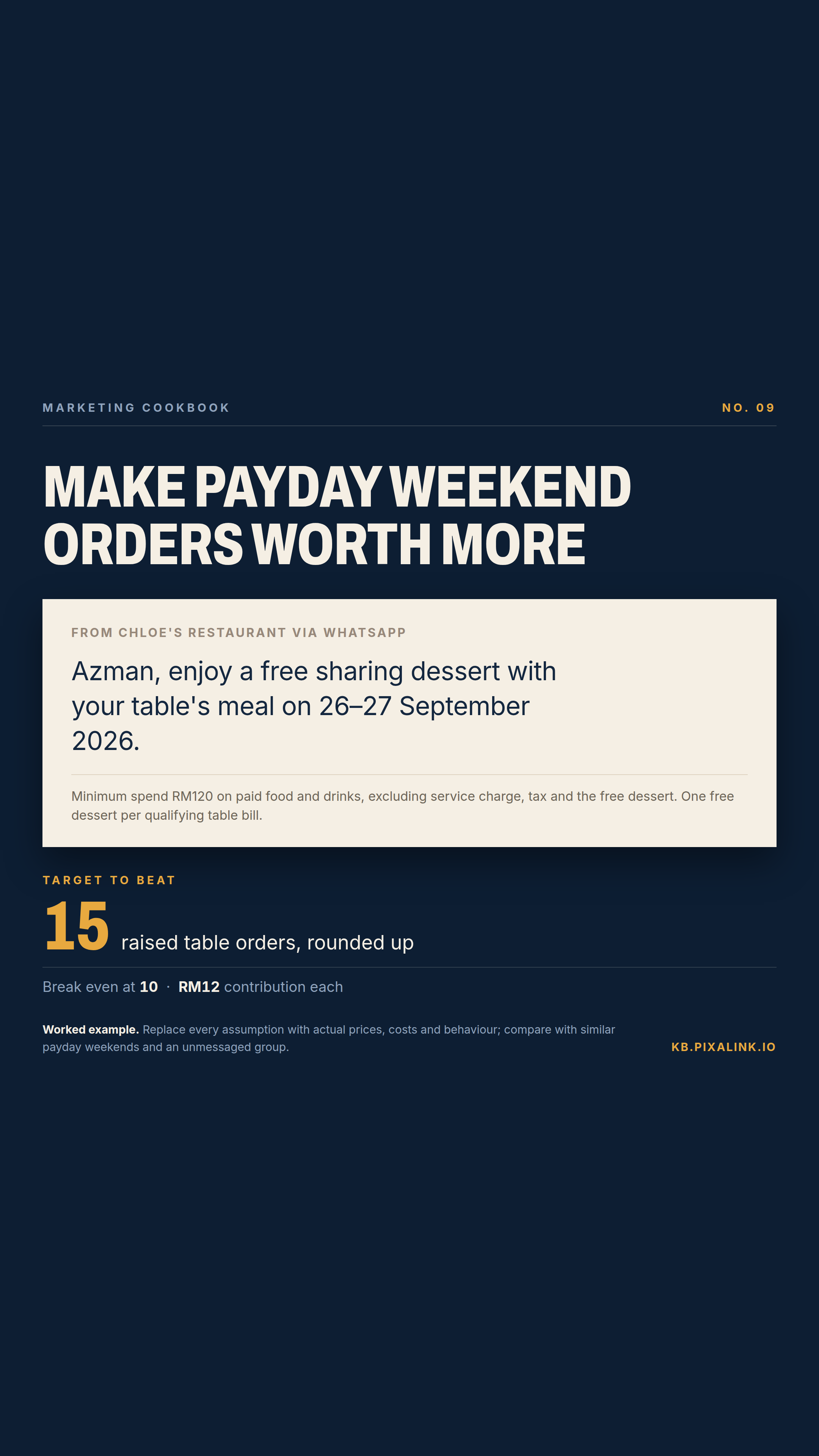
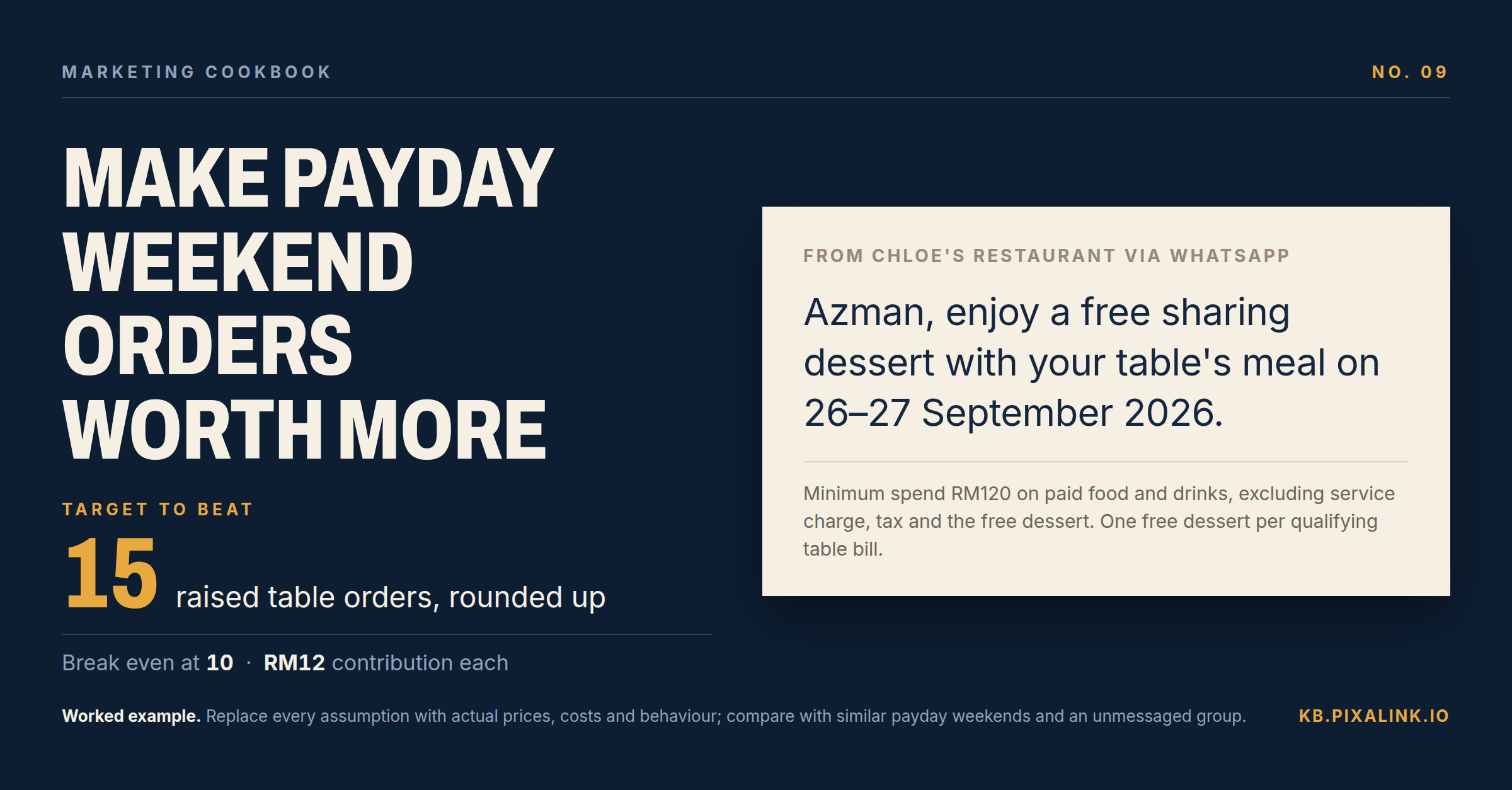
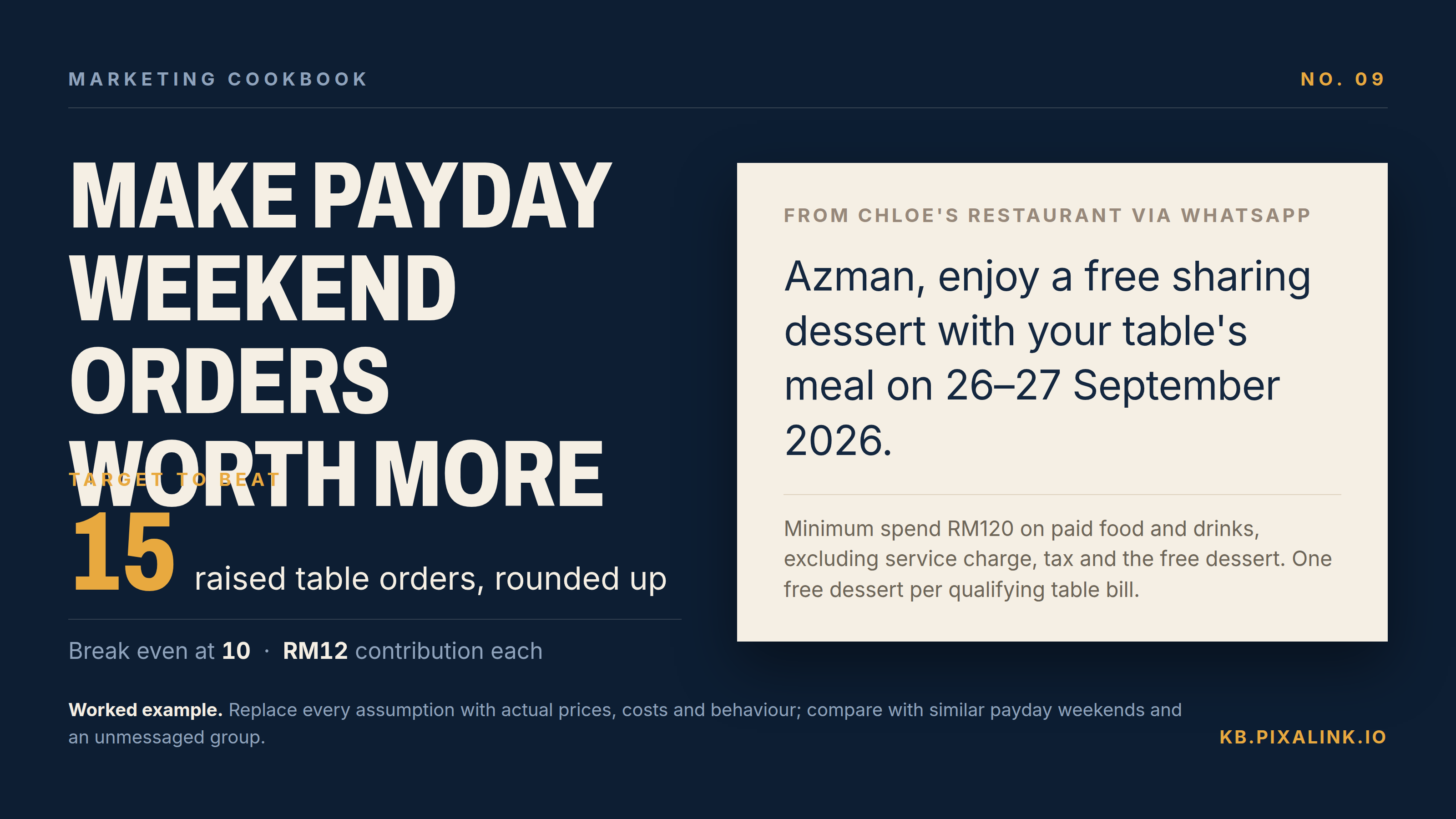
The same card at four sizes. Every figure on it comes from this article, and the message is the one written above — nothing on the card is generated.
Alt text for your post
Make Payday Weekend Orders Worth More. During 26–27 September 2026, a RM120 qualifying table bill unlocks a free sharing dessert costing Chloe RM6, with 30 benefits available. Replace every assumption with actual prices, costs and behaviour; compare with similar payday weekends and an unmessaged group.
Closing invitation
Try one payday window with a benefit your team can fulfil comfortably. Like Chloe, decide what to repeat from incremental customer value and contribution, rather than how busy the weekend looked.