
Moments That Matter
Keep Festive Sales Without Discounting the Whole Shop
How can she stay relevant at each festival without discounting the whole shop?

A worked example
- RM36
- Contribution per incremental action
- 9
- Break-even actions
- 14
- Minimum target
additional orders
additional orders, rounded up from 13.5
At a glance
The business problem
Hani’s problem is the cost of rewarding demand she already has. If 30 regular buyers would each spend RM100 anyway, her blanket discount sacrifices RM600 before creating any extra business.
A smaller festive benefit can protect more of that contribution while making the purchase feel considered. It still costs money, so Hani needs to distinguish a pleased regular like Raj from a genuinely additional order.
Why the usual promotion falls short
The same discount across Raya, Chinese New Year and Deepavali treats every shopping need alike. It also reduces the price of stock customers have already decided to buy.
A collection lets members choose something useful to their celebration. The commercial question becomes whether the chosen benefits add enough customer value to justify their cost, with full-price hampers still at the centre.
What you set up in Pixalink
Opening scenario
Hani is wrapping hampers in her Melaka gift shop when Raj arrives for his usual Deepavali order. Her annual promotion repeats the same message for every festival: 20% off everything. Raj already knows which hampers he wants and would have paid full price.
On a RM100 purchase, Hani gives away RM20 during the weeks her counter is busiest. Raj would find a thoughtful gift-wrap upgrade more useful than another generic sale. Hani and Raj are fictional, and all figures in this article are illustrative. How can she stay relevant at each festival without discounting the whole shop?
The recipe
The campaign recipe
Start with three benefits from a possible collection of three to five. These are alternatives, with separate stock limits; customers do not climb a reward ladder.
| Recipe element | Recommended starting point |
|---|---|
| Suitable industries | Gift and hamper shops; retailers with festive packaging services |
| Primary goal | Protect full-price festive contribution while testing additional orders |
| Customer segment | 60 existing members interested in festive gifting, selected for a small test |
| Offer | Free gift-wrap upgrade costing RM4, ribbon upgrade costing RM3, or decorative sleeve costing RM2; no extra customer charge; one benefit per qualifying bill, checked by staff |
| Validity | Open three weeks before Deepavali; end one week after the festival, with the exact end date printed in terms |
| Minimum spend | RM100 full-price hamper purchase; staff check the bill against the printed terms |
| Quantity or budget limit | 20 available per benefit, 60 total; conservative reward reserve RM240; RM204 preparation cost |
| Main success metric | Incremental festive contribution after reward and campaign costs |
The message your customer receives
This message is fictional, like the merchant and customer. All figures are illustrative.
From Hani's gift shop via WhatsApp
Raj, enjoy a free gift-wrap upgrade with your Deepavali hamper purchase. Valid from three weeks before Deepavali until one week after the festival.
Minimum spend RM100 on full-price hampers. One benefit per qualifying bill.
The journey
Follow the customer
- Three weeks before Deepavali, Raj sees the small collection in his portal. He checks the terms before choosing.
- Raj picks the gift-wrap upgrade because it suits his usual hampers. It adds presentation he values without pushing unwanted stock.
- The gift-wrap benefit stops accepting new claims when its stated cap is reached. Hani has set aside supplies for benefits already claimed, including Raj’s.
- Raj buys his usual hampers at full price and receives the upgrade after the counter check. He leaves ready to give them, while Hani records this as an existing customer’s purchase.
flowchart TD
    A[Browse festive choices] --> B{Chosen benefit available?}
    B -->|Yes| C[Claim before the cap]
    B -->|No| D[Choose another available benefit]
    D --> B
    C --> E[Buy hampers and use benefit by expiry]
Use case: how the merchant applies it
Hani starts at her Melaka outlet with 60 selected members and the three benefits above. Each has 20 available, one-time use, the same RM100 minimum and the stated festive expiry. Her printed terms allow one benefit per qualifying bill; staff check this and record the chosen benefit against the bill. She budgets up to RM4 per fulfilment, including extra materials and labour, even though two choices cost less.
Raj’s RM100 order receives the free wrap upgrade. Hani spends RM4 instead of surrendering RM20, retaining RM16 more than her old discount would have left. That comparison demonstrates avoided discount cost; it does not prove the campaign generated Raj’s order.
After fulfilment, staff record the benefit cost against the purchase. Hani introduces no automatic follow-up reward, keeping this test focused on festive choice.
How the platform helps
How Pixalink supports the strategy
Pixalink supports visibility dates, total availability, one-time use and tag targeting. Hani uses those controls to show the collection to her test group during the intended period and limit each benefit to its real stock allocation.
Staff enforce the RM100 minimum and one benefit per bill, printed in the terms; this recipe does not rely on an automatic till check. One-time use of each benefit is not a verified collection-wide “choose only one” lock, so Hani must not advertise that as automatic. She also calculates campaign contribution from her sales and cost records.
Configure this in Pixalink
Use What Are Rewards and How to Create Them for reward setup. Keep Hani’s minimum-spend check in the counter procedure.
The economics
ROI taste test
For Hani, an incremental action is an additional RM100 hamper order beyond expected festive demand. Assume RM60 variable fulfilment cost excluding the benefit, and conservatively allow RM4 reward cost per order under the staff-enforced one-benefit-per-bill term.
- Contribution per incremental action = cash collected - variable fulfilment cost - reward cost.
- Contribution per incremental action = RM100 - RM60 - RM4 = RM36.
Allow RM204 preparation cost plus RM120 for benefits used on 30 purchases that would happen anyway: 30 × RM4. Treat that combined RM324 as the campaign operating cost to recover from additional orders.
- Break-even actions = campaign operating cost / contribution per incremental action.
- Break-even actions = RM324 / RM36 = 9 additional orders.
- Minimum target = 9 × 1.5 = 14 additional orders, rounded up from 13.5.
At that target, 14 × RM36 - RM324 leaves RM180 incremental contribution under these assumptions. Raj’s baseline purchase contributes no additional order; neither portal claims nor sold-out benefits establish profit.
Reserve RM240 for all 60 benefits, making total planned cash exposure RM444 including preparation. The RM120 allowance is part of that reward reserve, not another cash budget. Replace every assumption with actual prices, costs and behaviour; recalculate the threshold if more baseline buyers take benefits.
Measure it
What to watch
- Incremental festive contribution: additional order contribution less preparation and baseline-buyer benefit costs, using the same festival last year and a comparable unoffered group as references.
- Additional qualifying orders: estimated orders above that baseline against the 14-order target.
- Reward cost per fulfilled order: actual benefit materials and labour against the RM4 allowance.
Common mistake: comparing Deepavali with last month. Festive volume can flatter a campaign that merely subsidises normal demand.
Safeguard: Hani keeps a stock-and-fulfilment log, reserving materials for claimed benefits and reconciling them with the published caps. A sold-out offer must reflect genuine availability.
Keep when the minimum target and safeguard hold. Improve a promising result by changing one offer or segment in another capped test. Stop the current offer if contribution is non-positive, the safeguard fails or the pre-set threshold is missed; do not expand it on claims alone.
Your first test
Try this first
- Select 60 members; retain 60 comparable unoffered members and record the same festival’s baseline from last year.
- Cap each benefit at 20 and reserve RM444 including preparation.
- Fix one collection, its RM100 minimum and the three-weeks-before to one-week-after measurement window.
- Record costs, baseline-buyer benefits and stock commitments; brief staff on the minimum-spend check.
- Apply the pre-set keep, improve or stop rule using estimated additional orders and net contribution.
Questions
Frequently asked questions
Must members celebrate a particular festival?
Let members express their gifting interests. Raj’s choice should reflect what he buys, without staff guessing his preferences from his name.
Does Pixalink enforce the RM100 minimum?
Staff enforce it for this recipe. Print it clearly and check the qualifying bill before providing the benefit.
Can one customer take several different benefits?
Members may claim different benefits, but Hani permits only one on each qualifying RM100 bill. Staff check and record that manually; an automatic collection-wide restriction is not verified for this recipe.
What if the cap is reached before Raj visits?
The cap stops new claims. Hani should honour Raj’s already-claimed benefit within its terms using the supplies she reserved.
Share this recipe
A card you can post
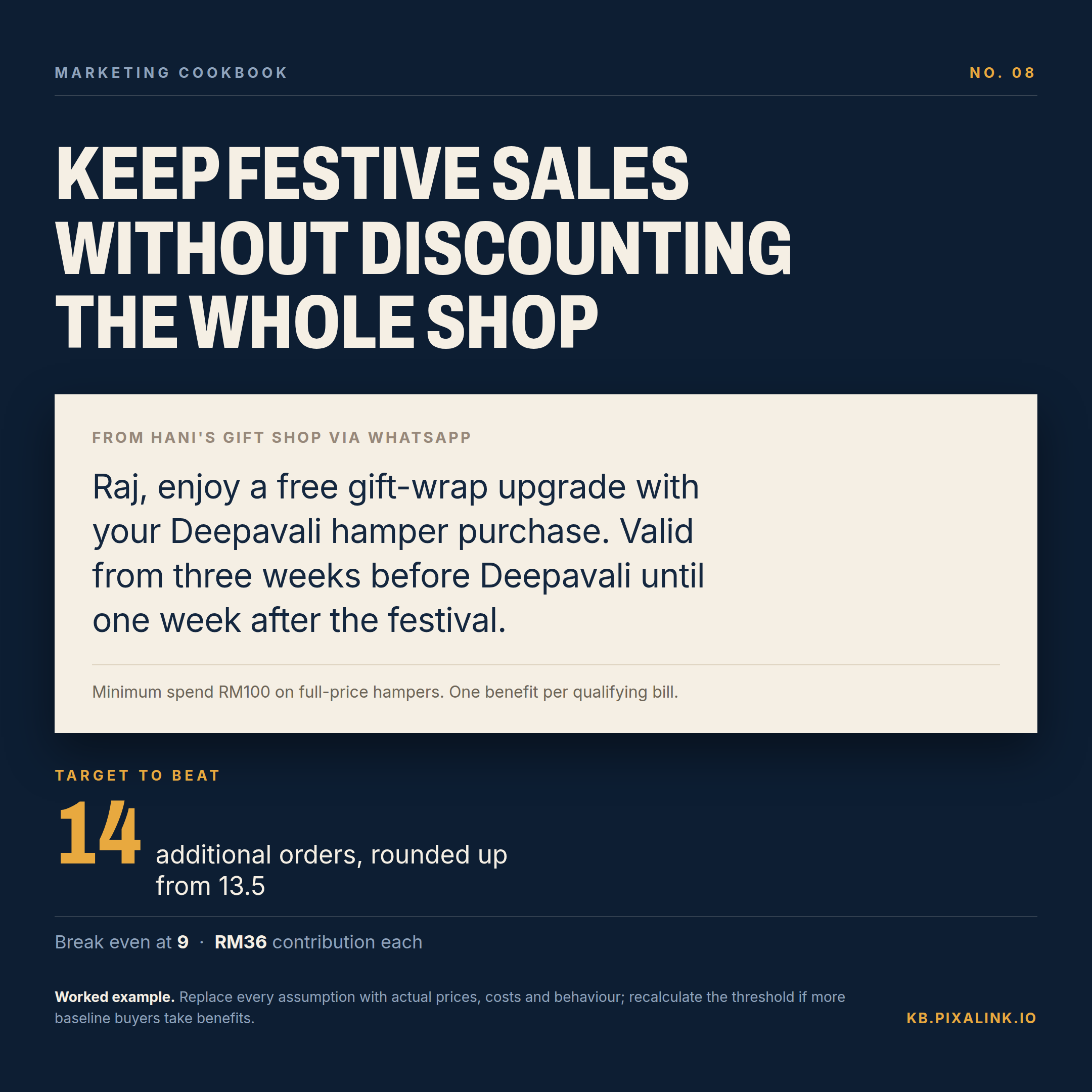
The same card at four sizes. Every figure on it comes from this article, and the message is the one written above — nothing on the card is generated.
Alt text for your post
Keep Festive Sales Without Discounting the Whole Shop. Choose a free festive gift-wrap, ribbon or sleeve benefit with a RM100 full-price hamper purchase checked by staff. Each benefit has 20 available; merchant costs are RM4, RM3 or RM2. Replace every assumption with actual prices, costs and behaviour; recalculate the threshold if more baseline buyers take benefits.
Closing invitation
Choose one festival and one small collection that fits your customers’ purchases. Like Hani, keep the test bounded and measure additional customer value before repeating it more widely.