
Moments That Matter
Thank Long-Standing Patients Before the Renewal Notice
He has a relationship worth recognising, but what can he celebrate besides a birthday—and will the thank-you change anyone's decision to stay?

A worked example
- RM180
- Contribution per incremental action
- 2
- Break-even actions
- 3
- Minimum target
per additional renewal
additional renewals
additional renewals, rounded up
At a glance
The business problem
Marcus has a retention problem hidden behind completed appointments. When the clinic only contacts patients about payment, renewal arrives without a recent conversation about their experience. Measure how many eligible patients renew within each tenure band, rather than treating every quiet patient as equally likely to leave.
Why the usual promotion falls short
A blanket renewal discount pays patients who already intended to stay and gives Siti the same recognition as a newcomer. An anniversary benefit can acknowledge her history while creating a reason to reconnect. It still costs money when it changes nothing, so Marcus needs a comparable group receiving usual care without the extra campaign.
What you set up in Pixalink
Opening scenario
Marcus watches Siti leave his Petaling Jaya dental clinic after her cleaning. She has paid for his annual care plan for three years, yet nobody has thanked her for staying. Other patients use their first cleaning and disappear until a renewal email reaches them eleven months later.
His next plan is another reminder, although the last batch took RM120 in staff time and messaging. Marcus, Siti and the clinic are fictional; all figures in this article are illustrative. He has a relationship worth recognising, but what can he celebrate besides a birthday—and will the thank-you change anyone's decision to stay?
The recipe
The campaign recipe
Use completed years with the clinic to choose one benefit band. These are alternative benefits, not gifts stacked across consecutive visits.
| Recipe element | Recommended starting point |
|---|---|
| Suitable industries | Dental clinics with annual care plans; adapt for other recurring service memberships |
| Primary goal | Improve paid renewals through earlier personal contact |
| Customer segment | Active patients by completed tenure; pilot only the three-year band |
| Offer | Years 1–2: basic take-home care pack, stated value RM15, clinic cost RM6. Years 3+: premium pack, stated value RM30, clinic cost RM12 |
| Validity | 30 days from the joining anniversary; verify the voucher's actual expiry |
| Minimum spend | RM0; no extra treatment or renewal purchase required |
| Quantity or budget limit | 20 offered patients, 20 packs and RM240 gift budget, controlled by staff; RM120 administration and messaging |
| Main success metric | Renewal rate by tenure band, compared with a holdout group |
The message your customer receives
This message is fictional, like the merchant and customer. All figures are illustrative.
From Marcus's dental clinic via WhatsApp
Siti, thank you for being with us. Your anniversary gift is a premium care pack worth RM30. Collect it within 30 days of your joining anniversary.
Minimum spend RM0. No extra treatment or renewal purchase required.
The journey
Follow the customer
- Receive recognition. On her joining anniversary, Siti receives a note thanking her for three years with the clinic. Staff have checked her tenure before selecting the message.
- Find a relevant benefit. The note describes her premium care pack, worth RM30. Marcus's team separately issues her voucher, rather than expecting the message to grant it.
- Book and return. Siti books her planned routine visit within the 30-day window and collects the pack. In this example, that brings her back two months before renewal.
- Discuss what comes next. Siti talks about the next plan term face to face. She can renew later without losing the thank-you she already received.
Use case: how the merchant applies it
Marcus selects patients whose joining anniversaries fall in the next month. For Siti, the anniversary of first joining the clinic differs from her current plan renewal date; check both dates before expecting a two-month lead. If they coincide, this is anniversary recognition, not an early renewal intervention.
Staff reserve 20 premium packs and issue one voucher to each offered patient. Collection is available during the 30-day window, including without an additional treatment purchase; the pack covers no clinical services. Routine appointments follow the patient's care needs, and the gift never requires unnecessary treatment.
Marcus randomly splits 40 comparable three-year patients into 20 offered patients and 20 holdout patients. Both groups retain normal care and renewal reminders; only the offered group receives this extra note and pack. Staff manage allocation, stock and the comparison outside the campaign automation.
How the platform helps
How Pixalink supports the strategy
Pixalink supports an anniversary broadcast using a date stored on the customer, with tier or tag targeting. Marcus checks tenure and maintains the appropriate groups; automatic tenure calculation is not established for this recipe. The platform enforces configured voucher expiry and one claim, while staff control which benefit is covered and issue the voucher separately.
The anniversary message does not grant the reward. Before sending, staff verify that the promised voucher exists and its expiry matches the anniversary-based deadline. A 30-day period starting from a later claim is not the same deadline; do not assume those clocks match.
Configure this in Pixalink
Use How to Create a Hidden Voucher and Give It to a Specific Member and What Voucher Expiry Dates Mean in Pixalink. These cover the voucher work; an anniversary-date broadcast setup guide was not verified among the supplied links.
The economics
ROI taste test
Count an incremental paid renewal, not a booking, as the action. Assume RM360 cash collected per annual renewal and RM180 variable fulfilment cost for its full term, including all promised care.
Marcus budgets every offered pack upfront: 20 × RM12 = RM240, plus RM120 administration and messaging, giving RM360 campaign operating cost. That includes gifts collected by patients who never renew or would renew anyway; reward cost below is RM0 because those gifts are already fully charged to the campaign budget.
- Contribution per incremental action = cash collected - variable fulfilment cost - reward cost.
- Contribution per incremental action = RM360 - RM180 - RM0 = RM180 per additional renewal.
- Break-even actions = campaign operating cost / contribution per incremental action.
- Break-even actions = RM360 / RM180 = 2 additional renewals.
- Minimum target = 2 × 1.5 = 3 additional renewals, rounded up.
Compare after renewal falls due
Measure each patient's renewal outcome by 30 days after their plan ends. If 14 of 20 offered patients renew and 10 of 20 holdout patients renew, estimated uplift is four renewals: RM720 contribution less RM360 campaign cost leaves RM360. This small sample is uncertain, not proof or a guaranteed result; replace every price, cost and behaviour assumption with clinic records.
Measure it
What to watch
- KPI 1 — Renewal rate by tenure band: compare offered and holdout patients over the same window.
- KPI 2 — Completed benefit visits: count offered patients who attend and collect, not just book.
- KPI 3 — Incremental contribution after campaign cost: use renewal uplift and include all packs and staff costs.
Common mistake: treating every renewal by an offered patient as campaign-generated. Siti might have stayed anyway, which is why Marcus preserves the holdout.
Safeguard: maintain one staff-controlled promise register covering issued vouchers, permitted packs, deadlines and collection capacity. Pause new invitations if the clinic cannot honour any promised benefit.
Keep when at least three additional renewals and the safeguard hold. Improve with one bounded change in a new test if the target holds but attendance is weak; stop expansion if contribution is non-positive, the safeguard fails or uplift misses three.
Your first test
Try this first
- Define 40 comparable three-year patients and record baseline renewal rates; randomly assign equal offered and holdout groups.
- Cap exposure at 20 invitations, 20 packs and RM360 total campaign cost.
- Fix the premium pack, 30-day collection window and renewal measurement deadline before sending.
- Record full-term fulfilment costs and every gift cost; check the promise register before each invitation.
- Apply the pre-set keep, improve or stop rule after both groups finish their measurement window.
Questions
Frequently asked questions
Does the anniversary broadcast issue Siti's voucher?
No, the team must issue it separately. Check that it is available before the note promises a benefit.
Must Siti buy something to collect?
No, this example has RM0 minimum spend. Staff must honour that even if she declines extra treatment or renewal.
Does Pixalink enforce the 20-patient cap?
That recipient and stock cap is a staff control here. Voucher expiry and one claim do not replace invitation budgeting.
What if joining and renewal fall together?
Keep the recognition, but drop the two-month claim. Pair it with a separate pre-expiry approach, as explored in Lesson 29, rather than changing the joining date to fit the story.
Share this recipe
A card you can post
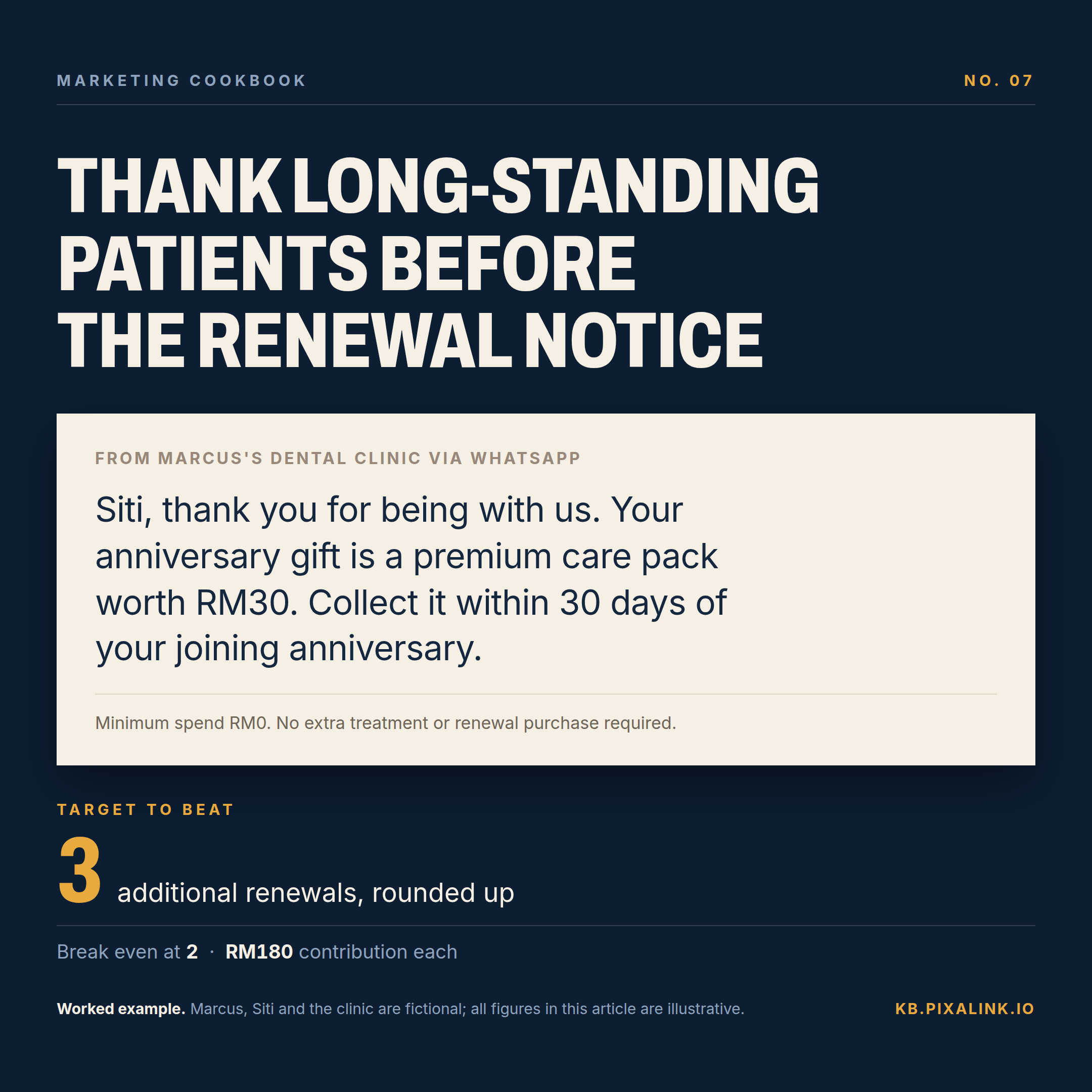
The same card at four sizes. Every figure on it comes from this article, and the message is the one written above — nothing on the card is generated.
Alt text for your post
Thank Long-Standing Patients Before the Renewal Notice. Choose one anniversary benefit by completed tenure: years 1 to 2 receive a basic pack worth RM15 costing RM6; years 3 and above receive a premium pack worth RM30 costing RM12. Both have RM0 minimum spend and 30 days from the anniversary. Marcus, Siti and the clinic are fictional; all figures in this article are illustrative.
Closing invitation
Start with one tenure band and a thank-you Marcus can afford to honour. Let Siti's experience and the comparison group's renewals guide whether the next anniversary deserves the same offer.