
Urgency & Collections
Bring Laundry Customers Back with Weekly Voucher Unlocks
How can she make the next benefit worth remembering without giving everything away at once?

A worked example
- RM12
- Contribution per incremental action
- 10
- Break-even actions
- 15
- Minimum target
incremental visits
incremental visits
At a glance
The business problem
Devi wants more useful return visits across the month. A voucher used on a laundry order Faizal would have placed anyway costs margin without adding business. An unused voucher saves fulfilment cost but does nothing to encourage another visit.
The commercial question is whether changing availability changes behaviour. Devi needs to compare visits and contribution, rather than celebrate how many bundles she gives away.
Why the usual promotion falls short
When every voucher opens immediately, customers can use the value early and forget what remains. One distant expiry also gives them little reason to think about next week.
Weekly unlocking introduces smaller moments to act. This approach is largely untested in practice: it is an experiment, not a proven way to create four visits. Compare it with an equally valuable bundle available all at once.
What you set up in Pixalink
Opening scenario
Devi is folding laundry at her Klang shop when Faizal brings in another bag. She remembers giving him a book of five vouchers: he used two in the first week, meant to use the rest, then lost the book. Other customers left theirs in drawers until expiry. For Devi, printing the books and explaining the offer took time, yet neither effort gave customers a reason to spread their visits out. Devi, Faizal and this business are fictional; all figures in this article are illustrative. How can she make the next benefit worth remembering without giving everything away at once?
The recipe
The campaign recipe
| Recipe element | Recommended starting point |
|---|---|
| Suitable industries | Laundry services with repeat household orders |
| Primary goal | Increase useful repeat visits across four weeks |
| Customer segment | Existing regulars with room to return more often |
| Offer | Four free single-shirt pressing benefits; one opens immediately, then after 7, 14 and 21 days; each costs Devi RM2 |
| Validity | Each expires two weeks after unlocking; last expiry is 35 days after issue |
| Minimum spend | RM30 laundry order per use, checked by staff |
| Quantity or budget limit | 20 test members and 20 control members; four benefits each; RM320 maximum reward cost plus RM120 operating budget; Devi caps assignments manually |
| Main success metric | Visits per member across the 28-day comparison |
Both groups receive four benefits, with the same two-week usable duration per benefit. Only their start dates differ. Staff apply one benefit per visit in both groups; the platform's one-time use applies to each individual voucher.
The message your customer receives
This message is fictional, like the merchant and customer. All figures are illustrative.
From Devi's laundry shop via WhatsApp
Faizal, your free single-shirt pressing benefit is ready to use today. Valid for two weeks from today.
Minimum laundry order RM30. Benefits cannot be combined on the same visit; vouchers cannot be reused.
The journey
Follow the customer
- Receive the bundle. Faizal gets four benefits together. Only the first is usable now.
- Use the first benefit. He adds free shirt pressing to a qualifying laundry order. He can see when the second becomes available.
- Return after the next unlock. A week later, the second opens without Devi sending a message. Faizal chooses whether he needs another laundry visit.
- Build towards four visits. The remaining benefits give him reasons to return over four weeks. Four visits is the intended journey, not a guaranteed result; after the last use, he returns at normal terms.
flowchart LR
 A[Receive four benefits] --> B[Use the first and see the next date]
 B --> C[Next benefit opens a week later]
 C --> D[Aim for four visits then normal terms]
Use case: how the merchant applies it
Devi selects 40 comparable regulars and randomly splits them into two groups of 20. Faizal joins the weekly group; the control group receives the same benefits immediately. She records each group's visits over the preceding 28 days before issuing either bundle.
She explains the unlock dates, RM30 qualifying order and one-benefit-per-visit rule at the counter. Each pressing benefit costs RM2 to fulfil, so full use across both groups costs RM320. With RM120 for preparation and staff administration, maximum planned exposure is RM440.
After redemption, the remaining benefits keep their original schedule. Missing one does not block the next, and overlapping windows mean two benefits can be active together. Devi compares visits after 28 days and settles outstanding benefit costs through day 35 before deciding.
How the platform helps
How Pixalink supports the strategy
Pixalink supports bundle assignment, activation delay for each reward, expiry and one-time use of each voucher. The customer can see when a delayed voucher becomes usable. This is a calendar schedule, not a chain unlocked by earlier purchases.
Devi must explain the schedule and check the minimum order, visit rule and participant cap herself for this test. Do not assume the activation delay enforces those conditions. She must verify each voucher expires two weeks after its own unlock; a shared expiry could cut later benefits short.
Configure this in Pixalink
Use How to Create and Use Reward Bundles with How the Reward Activation Delay Works. Check the timing against What Voucher Expiry Dates Mean in Pixalink before assigning the test bundles.
The economics
ROI taste test
For one extra RM30 order from Faizal, assume RM16 variable laundry fulfilment cost and RM2 pressing reward cost. The pressing cost is separate from the RM16; replace every assumption with your own prices, costs and customer behaviour.
- Contribution per incremental action = cash collected - variable fulfilment cost - reward cost. Contribution per incremental action = RM30 - RM16 - RM2 = RM12.
- Break-even actions = campaign operating cost / contribution per incremental action. Break-even actions = RM120 / RM12 = 10 incremental visits.
- Minimum target = break-even actions x 1.5, rounded up. Minimum target = 10 x 1.5 = 15 incremental visits.
Check the whole test
These calculations are a starting hurdle, not proof of profit. Estimate extra visits against the control, allowing for differences in the preceding month; voucher claims and orders that would happen anyway are not incremental.
Rewards used on existing visits still cost money. At settlement, Devi compares both groups' cash less all fulfilment and reward costs, then deducts the RM120 operating cost from the difference. She needs a positive difference as well as 15 extra visits; neither outcome is guaranteed.
Measure it
What to watch
- Visits per member: compare both groups across 28 days, alongside their earlier baseline.
- Benefit use by unlock window: record which benefits Faizal and other members use, including late use through day 35.
- Net contribution difference: reconcile all cash, variable costs, rewards and operating cost against the control.
Common mistake: treating four vouchers used as four extra visits. Customers may simply shift orders they already intended to place.
Safeguard: use one written counter schedule covering opening dates, expiry, qualifying spend and the visit rule. Brief every shift and pause the test if staff cannot honour it consistently.
Keep when at least 15 incremental visits, positive net contribution difference and the safeguard hold. Improve when those thresholds hold but a weak unlock window warrants one timing change in a fresh controlled test. Stop if contribution is non-positive, the safeguard fails or the test misses its preset threshold.
Your first test
Try this first
- Choose 40 comparable regulars, record 28-day baselines and randomly split them into two groups.
- Cap each group at 20 members and total planned exposure at RM440 manually.
- Fix the same four benefits, compare weekly versus immediate availability for 28 days, and settle through day 35.
- Record actual cash and costs, and check that every shift follows the written schedule.
- Apply the 15-visit, positive-contribution and safeguard decision rule before expanding.
Questions
Frequently asked questions
Must Faizal use the first benefit to open the second?
No, the next benefit opens on its scheduled date. Do not describe redemption as the unlocking condition.
Can he use two benefits on one visit?
The usable windows overlap, so this test needs a staff-enforced limit of one benefit per visit. One-time voucher use alone does not enforce that limit across different vouchers.
Why wait beyond the month to decide?
The last benefit opens after 21 days and remains usable for another two weeks. Finish the 28-day visit comparison, then include outstanding reward costs through day 35.
Will Pixalink send something each time a benefit opens?
This recipe does not rely on an unlock notification. Devi explains the schedule upfront; the customer decides when to return.
Share this recipe
A card you can post
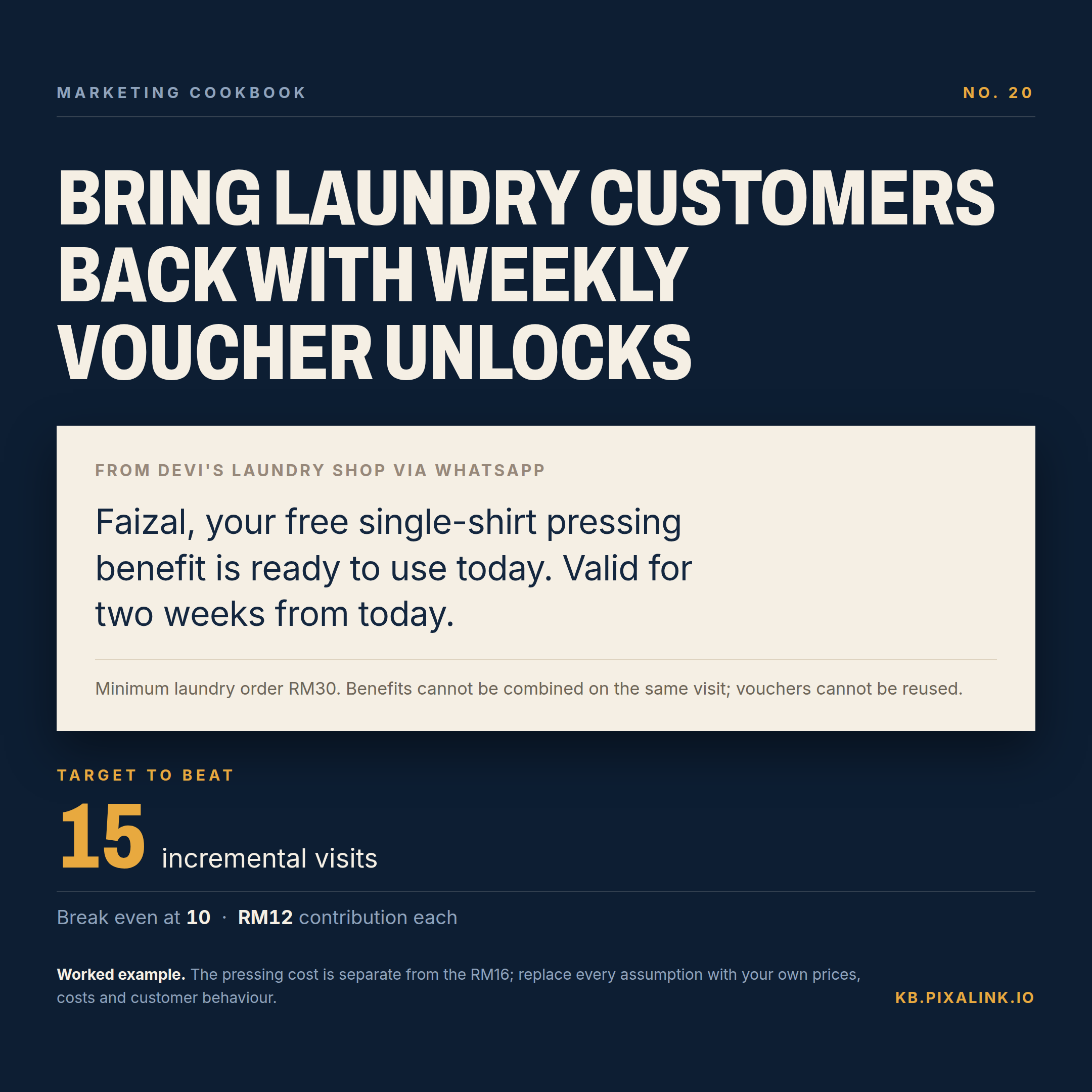
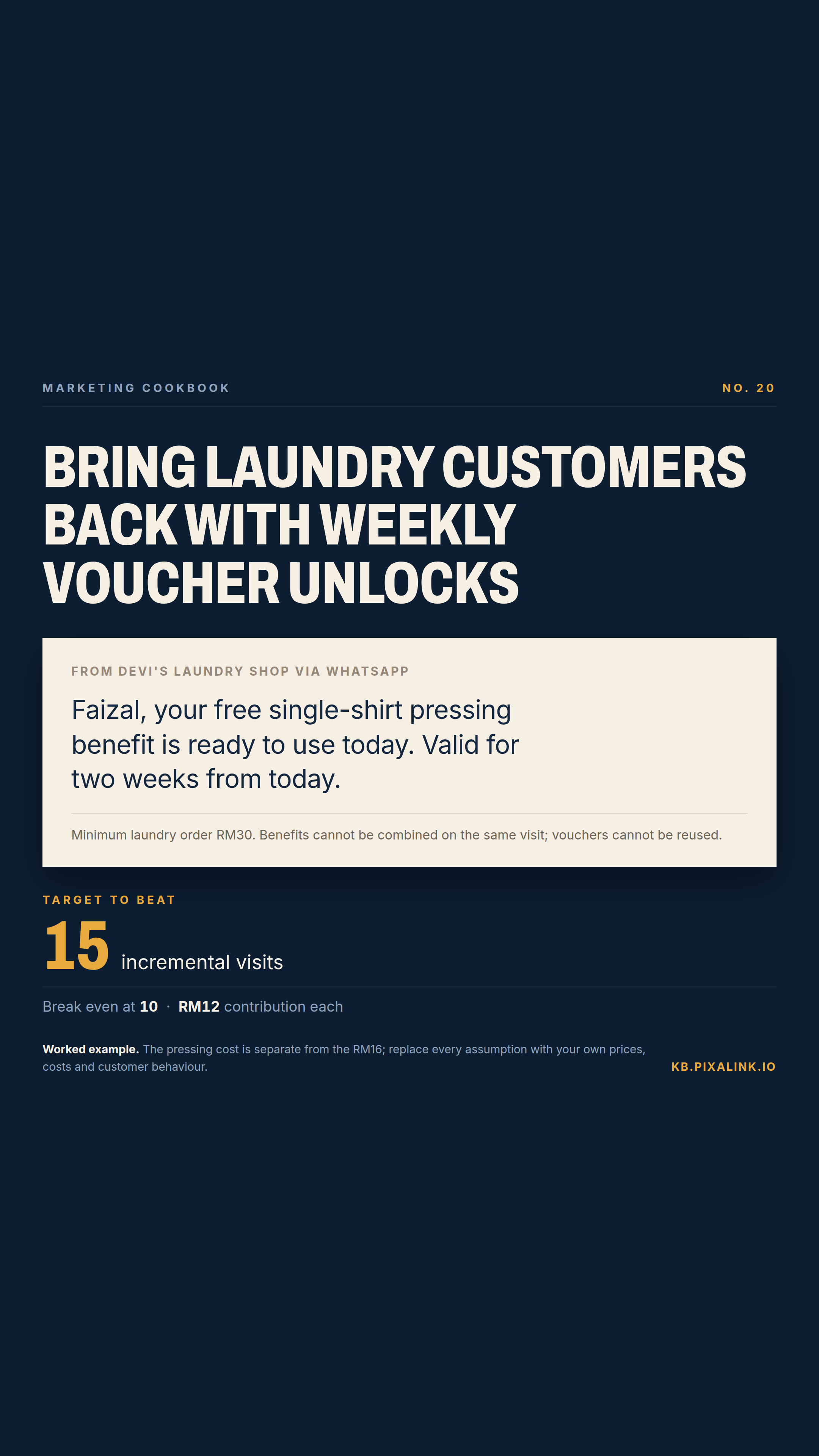
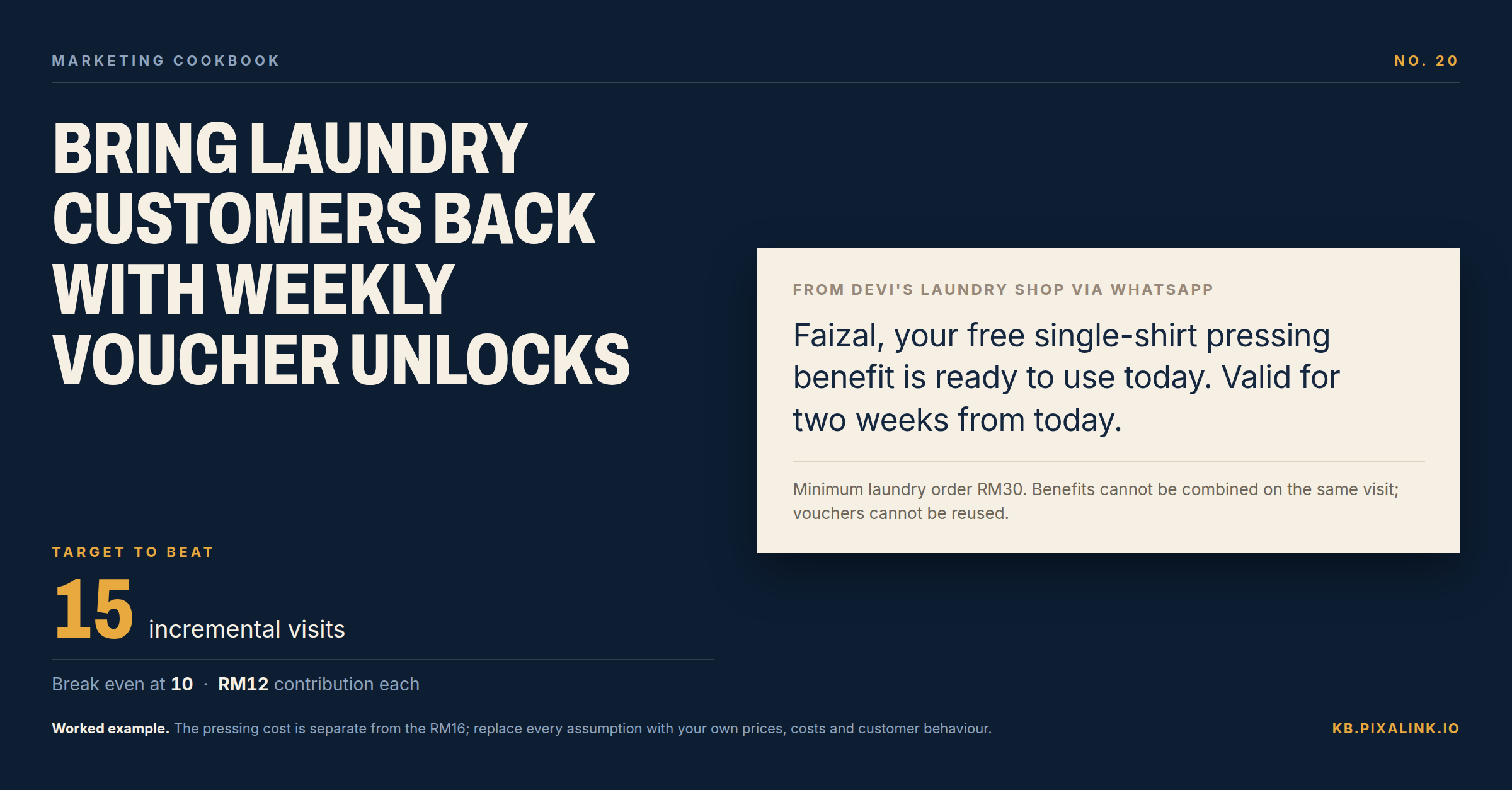
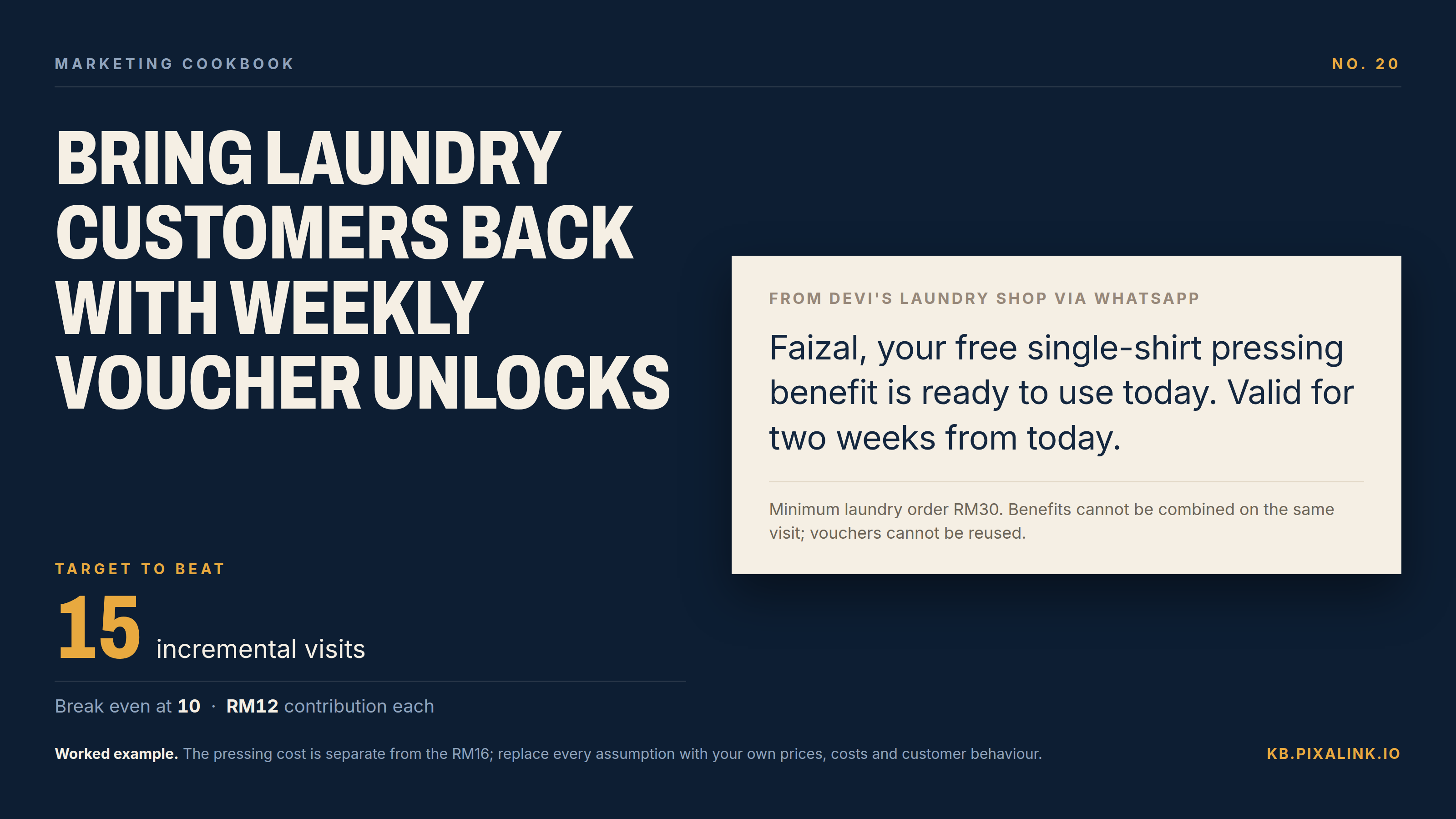
The same card at four sizes. Every figure on it comes from this article, and the message is the one written above — nothing on the card is generated.
Alt text for your post
Bring Laundry Customers Back with Weekly Voucher Unlocks. Four free shirt-pressing benefits unlock immediately, then after 7, 14 and 21 days. Each costs RM2 and requires a staff-checked RM30 order, with two weeks to use it. The pressing cost is separate from the RM16; replace every assumption with your own prices, costs and customer behaviour.
Closing invitation
Try one small bundle test with a clear schedule and an equally valuable control offer. Let Devi and Faizal's fictional example prompt your own cost check, then keep only what adds measurable customer value.