
Urgency & Collections
Recover Forgotten Voucher Sales Before Expiry
For her next small test, Lily wants to give customers time to remember before writing off the offer: were those people uninterested, or did they simply forget?

A worked example
- RM30
- Contribution per incremental action
- 4
- Break-even actions
- 6
- Minimum target
Formula: cash collected - variable fulfilment cost - reward cost
incremental orders. Formula: campaign operating cost / contribution per incremental action
incremental orders, rounded up
At a glance
The business problem
An unused voucher does not tell Lily why a customer stayed away. The offer may be unsuitable, but it may also have disappeared beneath everyday errands.
Her first-week redemption rate was 30%, leaving 70% unused. Those remaining vouchers represent a question to test, not 210 guaranteed sales; money spent preparing the original promotion is already gone, while fulfilment costs still arise when someone buys.
Why the usual promotion falls short
Sending the offer once assumes customers remember its deadline. Replacing it with a richer discount spends more before Lily knows whether the original value was enough.
A second redemption peak appears just before expiry, driven by anticipated regret — Inman & McAlister (1994). Modelled in one product category, so treat the shape as the finding, not the exact size. For Lily, that suggests testing a reminder about something Arif already holds, without increasing its value.
What you set up in Pixalink
Opening scenario
Lily looks at the quiet counter of her florist in Puchong and wonders whether her Mother's Day vouchers were worth the effort. She issued 300; ninety were used in the first week, while the other 210 expired silently. Arif still had one in his portal, but remembered it only the day after it expired.
Lily and Arif are fictional, and all figures in this article are illustrative. For her next small test, Lily wants to give customers time to remember before writing off the offer: were those people uninterested, or did they simply forget?
The recipe
The campaign recipe
Start with one reward type whose full outstanding stock is small enough to honour. These are planning assumptions for Lily's next batch, not changes to the expired Mother's Day vouchers.
| Recipe element | Recommended starting point |
|---|---|
| Suitable industries | Florists and small retailers already issuing vouchers |
| Primary goal | Recover forgotten purchases before vouchers expire |
| Customer segment | Holders of unredeemed vouchers of one reward type |
| Offer | Existing RM10 off a flower order; no additional discount |
| Validity | 14-day voucher ending on the 30th; reminder 7 days before expiry, on the 23rd |
| Minimum spend | Existing RM80 basket requirement, checked by Lily at checkout |
| Quantity or budget limit | One batch of 30 vouchers; Lily limits issuance manually and reserves RM300 maximum discount exposure plus RM120 reminder operating budget |
| Main success metric | Final-week redemptions, assessed against a comparable no-reminder baseline |
At an RM80 basket, Arif pays RM70 after the existing RM10 discount. The reminder adds RM0 reward value; Lily still budgets for sending and staff time.
The message your customer receives
This message is fictional, like the merchant and customer. All figures are illustrative.
From Lily's florist via WhatsApp
Arif, a reminder that your RM10 voucher for a flower order expires on the 30th. Use it before it expires.
Minimum spend RM80 before the discount.
The journey
Follow the customer
- Remember the date. Seven days before expiry, Arif receives a short reminder that his voucher runs out on the 30th. He has time to plan an order.
- Recognise the existing value. There is no new offer or extra discount. Arif still holds the same RM10 voucher with its original terms.
- Decide whether to use it. Letting it expire may now feel like losing something he owns. That feeling can prompt a decision, although a customer without a suitable purchase may still decline.
- Order before expiry. Arif orders on the 28th and uses the voucher. Lily fulfils the order and records the sale; his next purchase returns to her usual terms.
Use case: how the merchant applies it
Lily tries this on a later batch of 30 vouchers, each valid for 14 days and ending on the 30th. She retains the RM10 benefit and RM80 minimum basket, and enables the seven-day reminder before the 23rd.
Arif's RM80 flower order therefore brings in RM70. Lily plans capacity for every outstanding voucher, with up to RM300 in discounts if all 30 are used, and does not issue more under this test.
She compares the final week with a similar earlier batch that received no reminder. This is a practical baseline, but differences in gifting occasions can affect the comparison; it is not a randomised experiment.
How the platform helps
How Pixalink supports the strategy
Pixalink supports the reminder setting on each reward, with lead times of 10, 7, 5, 3, 2 or 1 days. It selects holders of unredeemed vouchers expiring on exactly the relevant day, so Lily does not need a separate campaign or audience list.
The setting also applies to vouchers of that type already in circulation, including older ones when they meet that expiry condition. It does not mean Lily can choose just 30 recipients within a larger outstanding pool; she bounds the test by choosing a reward type with limited exposure.
Lily handles the minimum-spend check, test budget and message calendar herself. The verified reminder behaviour does not provide an automatic cap for this test or prevent overlap with other messages that week.
Configure this in Pixalink
Use What Voucher Expiry Dates Mean in Pixalink to understand the voucher deadline before choosing the reminder lead time. This guide explains expiry; it is not a dedicated reminder setup walkthrough.
The economics
ROI taste test
For Arif's illustrative order, cash collected is RM70 after the discount, variable fulfilment cost is RM40, and additional reward cost is RM0. The RM10 discount is already reflected in cash collected, so do not subtract it twice.
- Contribution per incremental action = RM70 - RM40 - RM0 = RM30. Formula: cash collected - variable fulfilment cost - reward cost.
- Break-even actions = RM120 / RM30 = 4 incremental orders. Formula: campaign operating cost / contribution per incremental action.
- Minimum target = 4 × 1.5 = 6 incremental orders, rounded up.
The RM120 covers the reminder test's sending and staff costs. Assessing the original promotion's total profitability would also require its original costs.
Count additional orders above the baseline, not all redemptions. If Lily expects 3 final-week orders without reminders and observes 9, the estimated 6 extra orders contribute RM180, leaving RM60 after test operating costs; this does not prove causation or guarantee results. Replace every assumption with your own costs and buying patterns.
Measure it
What to watch
- Final-week redemption rate: redeemed vouchers divided by those still unused when the reminder becomes due.
- Estimated incremental orders: final-week orders above the comparable baseline; Lily's minimum target is 6.
- Net incremental contribution: contribution from those extra orders minus reminder operating costs.
Common mistake: treating every late redemption as a sale caused by the reminder. Arif might have ordered anyway, which is why Lily needs the baseline.
Safeguard: Lily checks the message calendar and avoids stacking another promotional message onto these customers in the same week. This is her operational responsibility.
Keep when at least 6 estimated incremental orders arrive and the safeguard holds. Improve a promising result by changing only the lead time in a fresh bounded test after a successful initial test. Stop if contribution is non-positive, the safeguard fails, or the test misses its pre-set minimum target.
Your first test
Try this first
- Choose one reward type and record a comparable no-reminder baseline.
- Check all outstanding vouchers; limit the test to 30 through manual issuance planning.
- Keep the RM10 offer unchanged and measure the final seven days before expiry.
- Record cash, fulfilment and sending costs, and check the no-overlap safeguard.
- Compare against 6 incremental orders, then apply the keep, improve or stop rule.
Questions
Frequently asked questions
Do I need a bigger discount?
No additional discount is part of this recipe. First test whether remembering the existing benefit is enough.
Will it include vouchers issued earlier?
Yes, still-unredeemed vouchers of the chosen type can qualify when their expiry matches the configured lead day. It does not revive Lily's already-expired Mother's Day vouchers.
Can I limit reminders to a few holders?
Do not assume a recipient cap from this reward setting. Choose a reward type whose entire outstanding exposure you can afford and fulfil.
Is the reminder free?
It adds no reward value, but sending and staff time may still cost money. Lily's RM120 is a planning allowance, not a Pixalink price quote.
Share this recipe
A card you can post
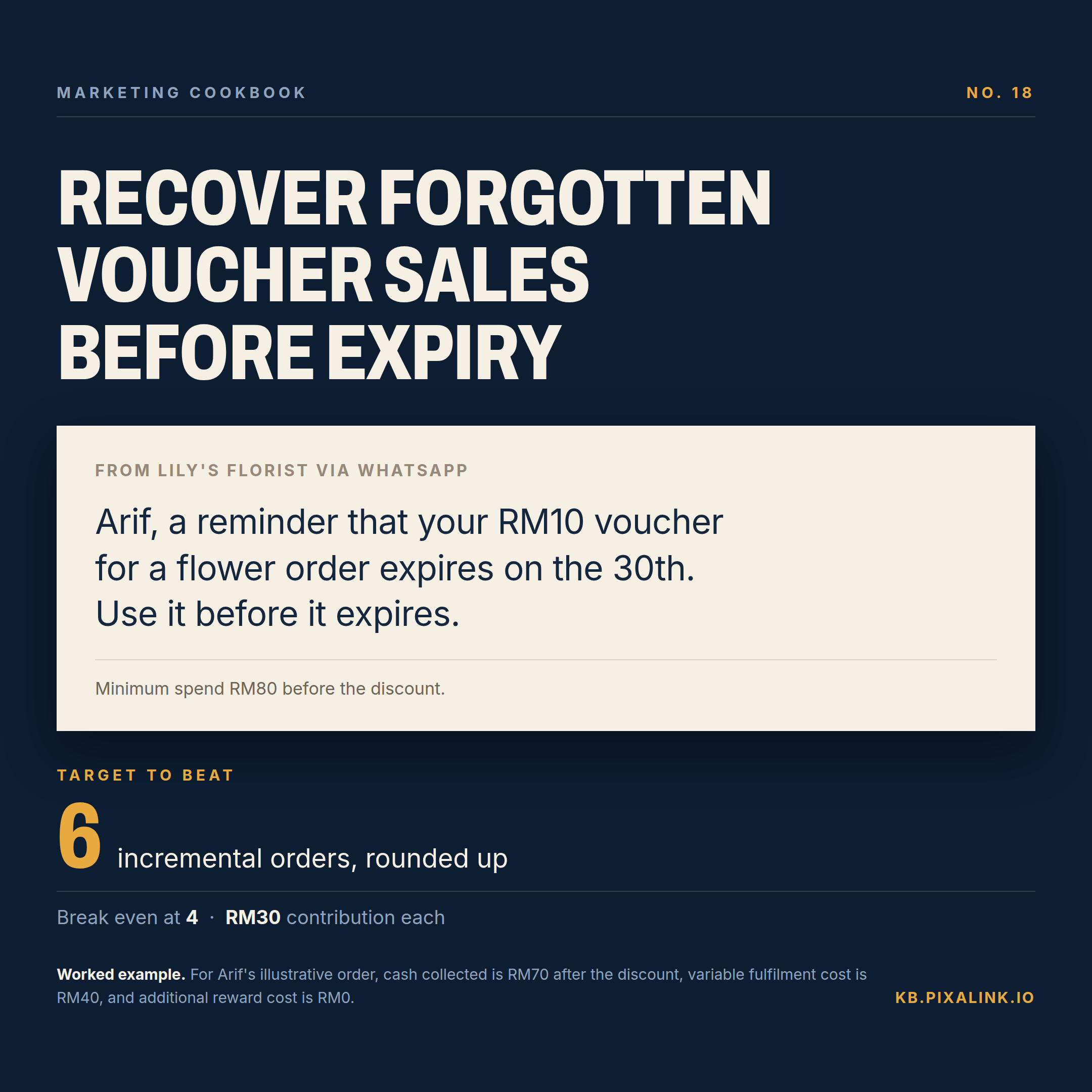
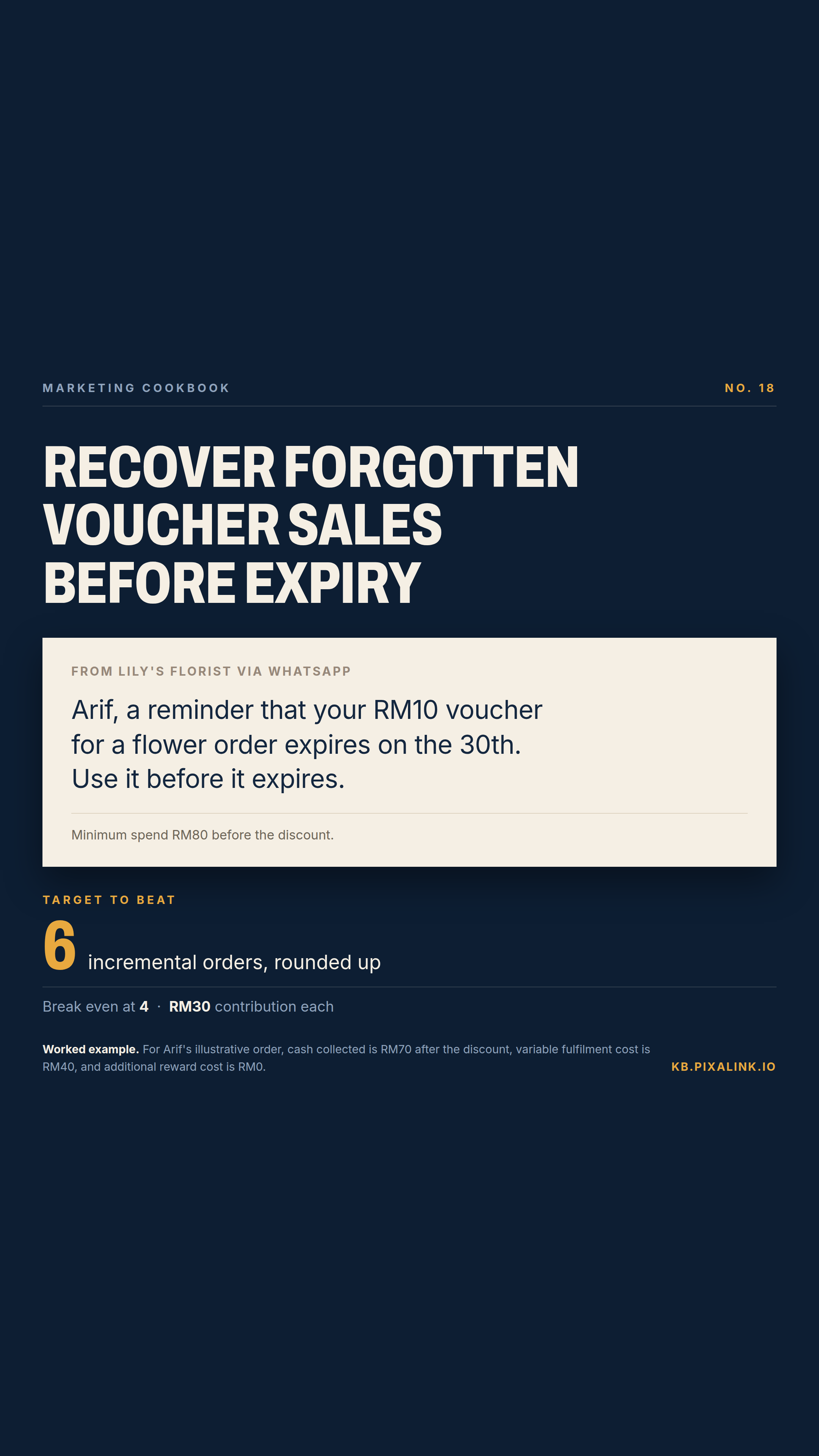
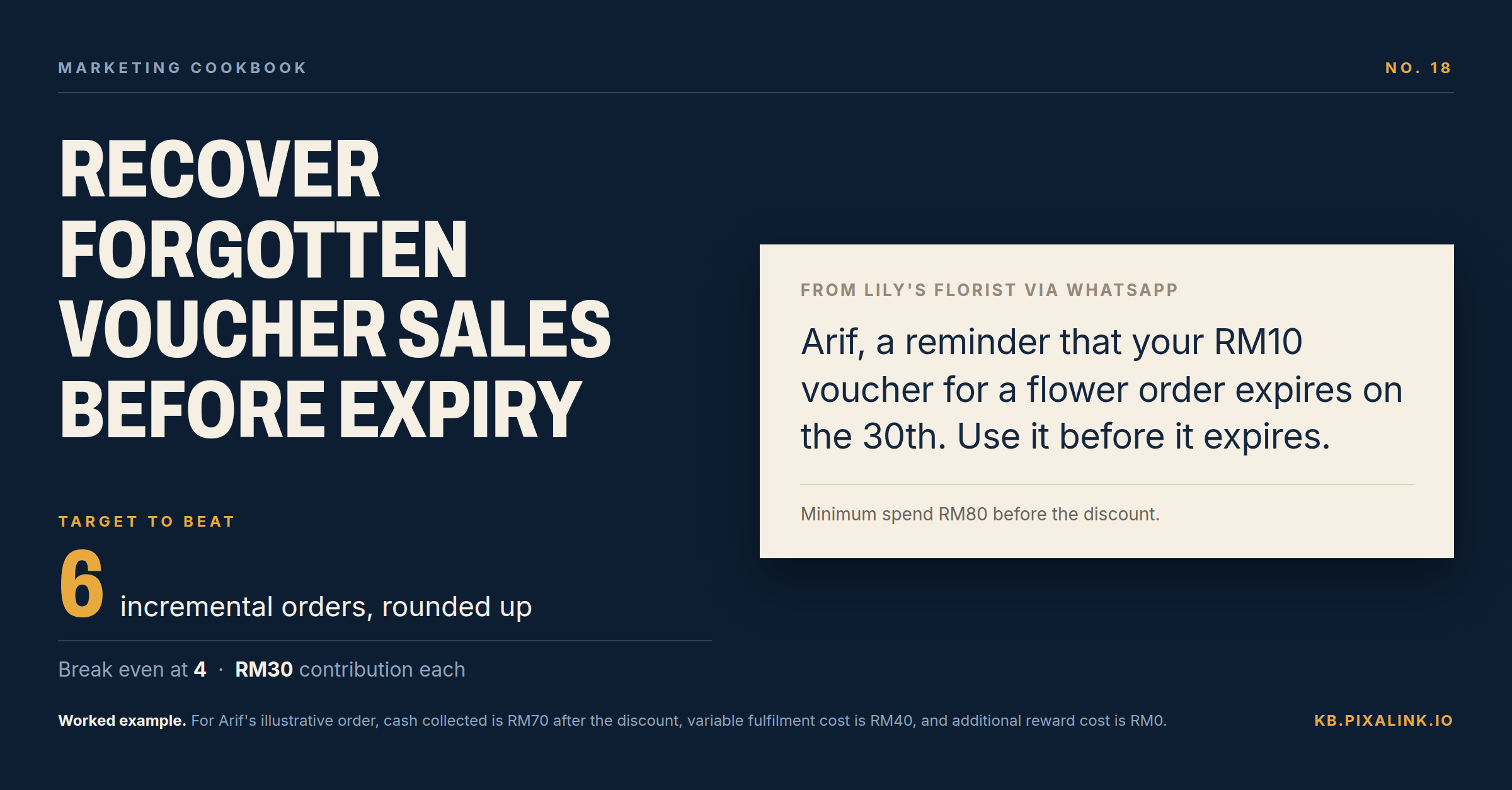
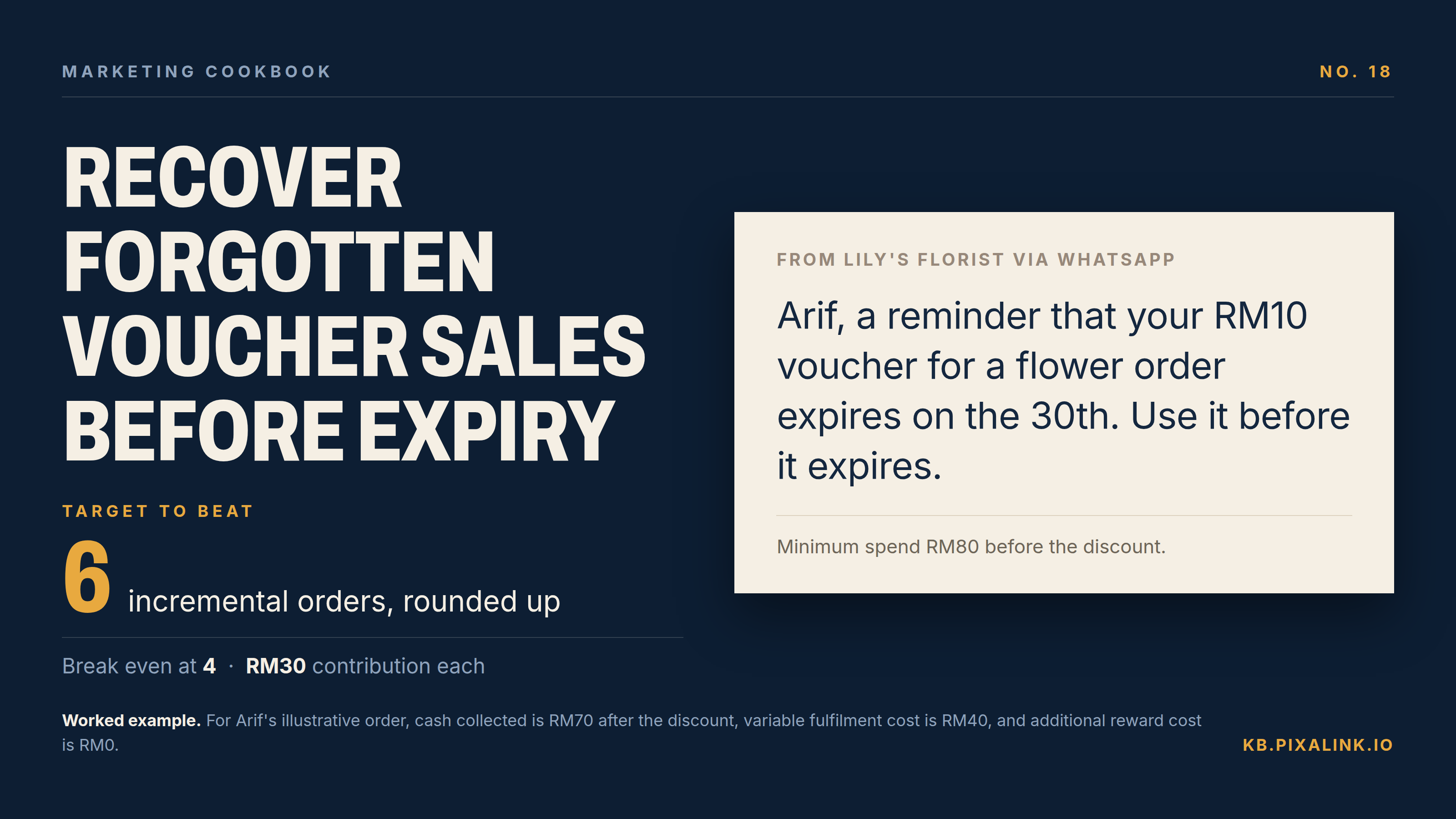
The same card at four sizes. Every figure on it comes from this article, and the message is the one written above — nothing on the card is generated.
Alt text for your post
Recover Forgotten Voucher Sales Before Expiry. An existing RM10 voucher on an RM80 basket stays unchanged: a reminder on the 23rd gives time to order before expiry on the 30th. The customer pays RM70; no extra reward is added. For Arif's illustrative order, cash collected is RM70 after the discount, variable fulfilment cost is RM40, and additional reward cost is RM0.
Closing invitation
If you already issue vouchers, this is a small test you can prepare today. Like Lily, choose one manageable reward type, give customers time to remember, and measure whether the extra orders pay their way.