
Urgency & Collections
Help Regulars Discover More of Your Shop
How can she make the other aisles worth exploring without paying customers to buy what they already wanted?
A worked example
- RM8
- Contribution per incremental action
- 30
- Break-even actions
- 45
- Minimum target
This is cash collected minus variable fulfilment cost minus reward cost
incremental paid visits. Divide campaign operating cost by contribution per incremental action
incremental paid visits, rounded up
At a glance
The business problem
Murni’s regulars may buy everyday food elsewhere. Check whether sales spread beyond supplements.
This tests discovery and margin mix, not retention. Cross-buying follows loyalty rather than causing it — Reinartz, Thomas & Bascoul (2008). Broader baskets do not prove the campaign created loyalty.
Why the usual promotion falls short
Discounting Kelvin’s planned RM100 purchase by RM5 costs RM5. It gives him no reason to try pantry food.
One familiar purchase starts the collection; two different categories finish it. One worthwhile benefit rewards completion.
What you set up in Pixalink
Opening scenario
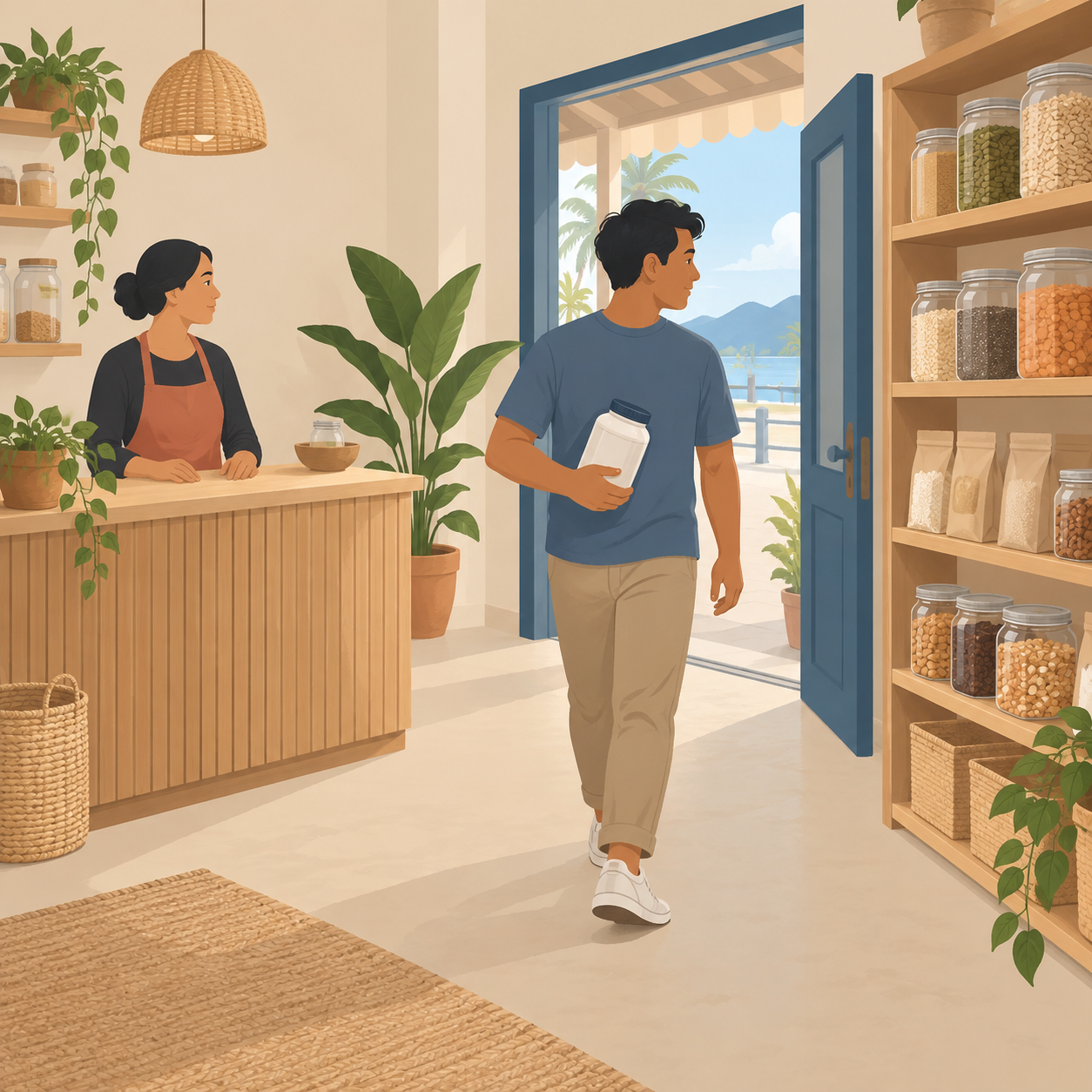
Kelvin heads straight for the supplement shelf in Murni’s health food store in Kota Kinabalu. He has spent RM2,000 there over two years, yet leaves without looking at the pantry range. Murni stocks six categories, but most regulars behave as though she stocks only one.
Murni, Kelvin and the business are fictional; all figures in this article are illustrative. Her usual response is another offer on familiar products, which gives Kelvin little reason to change his route through the shop. How can she make the other aisles worth exploring without paying customers to buy what they already wanted?
The recipe
The campaign recipe
These are test assumptions. Murni checks qualifying purchases and exposure limits herself.
| Recipe element | Recommended starting point |
|---|---|
| Suitable industries | Health food shops and retailers with distinct, complementary ranges |
| Primary goal | Range discovery and a more useful margin mix |
| Customer segment | Regulars whose recent purchases come from one category |
| Offer | Collect three stamps from supplements, pantry foods and snacks; unlock one discovery pack worth RM25, costing Murni RM12 |
| Validity | Shared 45-day collection window; claim and redeem by the same closing date |
| Minimum spend | RM30 in the qualifying category per visit; no extra purchase to redeem the pack |
| Quantity or budget limit | 40 invited customers, one pack each; reserve 40 packs and RM480 reward cost, controlled by staff |
| Main success metric | Incremental paid visits versus a comparable group without the offer |
The first and second stamps carry no separate gift: RM0 reward cost at those steps. A purchase in the remaining category unlocks the pack after the third stamp; staff allow one stamp per visit and each category once.
The message your customer receives
This message is fictional, like the merchant and customer. All figures are illustrative.
From Murni’s health food store via WhatsApp
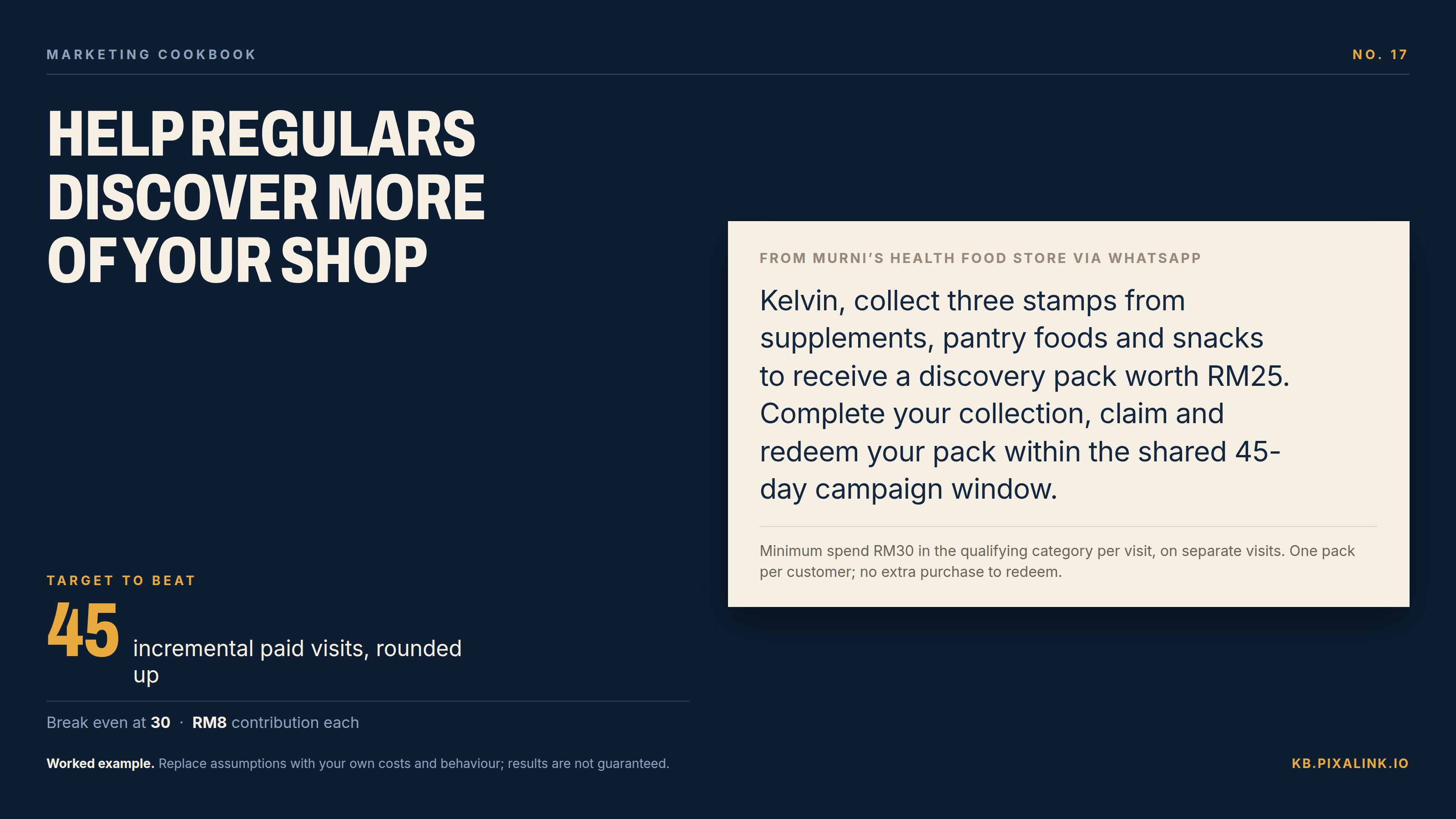
Kelvin, collect three stamps from supplements, pantry foods and snacks to receive a discovery pack worth RM25. Complete your collection, claim and redeem your pack within the shared 45-day campaign window.
Minimum spend RM30 in the qualifying category per visit, on separate visits. One pack per customer; no extra purchase to redeem.
The journey
Follow the customer
- Kelvin sees the destination. Murni shows him the card: buy from three different categories and unlock the discovery pack. She explains the shared deadline before he starts.
- His usual purchase starts progress. Today’s RM100 supplement purchase fills the first slot after staff check it. His earlier RM2,000 spending does not count retrospectively.
- The empty slots point somewhere new. Kelvin returns for RM50 of pantry foods. Staff check the new category and record his second stamp, leaving snacks to explore.
- He completes and claims. A later RM50 snack purchase completes the card, and he redeems the pack before closing. Kelvin now knows more of Murni’s range; his next purchase can be an ordinary choice without another incentive.
Use case: how the merchant applies it
Murni invites 40 regulars, retaining a comparable group without the offer. She reserves packs and explains which products belong to each category.
Kelvin’s RM100, RM50 and RM50 purchases qualify on separate visits within 45 days. No further spend is needed, but completion, claim and redemption share the closing date.
Staff record each customer’s categories and enforce one pack per person. After redemption, Murni observes shopping without another collection.
How the platform helps
How Pixalink supports the strategy
Pixalink enforces stamp progress, the completion reward, campaign window and expiry. Murni’s team enforces what counts as a qualifying action, including different categories, RM30 spend, separate visits and invitation limits.
Automatic category validation is not supported for this recipe. Staff check purchases before recording progress. The 40-person cap and stock reservation need staff control.
Configure this in Pixalink
Use How to Set Up a Stamp Card Campaign for the underlying card. Check What Voucher Expiry Dates Mean in Pixalink so the reward deadline matches the offer communicated to Kelvin.
The economics
ROI taste test
An incremental action is an extra paid visit. Assume RM50 cash, RM30 variable fulfilment cost and conservatively RM12 reward cost per extra visit, although each completed collection gives only one pack.
Campaign operating cost is RM240: RM120 staff preparation plus RM120 for ten packs earned on baseline visits. That reserve is within the RM480 reward budget.
- Contribution per incremental action = RM50 - RM30 - RM12 = RM8. This is cash collected minus variable fulfilment cost minus reward cost.
- Break-even actions = RM240 / RM8 = 30 incremental paid visits. Divide campaign operating cost by contribution per incremental action.
- Minimum target = 30 × 1.5 = 45 incremental paid visits, rounded up.
Exclude Kelvin’s usual visit from uplift. Compare paid visits with the other group and reconcile all actual reward costs, increasing the baseline-reward reserve if needed. Replace assumptions with your own costs and behaviour; results are not guaranteed.
Measure it
What to watch
- Incremental paid visits: extra visits above the comparison group, targeting at least 45.
- New-category buying rate: invited single-category regulars who buy from a previously unbought category, compared with the other group.
- Net incremental contribution: extra sales less fulfilment, all actual reward costs and staff costs, without double-counting reserves.
Common mistake: counting three repeat supplement purchases as category discovery. Murni would reward the habit she wanted Kelvin to broaden.
Safeguard: maintain one receipt-and-reward register covering category checks, returns and reserved packs. Staff review returns before fulfilment; automatic stamp reversal is not supported by the verified recipe, so resolve exceptions manually before proceeding.
Keep when at least 45 incremental visits, positive contribution and the safeguard hold. Improve a promising interim signal with one bounded change in a fresh test. Stop if contribution is non-positive, the safeguard fails, or the final test misses its threshold.
Your first test
Try this first
- Select single-category regulars and record baseline visits alongside a comparable group without the offer.
- Cap invitations at 40 and reserve 40 packs within RM480 reward cost.
- Fix the three-category offer and shared 45-day measurement window before starting.
- Record cash, fulfilment, rewards and staff costs; check the receipt-and-reward register.
- Apply the pre-set keep, improve or stop rule before expanding the campaign.
Questions
Frequently asked questions
Can customers buy all three categories together?
Not in this test, which requires separate visits. Staff enforce that rule; a broader-basket test would need different measurement.
Does every category have to be visited in the same order?
No; Kelvin’s route is an example. Each category counts once, and staff check which remains.
What if someone finishes near the deadline?
The same closing date applies to claim and redemption. Explain this upfront and avoid promising extra days that the configured expiry does not provide.
What happens when all packs are reserved?
Murni stops new invitations while keeping existing promises funded. Pixalink’s stamp count does not replace her stock and invitation register.
Share this recipe
A card you can post
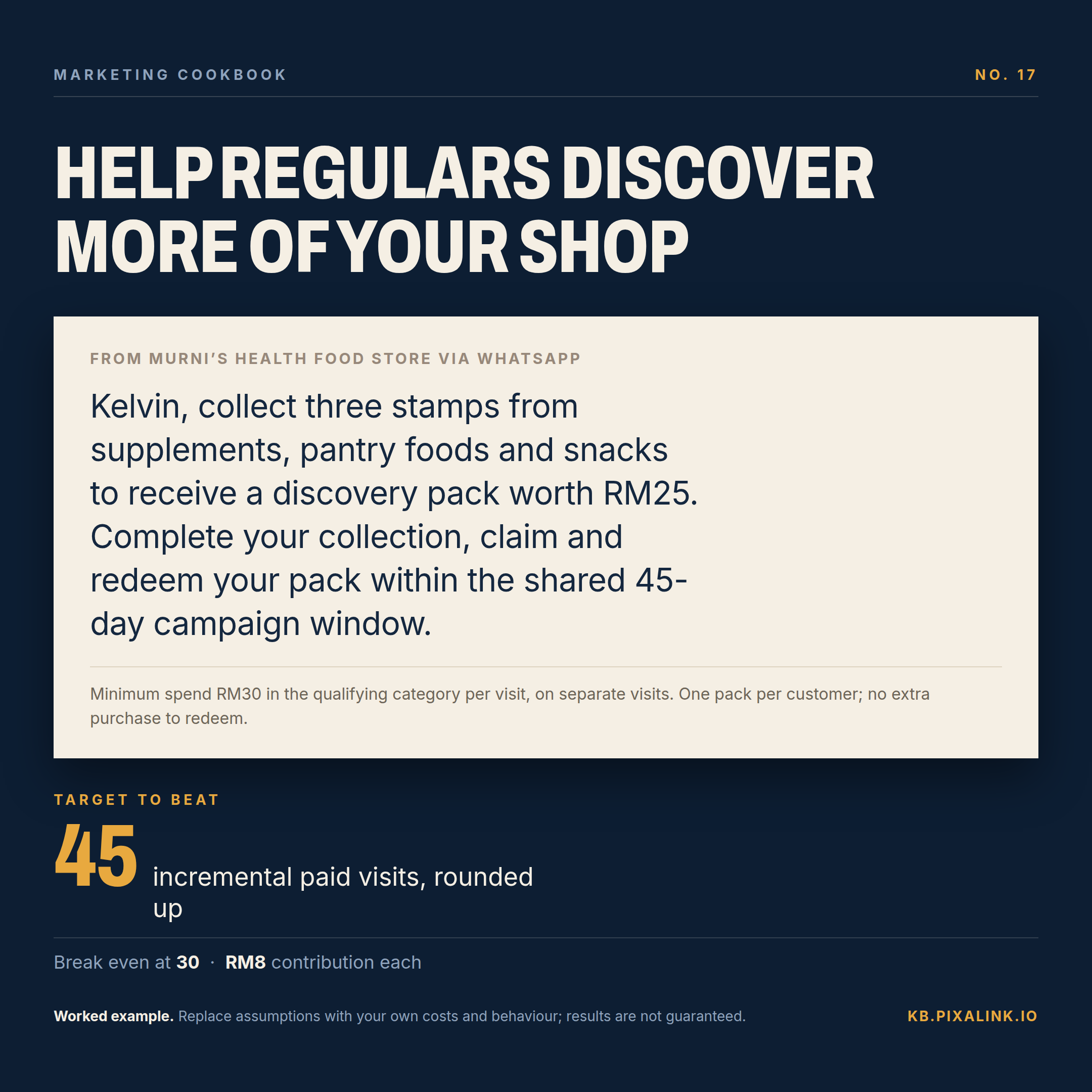
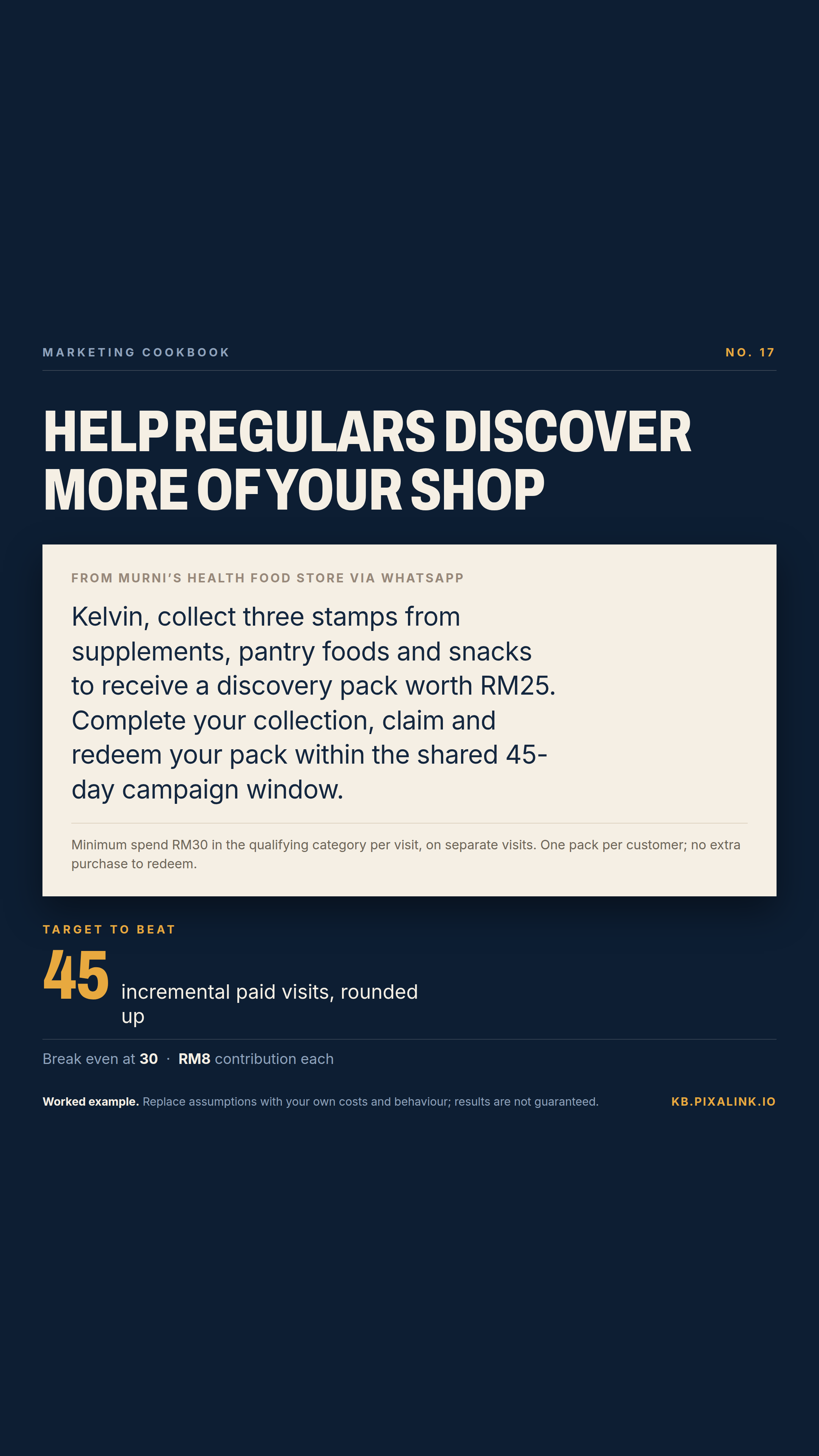
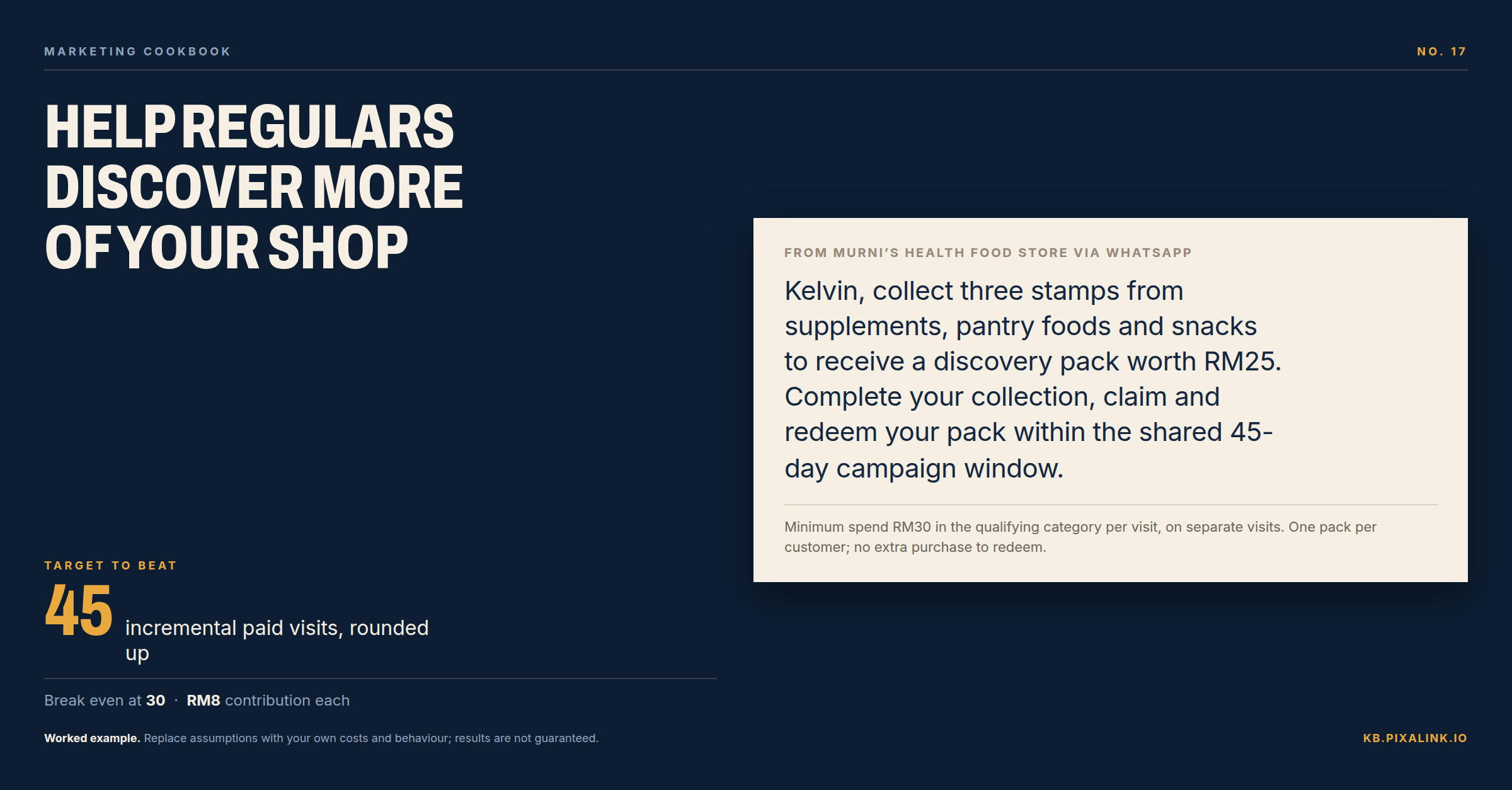
The same card at four sizes. Every figure on it comes from this article, and the message is the one written above — nothing on the card is generated.
Alt text for your post
Help Regulars Discover More of Your Shop. Buy from supplements, pantry foods and snacks on separate visits, spending RM30 per category. Three stamps unlock a discovery pack worth RM25, costing the merchant RM12, within 45 days. Replace assumptions with your own costs and behaviour; results are not guaranteed.
Closing invitation
Choose one range-discovery offer that customers can finish without buying unwanted products. Run Murni’s small test, then let incremental visits and actual contribution decide whether it deserves another round.