
Urgency & Collections
Give Loyal Sneaker Buyers First Access Without a Discount
What if loyalty bought Tan time instead?
A worked example
- RM60
- Contribution per incremental action
- 2
- Break-even actions
- 3
- Minimum target
additional purchases
additional purchases, rounded up
At a glance
The business problem
A release can sell out while the loyalty programme feels empty. Tan’s monthly purchases earn status, yet that status changes nothing when the product he wants arrives.
Zul’s leak is the missed chance to make continued loyalty worthwhile. Giving RM30 off an illustrative 20-pair run would cost RM600 in revenue without giving Tan a better chance of buying.
Why the usual promotion falls short
A public discount rewards speed with a cheaper price. It still leaves Tan competing with everyone else, while Zul gives away margin on stock that may sell anyway.
Early access changes the order of availability. Its value depends on the head start remaining exclusive to the tier or tag that earned it.
What you set up in Pixalink
Opening scenario
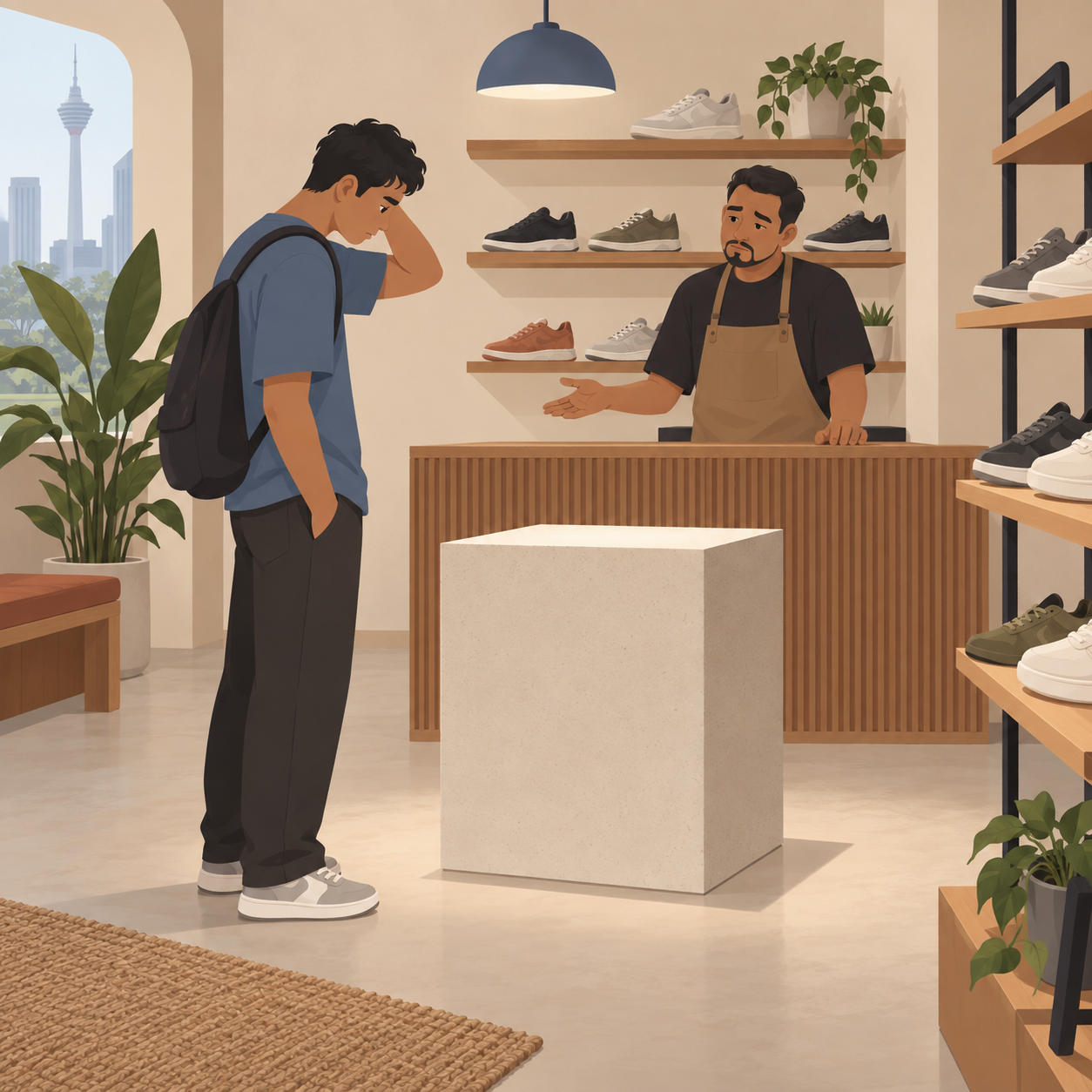
Tan pauses at the empty display in Zul’s Kuala Lumpur sneaker boutique. He buys from Zul monthly, but another sought-after release has gone before he could get a pair. Zul’s small allocations go first-come-first-served, rewarding whoever happens to be online rather than customers who spend with him all year.
Zul, Tan and the boutique are fictional; all figures in this article are illustrative. Preparing each release already takes staff time, and Zul cannot increase his allocation just because a regular misses out. He wants Tan to feel recognised without reducing a price customers already pay. What if loyalty bought Tan time instead?
The recipe
The campaign recipe
Give one existing tier a private buying window at the ordinary price. These starting assumptions combine earned status with a real quantity cap, the ideas behind lessons 10 and 16.
| Recipe element | Recommended starting point |
|---|---|
| Suitable industries | Sneaker boutiques and small retailers with limited new collections |
| Primary goal | Make earned status valuable enough to encourage continued purchasing |
| Customer segment | Existing Gold-tier members such as Tan; a named earned tag is an alternative |
| Offer | First access to a RM450 pair, with no discount; RM0 reward cost |
| Validity | Opens 3 days before public release; priority ends at public opening; staff confirm payment and collection within that window |
| Minimum spend | RM450 for the pair, no additional basket requirement; staff handle payment |
| Quantity or budget limit | One 20-pair allocation; maximum 20 access claims; RM120 operating budget; staff match claims to physical sizes |
| Main success metric | Share of the 20-pair run purchased by eligible members during early access |
Ordinary fulfilment costs RM330 per pair; this is stock and selling cost, not a free gift. Any unallocated pairs reach the public at the same RM450 price after the head start.
The message your customer receives
This message is fictional, like the merchant and customer. All figures are illustrative.
From Zul’s sneaker boutique via WhatsApp
Tan, you have first access to the new sneaker release at the usual price, starting 3 days before public release. Priority ends when public sales open.
Minimum spend RM450 for the pair, with no additional purchase required. Complete payment and collection within the early-access window.
The journey
Follow the customer
- See it first. Three days before public release, the pair appears in Tan’s portal. His existing Gold tier gives him access.
- Understand the benefit. It is not cheaper. Tan can claim access while the general public must still wait.
- Claim and buy. Tan claims access, then staff confirm his size and arrange payment and collection within the private window. His year of spending has finally changed his release-day experience.
- See a reason to stay. After collecting, Tan has a concrete reason to maintain his tier. Zul watches whether that becomes continued purchasing, rather than assuming gratitude guarantees another sale.
Use case: how the merchant applies it
Zul tests one release with his existing Gold members and 20 physical pairs. He opens access 3 days early at RM450, with no compulsory extras, and reserves RM120 for preparation and staff coordination.
Tan receives priority, not a free pair or a guarantee of his size. Staff confirm availability before he travels, complete payment and collection within the window, and reconcile allocations before Zul opens any remainder to the public.
After collection, Zul observes ordinary purchases for 30 days. He compares member participation with a similar public release and later buying with the same members’ normal behaviour, allowing for differences in product appeal.
How the platform helps
How Pixalink supports the strategy
Pixalink enforces the visibility start date, tier and tag restriction, and total availability. For this test, Zul uses Gold eligibility and caps access claims at 20; the cap is not evidence of physical stock by size.
Zul enforces the public opening promise across every selling channel. Automatic size reservation, payment collection, claim expiry and switching to public access are not supported by this recipe’s verified scope; staff manage those handoffs and state the terms clearly.
Configure this in Pixalink
Use What Are Rewards and How to Create Them for reward visibility and availability controls. Refer to How to Set Up Loyalty Tiers for the earned audience before launching.
The economics
ROI taste test
Zul expects the release to sell anyway, so its RM450 sales are not automatically incremental. For this test, count an incremental action as an additional ordinary purchase during the 30-day follow-up: RM150 cash collected, RM90 variable fulfilment cost and RM0 reward cost.
Contribution per incremental action = cash collected - variable fulfilment cost - reward cost. Contribution per incremental action = RM150 - RM90 - RM0 = RM60.
Break-even actions = campaign operating cost / contribution per incremental action. Break-even actions = RM120 / RM60 = 2 additional purchases.
Minimum target = break-even actions × 1.5, rounded up. Minimum target = 2 × 1.5 = 3 additional purchases, rounded up.
Three additional purchases contribute RM180, leaving RM60 after operating cost. Tan’s usual monthly purchase does not count as extra; exclude purchases merely brought forward and subtract lost contribution from displaced sales. Replace every assumption with your own prices, costs and baseline behaviour; this example does not guarantee a return.
Measure it
What to watch
- Member share of the run: eligible members’ paid early purchases divided by 20 pairs; target at least 50%.
- Incremental follow-up purchases: additional purchases above baseline during 30 days, against the target of 3.
- Net incremental contribution: additional contribution less RM120 operating cost and any displaced contribution.
Common mistake: calling every early claim an additional sale. Zul needs evidence that Tan’s later spending exceeds his usual pattern.
Safeguard: keep one staff allocation ledger covering eligibility, sizes, claims, payment and release timing. Reconcile daily and never quietly sell to the public during the promised private window.
Keep when the 3-purchase minimum, 50% member share, positive net contribution and safeguard hold. Improve a promising result through one bounded change in a fresh test; stop this version if it misses either threshold, contribution is non-positive or the safeguard fails.
Your first test
Try this first
- Define the existing Gold audience and record its normal purchasing and a comparable release baseline.
- Cap exposure at one 20-pair allocation and RM120 operating cost.
- Set one RM450 offer, the 3-day head start and a 30-day follow-up window.
- Record cash, variable costs and displaced sales alongside the daily allocation-ledger safeguard.
- Apply the preset keep/improve/stop rule before repeating; change only one assumption if retesting.
Questions
Frequently asked questions
Must the early price be lower?
No; Tan pays the normal RM450. The benefit is first access, with RM0 discount or gift cost.
Does a claim guarantee a particular size?
No automatic size reservation is supported here. Staff must confirm the physical pair and collection arrangement before Tan travels.
Can anyone join the early window?
Use the named tier or earned tag promised in the offer. Admitting everyone early removes the benefit Zul wanted his regulars to experience.
What happens to cancellations or unclaimed pairs?
Staff reconcile them before public opening. Do not assume a cancellation automatically restores claim availability or that the public switch happens automatically.
Share this recipe
A card you can post
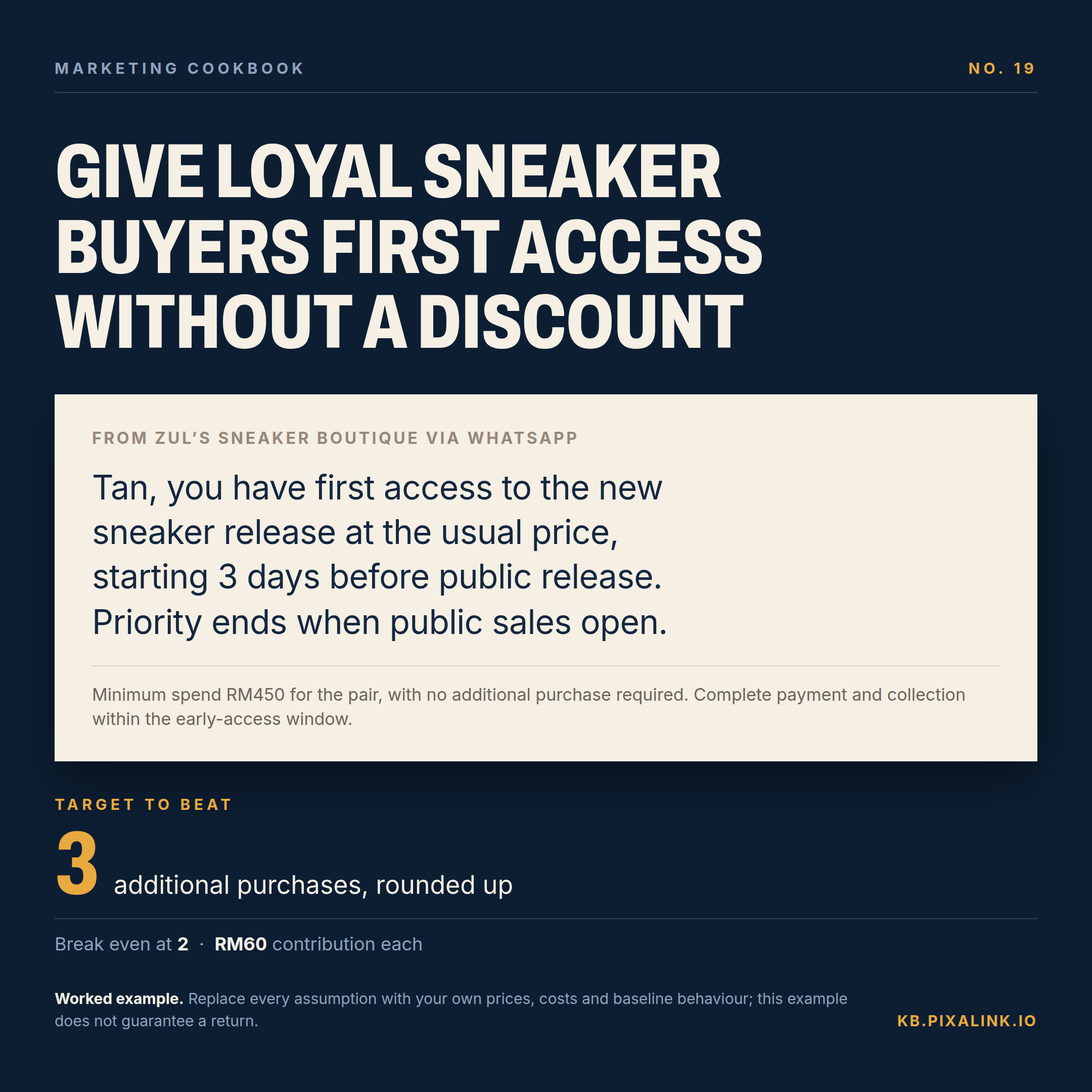
The same card at four sizes. Every figure on it comes from this article, and the message is the one written above — nothing on the card is generated.
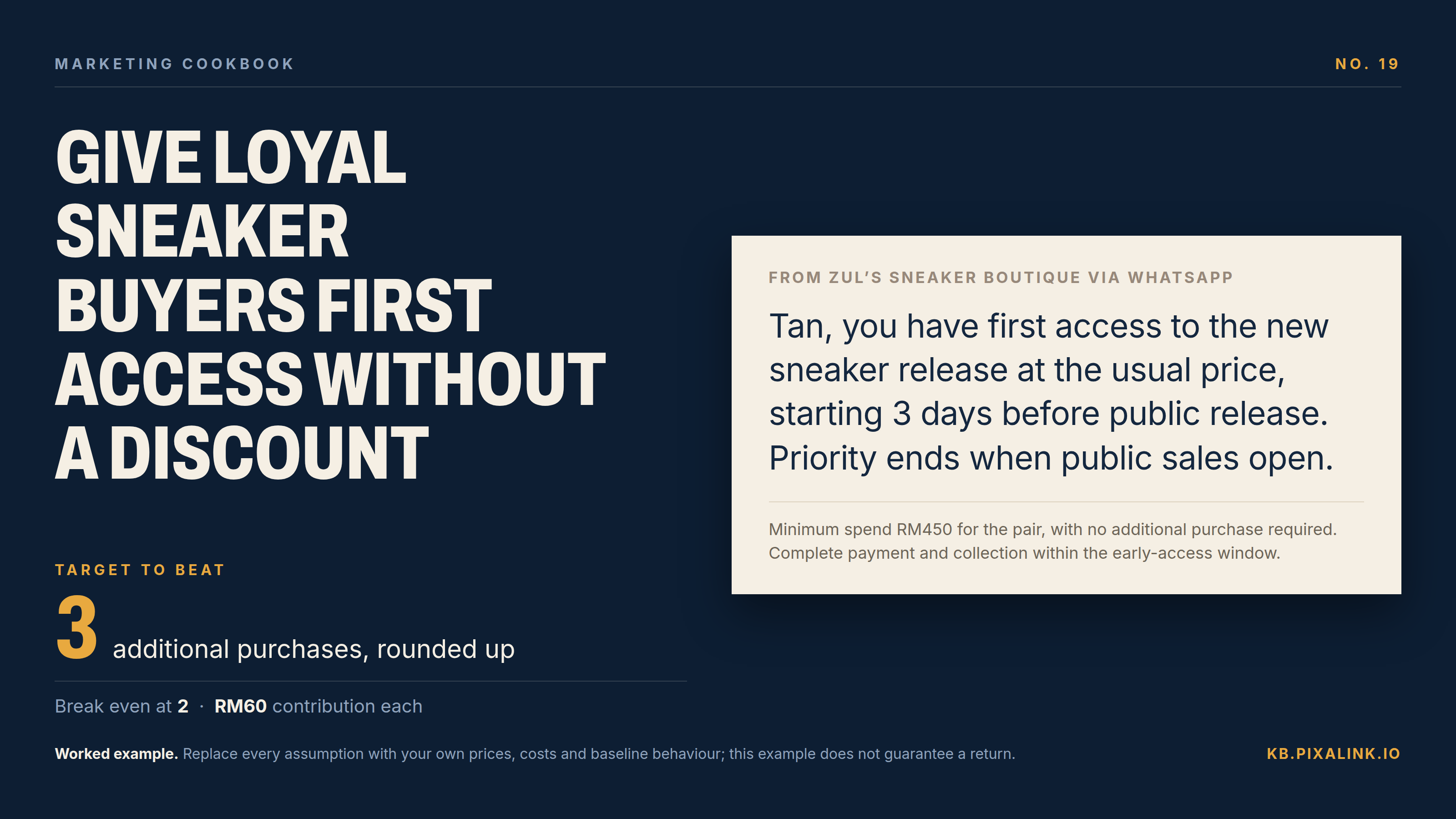
Alt text for your post
Give Loyal Sneaker Buyers First Access Without a Discount. Gold members receive 3 days of early access to a 20-pair allocation at RM450 per pair. Fulfilment costs RM330 per pair and reward cost is RM0. The public can buy any unallocated pairs afterwards at the same price. Replace every assumption with your own prices, costs and baseline behaviour; this example does not guarantee a return.
Closing invitation
Choose one release where earned priority would matter to customers like Tan. Run Zul’s small test, honour the head start and measure whether members create additional value afterwards.