
Win Back & Recovery
Win Back Quiet Customers Without Giving Everyone RM12 Off
Roslan needs a gentler first approach and a reliable purchase record: how can he match the offer to the silence without rewarding people who already came back?
A worked example
- RM12
- Contribution per incremental action
- 10
- Break-even actions
- 15
- Minimum target
incremental return visits
incremental return visits
At a glance
The business problem
The leak is paying the same incentive for different situations. A recent diner with an unrecorded purchase, a busy regular and someone absent for months should not all cost Roslan RM12 to contact.
Ten unnecessary discounts cost RM120 before messaging or staff time. Roslan needs incremental return visits with contribution left over, rather than a busy redemption counter alone.
Why the usual promotion falls short
A blanket voucher spends the strongest incentive before testing whether a menu reminder would work. A modest service or add-on choice gives someone a reason to return without immediately cutting the bill.
The supplied research note supports testing that order: “Offer type changes who you get back and what they are worth: a discount-plus-service bundle reacquires the most customers but they churn soonest and spend least, while a service-led offer reacquires fewest and yields the longest, highest-spending second lifetime — Kumar, Bhagwat & Zhang (2015). Reacquisition pricing, in their newspaper setting — Thomas, Blattberg & Fox (2004).” These findings are a reason to test locally, not a forecast for Roslan’s restaurant.
What you set up in Pixalink
Opening scenario
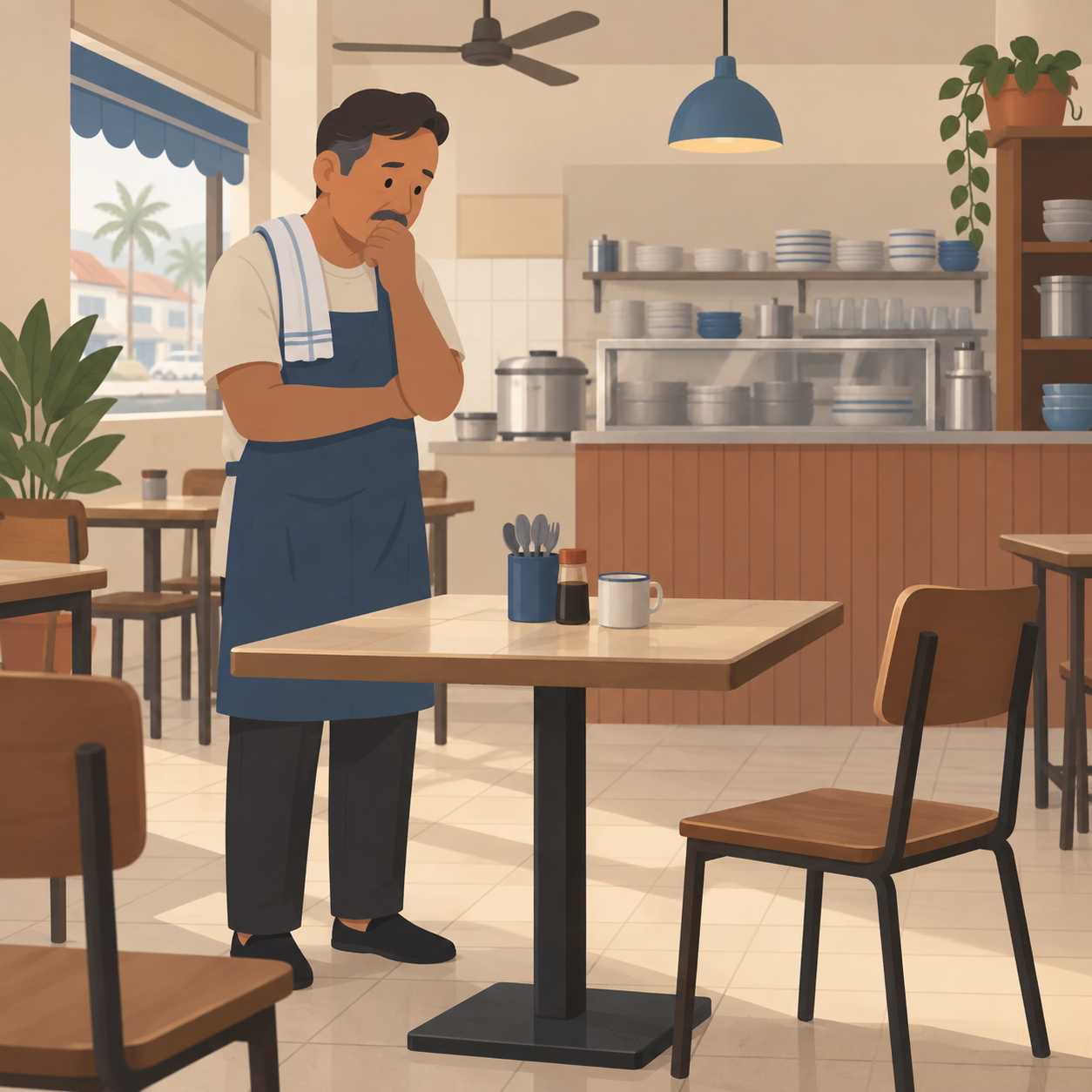
Roslan straightens the empty tables in his casual restaurant in Klang and wonders where his regulars have gone. His usual answer is RM12 off for anyone who has not visited in 30 days. Hana received that offer two days after eating there, costing him margin on a return he had already won.
Roslan, Hana and this restaurant are fictional; all figures in this article are illustrative. Meanwhile, quieter customers are learning to wait for a discount. Roslan needs a gentler first approach and a reliable purchase record: how can he match the offer to the silence without rewarding people who already came back?
The recipe
The campaign recipe
Use three separate campaigns, launched weeks apart. Each threshold means days without a recorded purchase; receiving an earlier stage does not block a later one.
| Recipe element | Recommended starting point |
|---|---|
| Suitable industries | Casual restaurants with identifiable repeat diners |
| Primary goal | Recover profitable visits without discounting every lapse |
| Customer segment | Previous purchasers quiet for 30, 60 or 90 days |
| Offer | Day 30: menu reminder, no voucher, RM0 reward cost. Day 60: choose a small soup or drink add-on, either costing RM3. Day 90: RM12 off |
| Validity | Add-on and discount each valid 14 days from their offer; staff check dates |
| Minimum spend | RM40 before the benefit at both reward stages; staff enforce |
| Quantity or budget limit | 20 add-on redemptions and 20 discounts: RM60 + RM240 = RM300 reward exposure; cap rewards, not recipients |
| Main success metric | Incremental reactivation with retained contribution, by stage |
The message your customer receives
This message is fictional, like the merchant and customer. All figures are illustrative.
From Roslan's restaurant via WhatsApp
Hana, you have RM12 off your next visit. Valid for 14 days from today.
Minimum spend RM40 before the discount. One use per customer.
The journey
Follow the customer
- Thirty quiet days: Hana hears about the new menu. There is no voucher to wait for or claim.
- Still quiet at sixty: Hana can choose a small soup or drink with a qualifying meal. She has a fortnight to use the offer.
- Ninety quiet days: Hana receives the strongest offer, RM12 off. This is the first cash discount, although the earlier add-on also costs Roslan money.
- Hana returns and pays: Her recorded purchase resets the clock, so remaining stages stop selecting her while she is below their thresholds. Roslan then watches for another ordinary paid visit.
flowchart LR
    A["Menu reminder"] -->|Still quiet| B["Choose an add-on"]
    B -->|Still quiet| C["RM12 off"]
    A --> D["Return and pay"]
    B --> D
    C --> D
    D --> E["Purchase clock resets"]
Use case: how the merchant applies it
Roslan tests the ladder manually before automating it. For automation, he plans separate launches about four weeks apart; switching everything on together would select already long-lapsed diners for all three messages on the same night.
At his Klang restaurant, staff offer Hana one soup or drink after checking her RM40 bill and 14-day deadline. They record the choice against the shared 20-redemption allowance; she cannot take both. At the final rung, the same qualifying bill becomes RM28 after RM12 off, within a separate 20-discount allowance.
These are merchant-managed offer terms, including outlet eligibility and no stacking. Messages state the limited quantities and ask diners to confirm availability before travelling. After redemption, staff ensure the purchase is recorded; Roslan does not promise that an already scheduled message will disappear.
How the platform helps
How Pixalink supports the strategy
Pixalink enforces inactivity windows, a purchase-only clock reset, one contact per stage, and exclusion of opted-out and blocked members. It can tag lapsed members nightly and untag them when they return, helping Roslan maintain the segment.
There is no recipient cap or outlet filter on this campaign. Roslan manages frequency across campaigns, outlet scope and every spend threshold; tags do not create those missing controls. The shared choice allowance is an operational tally, not a claimed automatic choice-voucher feature.
Configure this in Pixalink
Use Win Back Lost Customers for campaign setup. Read Why Some Tagged Customers Don't Get Your Broadcasts for the contact-status exclusions.
The economics
ROI taste test
Use the final rung as Roslan’s conservative starting assumption: a RM40 basket becomes RM28 cash collected, with RM16 variable fulfilment cost. The RM12 discount is already deducted from cash, so additional reward cost is RM0.
| Calculation | Formula and illustration |
|---|---|
| Contribution | Cash collected - variable fulfilment cost - reward cost. Contribution per incremental action = RM28 - RM16 - RM0 = RM12 |
| Break-even | Campaign operating cost / contribution per incremental action. Break-even actions = RM120 / RM12 = 10 incremental return visits |
| Minimum target | Break-even actions × 1.5, rounded up. Minimum target = 10 × 1.5 = 15 incremental return visits |
Count the extra visits
The RM120 allowance includes messaging, staff time and incentive leakage on visits that would happen anyway; replace it with actual costs. Count all stage costs once, and recalculate if the allowance is exceeded.
Compare purchases with a matched historical quiet-customer baseline over the same window. Delivered messages and redemptions are not automatically incremental profit; this comparison is an estimate, not causal proof. Replace every assumption with Roslan’s actual prices, costs and behaviour before expanding.
Measure it
What to watch
- KPI 1 — Incremental reactivations by stage: paid returns above the matched baseline, counted once per customer.
- KPI 2 — Retained contribution by stage: cash less fulfilment, incentives and allocated operating costs.
- KPI 3 — Subsequent paid-return rate: reactivated diners buying again within 30 days, without another win-back benefit.
Common mistake: treating all three campaigns as one contact limit. Earlier contact does not exclude later stages, so Roslan must space launches and coordinate other promotions.
Safeguard: honour contact status throughout the test. Pixalink automatically excludes Do Not Contact and Blocked members; staff must not bypass that exclusion through manual follow-ups.
Keep when at least 15 incremental returns cover actual costs and the safeguard holds. Improve one offer, timing or cost assumption in a new bounded test if the signal is promising. Stop the current test if contribution is non-positive, the safeguard fails, or returns miss the pre-set threshold.
Your first test
Try this first
- Fix a manual pilot cohort of 60 previous purchasers already quiet for at least 30 days, and a matched historical baseline.
- Contact only that cohort, once per stage: at most 180 messages. Cap rewards at RM300; these manual limits are not automated campaign caps.
- Send the fixed offers on pilot days 0, 30 and 60, only if the corresponding inactivity threshold still holds. End sends on day 60; all benefits expire by day 74. Measure returns through day 88 and subsequent visits through day 118.
- Record actual cash, costs, offer usage and compliance with the contact-status safeguard.
- Apply the 15-return keep/improve/stop rule before approving another test.
Questions
Frequently asked questions
Does opening the message reset the clock?
No; only a purchase resets inactivity. Hana needs a recorded purchase, not simply interest in the offer.
Will a purchase cancel a queued message?
Do not assume automatic cancellation of an already scheduled message. The verified promise here is that purchase history changes future selection.
Can I cap messages at one outlet?
This campaign has neither an outlet filter nor a recipient cap. Manage outlet eligibility operationally and cap the reward exposure instead.
Is the add-on free for Roslan?
No; its illustrative fulfilment cost is RM3. Record that cost even though Hana sees a complimentary choice.
Share this recipe
A card you can post
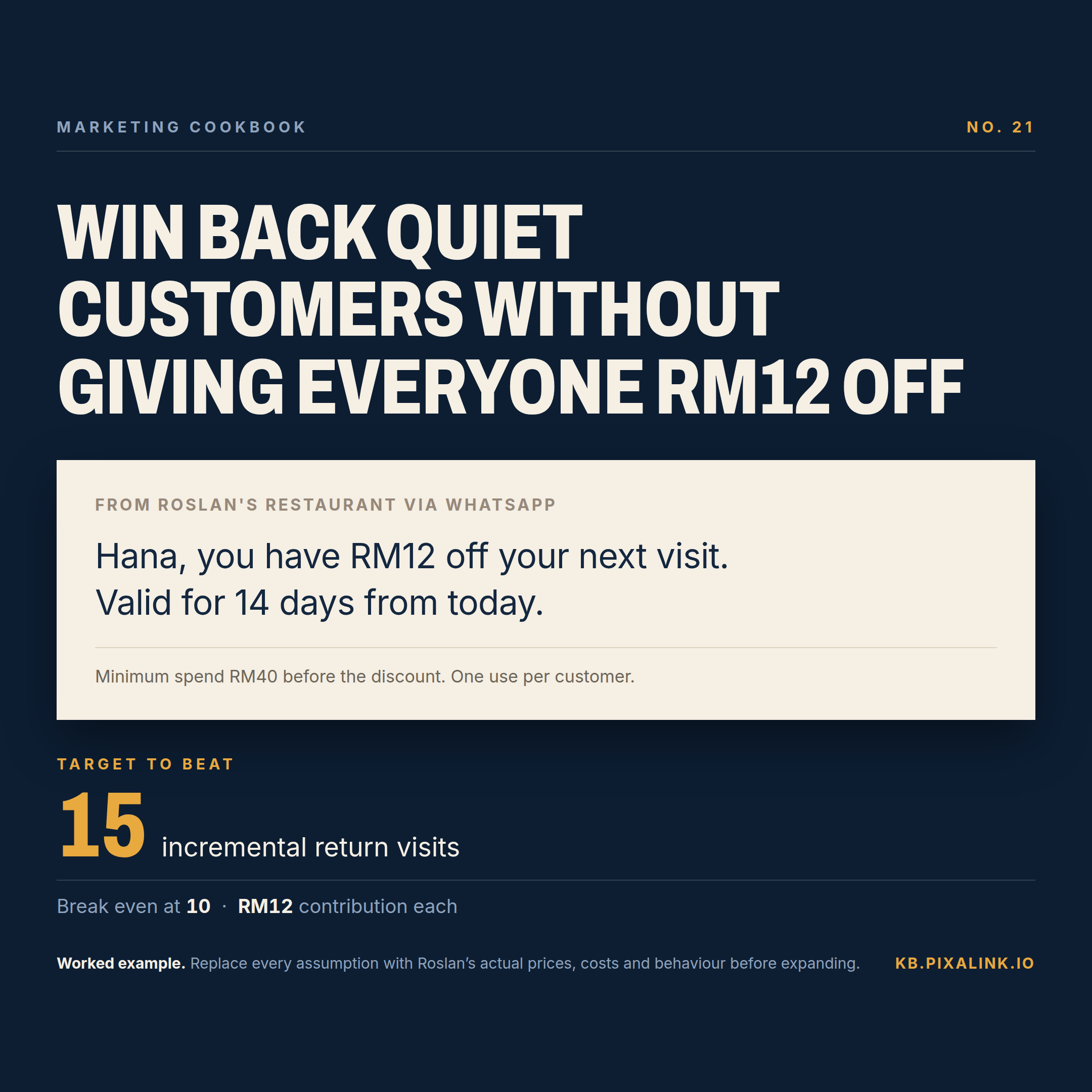
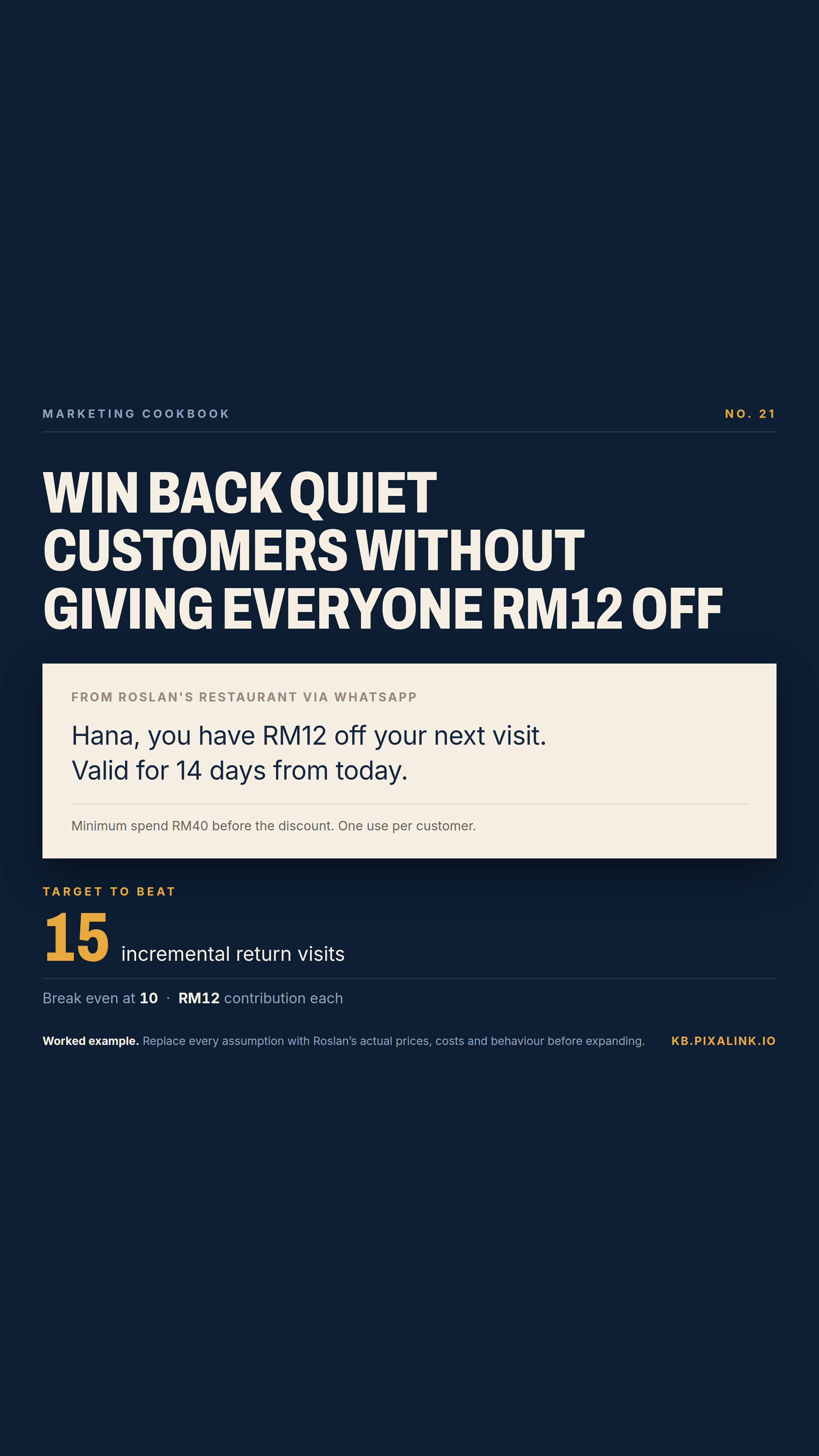
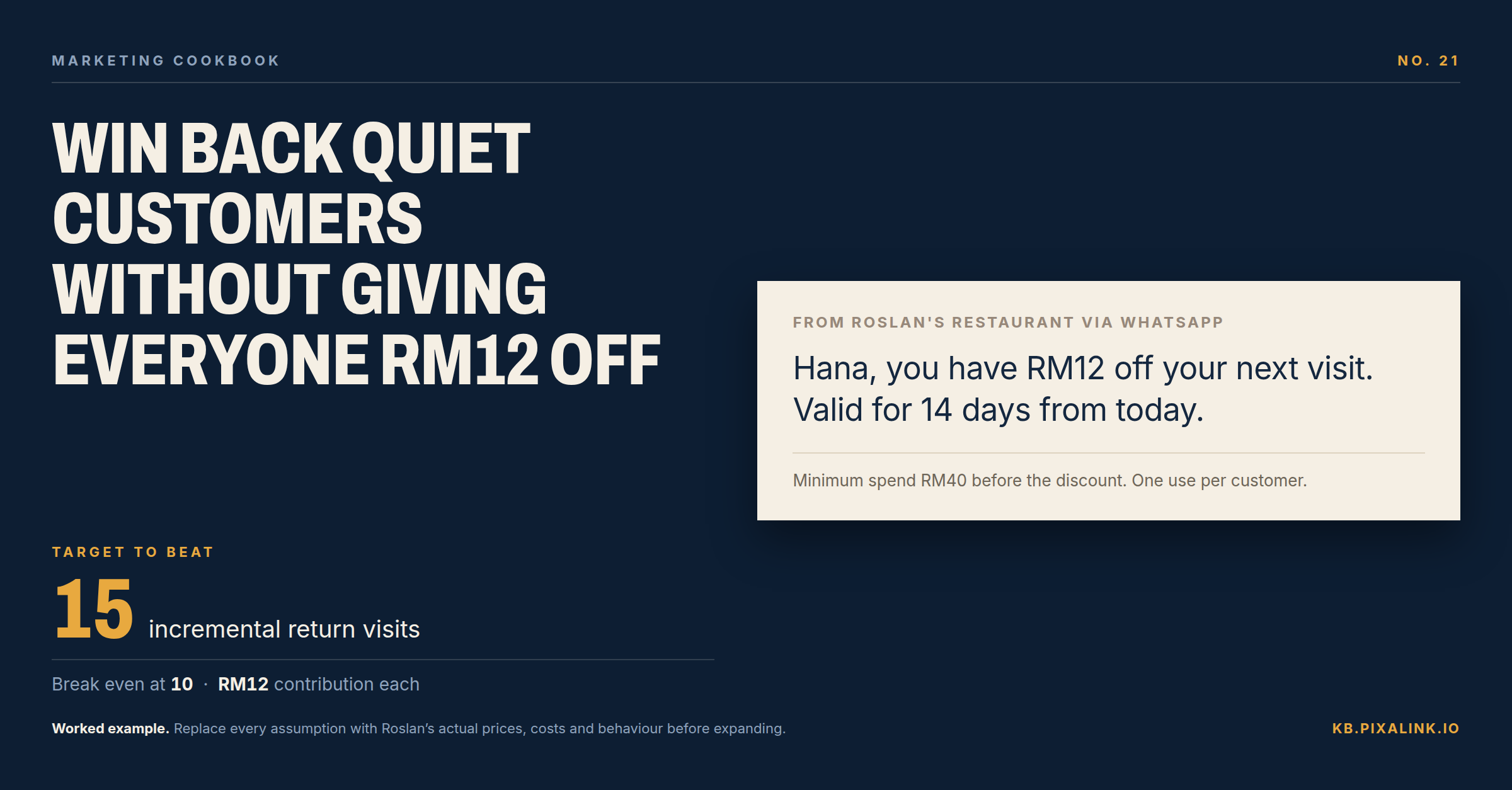
The same card at four sizes. Every figure on it comes from this article, and the message is the one written above — nothing on the card is generated.
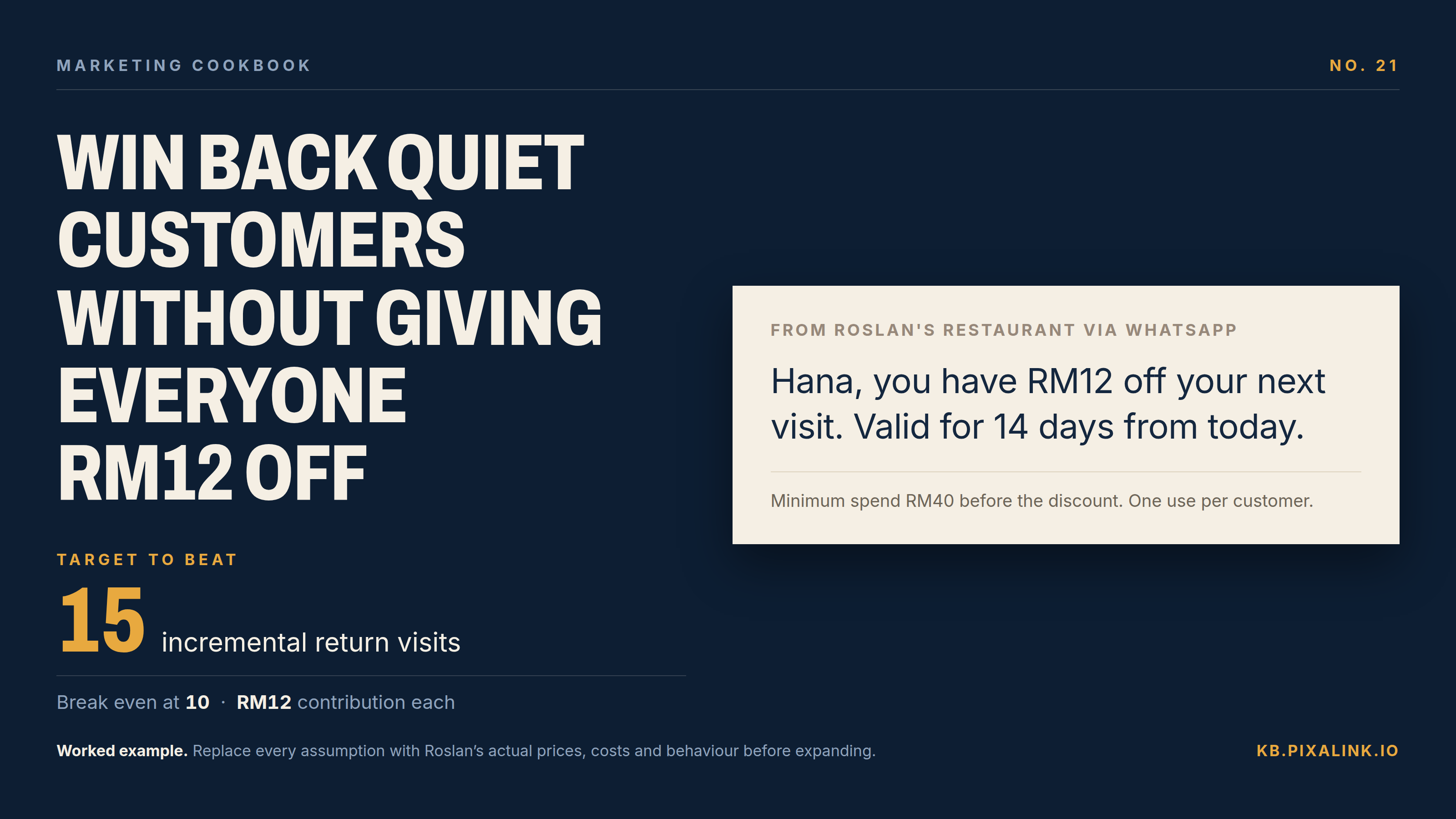
Alt text for your post
Win Back Quiet Customers Without Giving Everyone RM12 Off. After 30 quiet days, a reminder costs RM0 in rewards; after 60, an add-on costs RM3; after 90, RM12 off. Both benefits require RM40 spend and expire after 14 days. Replace every assumption with Roslan’s actual prices, costs and behaviour before expanding.
Closing invitation
Start with Roslan’s question: which quiet customers need a reminder, and which need more? Test one ladder, measure incremental value, and let the evidence decide whether it deserves another run.