
Win Back & Recovery
Repair Customer Trust After a Late Delivery
The gesture has acknowledged the inconvenience without answering Kelvin’s real concern: will the next lunch arrive on time?

A worked example
- RM300
- Contribution per incremental action
- 4
- Break-even actions
- 6
- Minimum target
per additional fulfilled order
additional orders
additional orders, rounded up
At a glance
The business problem
Noor can see the voucher issued, but silence tells her little about trust. Kelvin’s lost catering orders matter more than whether the apology looks generous.
The commercial leak is an unresolved delivery failure that can affect other clients. Recovery needs a named owner, a practical kitchen change and a way to track whether late deliveries recur, separately from spending.
Why the usual promotion falls short
A voucher cannot explain why the kitchen missed dispatch or how tomorrow’s delivery will differ. Asking Kelvin to spend again before hearing that explanation makes the apology feel unfinished.
The recovery paradox holds for satisfaction only: a well-recovered customer can end up more satisfied than one who never had a problem at all — but that bonus does not carry into repurchase intention, word of mouth or brand image — de Matos, Henrique & Rossi (2007), meta-analysis.
Noor should therefore treat goodwill as a chance to repair the relationship. It is not a prediction of another order.
What you set up in Pixalink
Opening scenario
Noor’s catering delivery arrives late to a corporate lunch in Shah Alam. The trays finally reach the table, but Kelvin Ooi has already spent his lunch break explaining the delay to colleagues. Noor sends a RM100 voucher within the hour and, hearing nothing back, assumes the matter is closed.
Kelvin accepts it, never uses it, and quietly books elsewhere. Noor, Kelvin and this business are fictional; all figures in this article are illustrative. The gesture has acknowledged the inconvenience without answering Kelvin’s real concern: will the next lunch arrive on time?
The recipe
The campaign recipe
Start with a small service-recovery trial. These are merchant operating terms, not promises that Pixalink automates the process.
| Recipe element | Recommended starting point |
|---|---|
| Suitable industries | Catering and appointment or delivery businesses |
| Primary goal | Prevent the same service complaint recurring |
| Customer segment | Clients with a confirmed late catering delivery |
| Offer | One RM100 apology voucher per affected client; Noor authorises each issue |
| Validity | 60 days from issue; communicate the actual expiry date |
| Minimum spend | No added minimum spend; apply up to RM100 against a later order |
| Quantity or budget limit | First 10 approved cases; RM1,000 face-value exposure plus RM600 operating spend, capped manually |
| Main success metric | Repeat late-delivery complaint rate, tracked apart from spend |
The voucher costs the customer RM0 to receive; it is not cash compensation. A confirmed failure and Noor’s approval unlock it, while the next-day explanation requires no purchase or redemption.
The message your customer receives
This message is fictional, like the merchant and customer. All figures are illustrative.
From Noor's catering business via WhatsApp
Kelvin, I'm sorry your catering delivery was late. I've issued you an apology voucher worth up to RM100 towards a later catering order. Valid for 60 days from issue.
No added minimum spend. One apology voucher per client.
The journey
Follow the customer
- Kelvin receives an acknowledgement. Noor authorises the voucher within the hour and logs it against him, without treating acceptance as closure.
- Kelvin hears what changed. Noor calls the next day to explain the delay and the kitchen’s revised dispatch check, whether he uses the voucher or not.
- Kelvin does not start again. Staff consult the reward record and Noor’s separate complaint notes before their next conversation, including after redemption.
- Kelvin’s next delivery tests the repair. Noor checks for another late-delivery complaint; redeeming RM100 alone does not establish success, and no further order leaves the outcome unknown.
flowchart LR
 A[Apology received] --> B[Kitchen fix explained]
 B --> C[History remembered]
 C --> D[Next delivery checked]
Use case: how the merchant applies it
Noor selects the first 10 approved late-delivery cases over 30 days. She offers each client one RM100 voucher, valid for 60 days from issue, with no added minimum spend; her written terms explain how orders below RM100 are handled before anyone accepts.
She reserves RM1,000 for the vouchers and RM600 for calls, recordkeeping and the dispatch change. She manually records approval, expiry and budget use, and stops new trial enrolment at the cap while continuing to handle complaints.
For Kelvin, she checks the kitchen handover, assigns a dispatch owner and explains the actual correction next day. After redemption, she checks delivery performance rather than issuing another incentive; follow-up lasts through each client’s 60-day window.
How the platform helps
How Pixalink supports the strategy
Pixalink supports targeted assignment, one claim, and a record of when the voucher was redeemed and which staff member validated it. The issuer is found in the audit log, not the reward list; the validator is not necessarily the person who authorised the apology.
Noor controls who may authorise and protects Kelvin’s ability to continue complaining. The trial’s cap, calls, kitchen correction and complaint tracking remain manual; this recipe does not provide an automated complaint-resolution workflow.
Configure this in Pixalink
Use How to Create a Hidden Voucher and Give It to a Specific Member for targeted assignment. Use How to See Who Redeemed a Reward Voucher to understand the redemption record.
The economics
ROI taste test
Count the extra order honestly
Suppose Kelvin places a genuinely additional RM1,000 order: after RM100 off, cash collected is RM900 and variable fulfilment costs RM600. Additional reward cost is RM0 because the discount already reduced cash; subtracting RM100 again would double-count it.
- Contribution per incremental action = cash collected - variable fulfilment cost - reward cost.
- Contribution per incremental action = RM900 - RM600 - RM0 = RM300 per additional fulfilled order.
- Break-even actions = campaign operating cost / contribution per incremental action.
- Break-even actions = RM1,200 / RM300 = 4 additional orders.
- Minimum target = 4 × 1.5 = 6 additional orders, rounded up.
The RM1,200 planning allowance combines RM600 operating spend with RM600 reserved for discounts on orders that would happen anyway. It is a conservative allowance, not another voucher budget; reconcile actual non-incremental discounts and recalculate before deciding.
Compare with similar previous recovery cases and their reorder behaviour. Claims, redemptions and Kelvin’s intended purchases are not automatically incremental profit; replace every assumption with your own prices, costs and baseline, without treating this small trial as proof of causation.
Measure it
What to watch
- Repeat complaint rate: later deliveries to trial clients with another lateness complaint divided by all their later deliveries; target no more than 10%, with at least 10 deliveries observed.
- Next-day follow-up rate: completed explanation calls divided by approved cases; target 100%.
- Incremental contribution: additional-order contribution minus actual operating costs and discounts on baseline orders; compare with the six-order minimum target.
Common mistake: Noor marks Kelvin’s case resolved when he accepts the voucher. That records acceptance, not a corrected delivery process.
Safeguard: Noor uses a named-authoriser record stating that accepting the voucher never closes the complaint or requires silence. Staff must honour that condition throughout the trial.
Keep when the minimum target, complaint and follow-up thresholds, and safeguard hold. Improve a promising mid-trial signal with one bounded dispatch or call-timing change; stop expansion if contribution is non-positive, the safeguard fails or a pre-set threshold is missed at the final review, including insufficient delivery observations.
Your first test
Try this first
- Define eligible late-delivery cases and record comparable historical complaint and reorder baselines.
- Limit enrolment to 10 approved clients, reserving RM1,000 plus RM600 operating spend manually.
- Use one RM100 offer, enrol over 30 days and observe each client for 60 days.
- Record cash, costs, baseline discounts, delivery outcomes and named approval without silencing complaints.
- Apply the pre-set keep/improve/stop rule after the final observation window.
Questions
Frequently asked questions
Must Kelvin order again to receive the apology?
No purchase is required to receive the voucher or explanation. Using the voucher does require a later order, so describe it honestly as future-order value.
Does Pixalink decide who can authorise it?
That approval policy belongs to Noor. An issuance audit record is not a merchant approval workflow.
What if Kelvin never redeems it?
Make the promised follow-up anyway. No redemption does not prove dissatisfaction, and no later delivery cannot demonstrate that the problem stopped.
What about a cancelled order or unused balance?
Noor must explain those terms before launch and review exceptions herself. Automatic voucher restoration or balance carry-forward is not established for this recipe; do not promise either.
Share this recipe
A card you can post
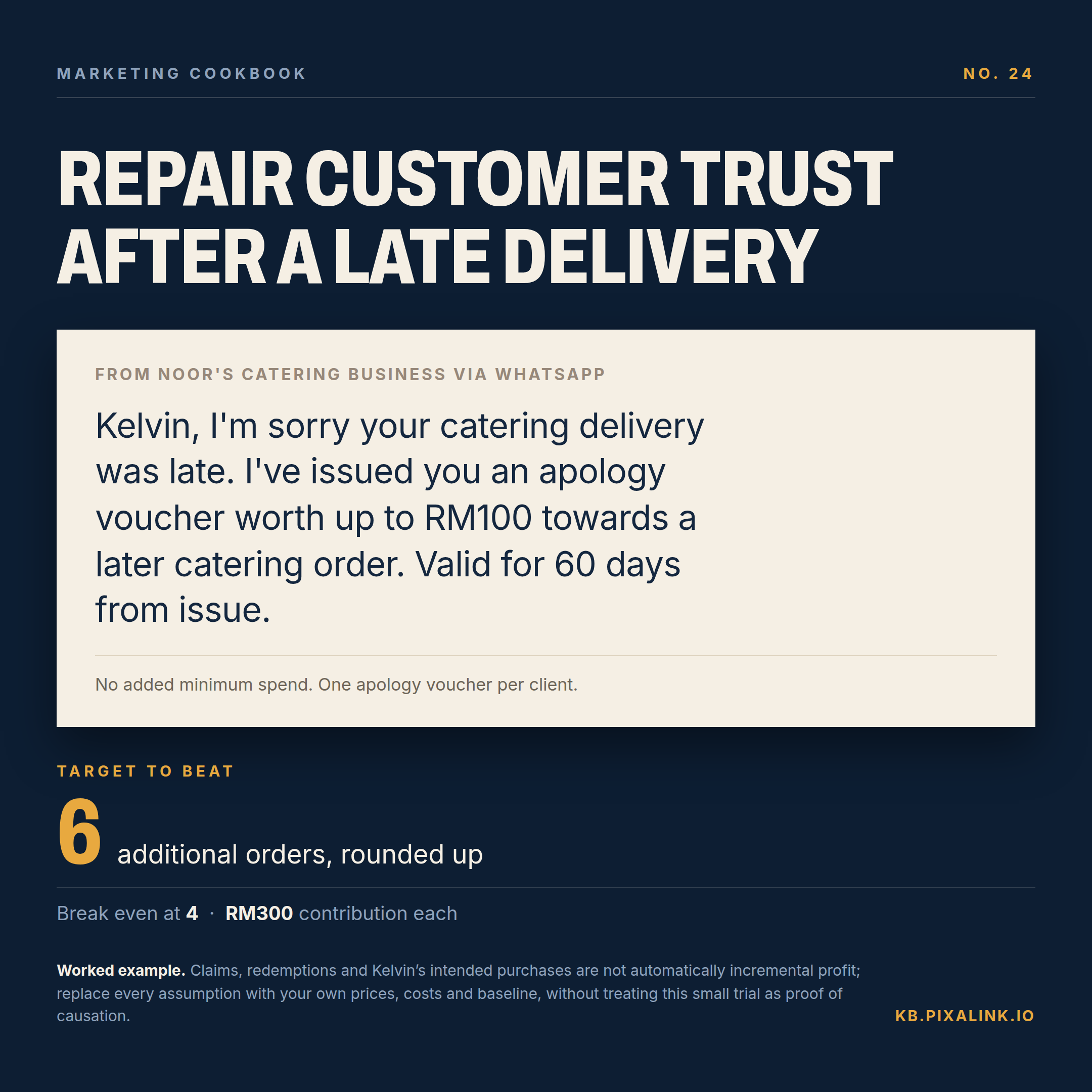
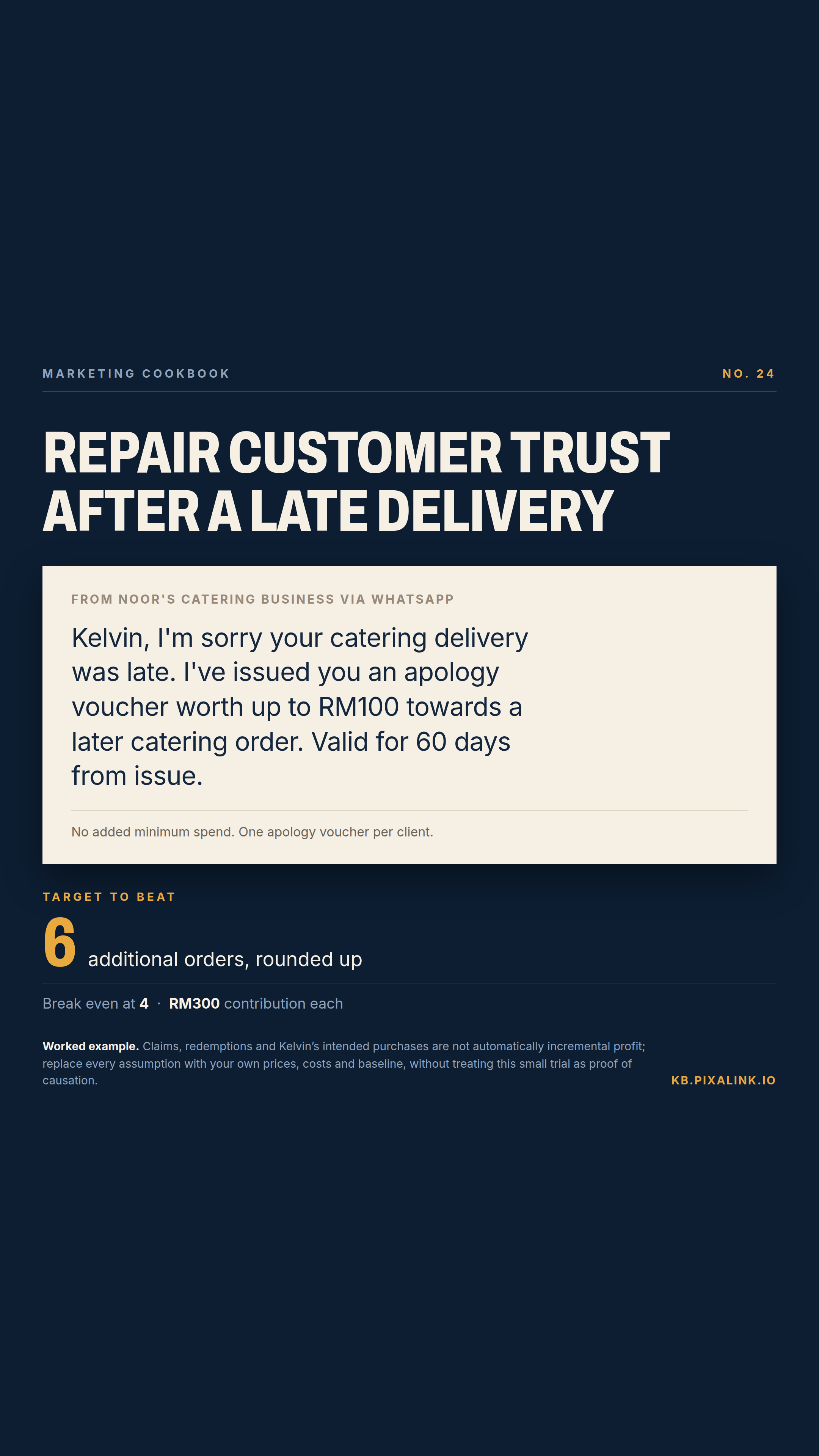
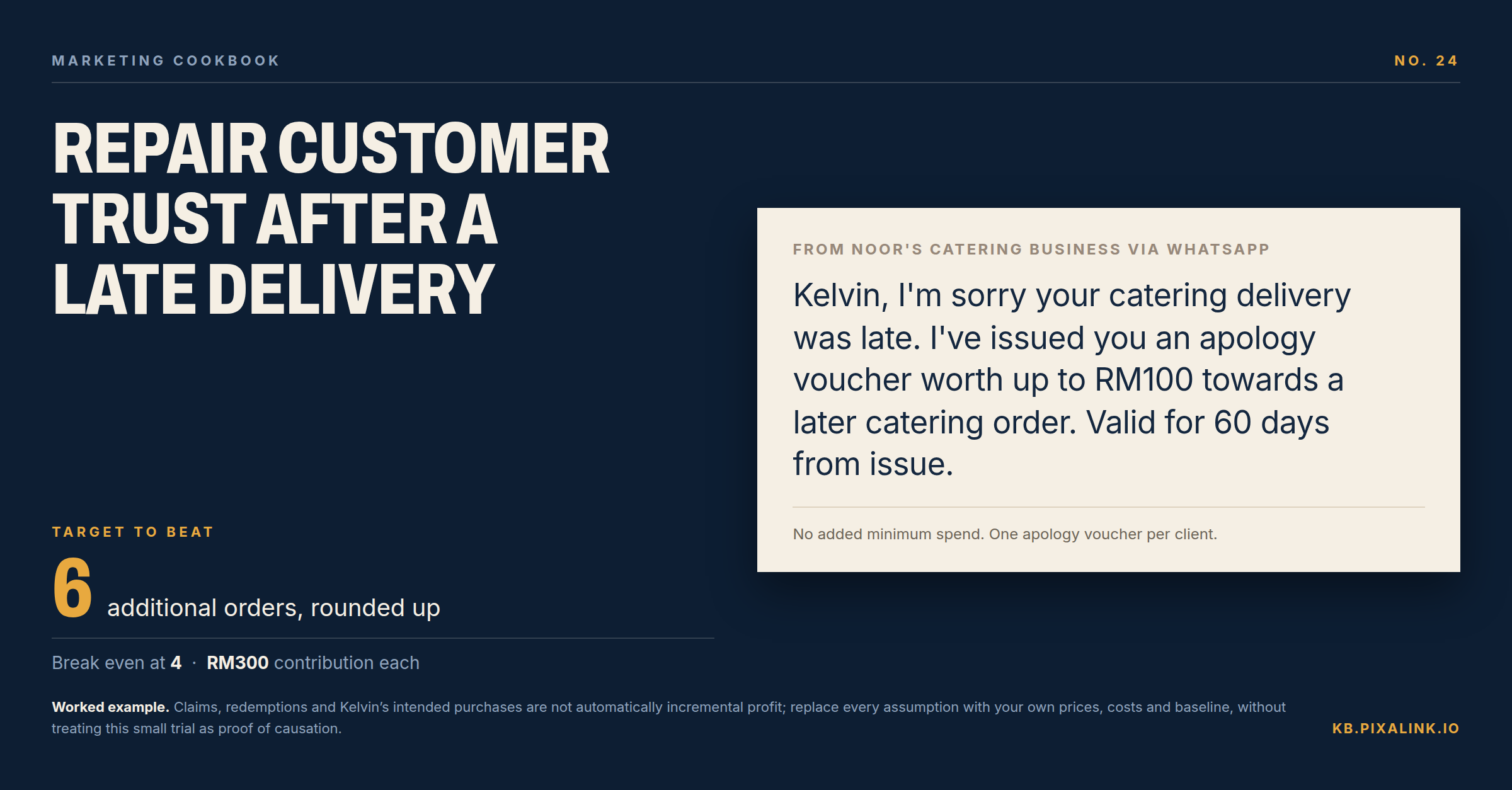
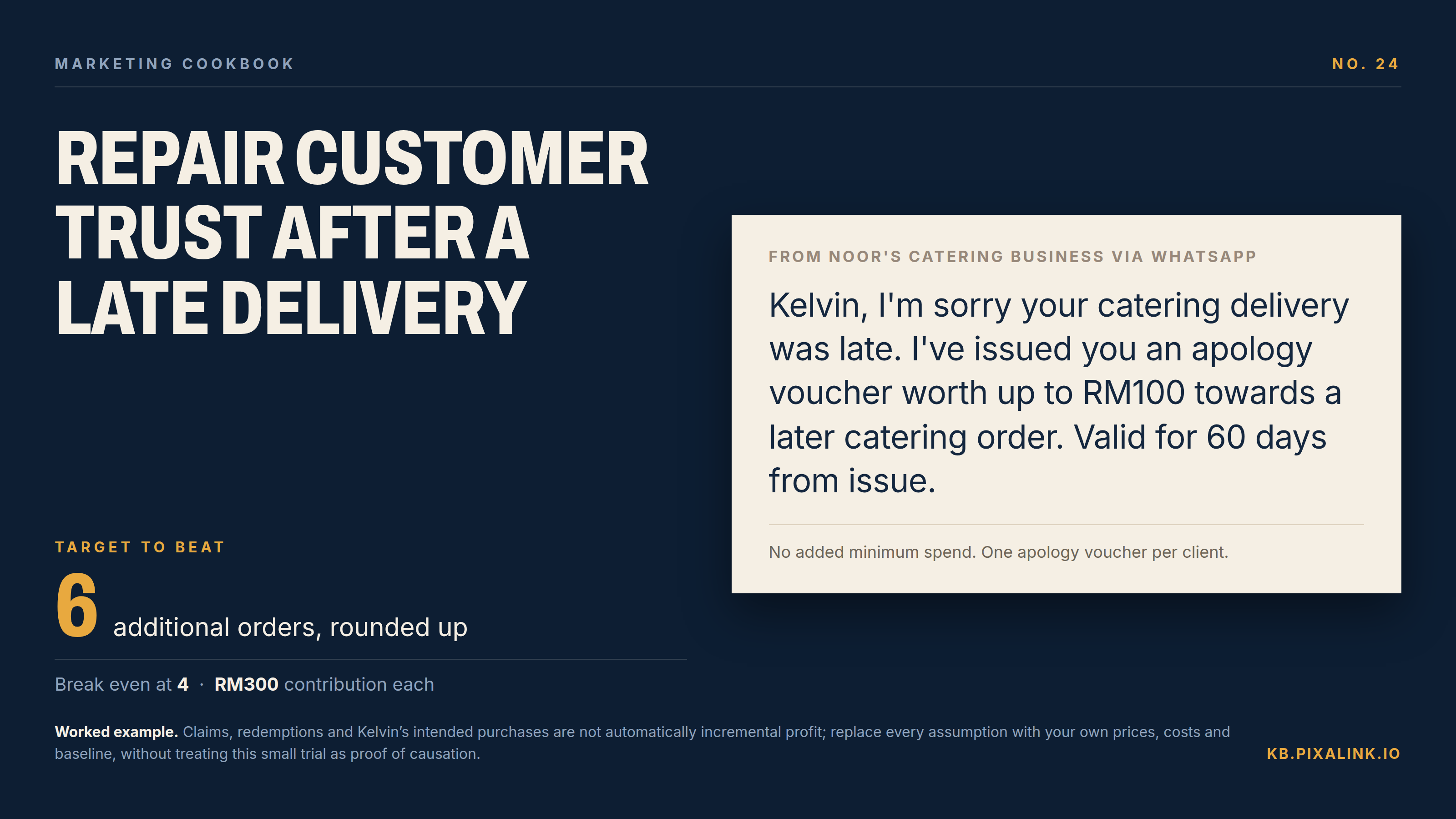
The same card at four sizes. Every figure on it comes from this article, and the message is the one written above — nothing on the card is generated.
Alt text for your post
Repair Customer Trust After a Late Delivery. Noor approves a free RM100 apology voucher after a confirmed late delivery, followed by an explanation next day regardless of redemption. The voucher lasts 60 days. Claims, redemptions and Kelvin’s intended purchases are not automatically incremental profit; replace every assumption with your own prices, costs and baseline, without treating this small trial as proof of causation.
Closing invitation
Choose one service failure you can actually fix and test this recovery routine on a small group. Let Noor’s lesson guide the review: measure the next delivery and real incremental value, while keeping Kelvin’s complaint open to be heard.