
Win Back & Recovery
Bring Back Lapsed VIPs with Recognition, Not Another Coupon
Should someone who helped build the business receive another coupon, or a personal reason to return?

A worked example
- RM120
- Contribution per incremental action
- 1
- Break-even actions
- 2
- Minimum target
incremental completed return
incremental completed returns
At a glance
The business problem
Elena risks losing a valuable relationship while paying for returns that might happen anyway. On a RM240 treatment, her usual 15% discount gives away RM36 without asking why the client stopped visiting.
The useful question is whether a former regular will return profitably and stay. A reply to a note is encouraging, but future contribution pays for the attention.
Why the usual promotion falls short
An identical discount treats Datin Zarina's long relationship like any other dormant record. It may answer a price objection she never had, while leaving a scheduling problem or disappointing visit unresolved.
Research gives Elena a reason to review prior value: “First-period behaviour predicts both reacquisition and second-period value — Kumar, Bhagwat & Zhang (2015).” That supports careful selection, without predicting what this spa will achieve.
What you set up in Pixalink
Opening scenario
Elena straightens the towels beside an empty treatment bed at her Langkawi spa. Her top twenty clients account for a third of revenue, but four have not booked in three months. Datin Zarina, once a fortnightly visitor, has not been in since May; she now receives the same automated 15% off as everyone else.
Elena, Datin Zarina and the spa are fictional, and all figures in this article are illustrative. Elena remembers years of conversations, yet her promotion remembers only an absence. Should someone who helped build the business receive another coupon, or a personal reason to return?
The recipe
The campaign recipe
Make a personal invitation with a service benefit Elena can deliver well. These are starting assumptions for a small test, with the full programme capped at twenty places.
| Recipe element | Recommended starting point |
|---|---|
| Suitable industries | Spas and appointment businesses with established repeat clients |
| Primary goal | Restore valuable client relationships profitably |
| Customer segment | Top-tier members or prior top spenders quiet for 90 days; staff check history |
| Offer | Personal note, reserved appointment choice and complimentary hand treatment costing RM20 with a RM240 treatment |
| Validity | Book and complete the visit within 28 days of the invitation |
| Minimum spend | RM240 paid treatment; staff enforce the qualifying service and payment |
| Quantity or budget limit | Maximum 20 benefits: RM400 reward exposure. Pilot only the four eligible clients: RM80 benefits plus RM100 outreach cost = RM180 maximum |
| Main success metric | Net incremental future contribution over 90 days |
The message your customer receives
This message is fictional, like the merchant and customer. All figures are illustrative.
From Elena's spa via WhatsApp
Datin Zarina, thank you for your years of visits. I'd love to welcome you back with a complimentary hand treatment and a choice of reserved appointments. Please book and complete your visit within 28 days from today.
Minimum spend RM240 on the qualifying paid treatment.
The journey
Follow the customer
- Recognised by past value: Datin Zarina belongs to Elena's twenty-client VIP group. Staff confirm her 90-day absence; only four currently qualify for outreach.
- Acknowledged personally: She receives a note thanking her for years of visits. Elena invites a conversation about what would make returning comfortable.
- Offered something reserved: She can choose an available appointment with a complimentary hand treatment alongside the RM240 service. Elena explains the limited availability and 28-day deadline.
- Welcomed back: Datin Zarina books, attends and receives the benefit with her paid treatment. Elena listens to her feedback and offers an ordinary next appointment, without another rescue discount.
flowchart LR
    A["Recognised as a former regular"] --> B["Receives a personal note"]
    B --> C["Chooses a reserved appointment"]
    C --> D["Returns, then plans her next visit"]
Use case: how the merchant applies it
Elena reviews the twenty names without filling the campaign with active clients simply to use every slot. She personally handles the four eligible invitations, after checking consent, and keeps the pilot's benefit allowance at four.
Her note to Datin Zarina acknowledges the relationship before describing the hand treatment. Reception reserves suitable times, checks the RM240 payment and records one benefit per invited client; those are staff procedures, not automatic booking controls.
The same 28-day deadline covers booking and attendance. After the visit, Elena records the concern raised and the next ordinary booking; she does not treat a courteous response as a repaired relationship.
How the platform helps
How Pixalink supports the strategy
Pixalink enforces tier and membership targeting, total reward availability and expiry. Elena can therefore bound the reward supply and deadline, while her team reviews prior spending, the 90-day absence and the final invitation list.
Consent and who calls or writes remain Elena's responsibility. Automatic personal outreach, appointment reservation and enforcement of this spa's RM240 service condition are not supported by the verified controls for this recipe; staff must handle them.
Configure this in Pixalink
Use What Are Rewards and How to Create Them for reward availability and expiry. Review Why Some Tagged Customers Don't Get Your Broadcasts alongside the consent check; broadcast exclusions do not authorise a personal call.
The economics
ROI taste test
For Datin Zarina's completed return, assume RM240 cash collected, RM100 variable fulfilment cost and RM20 additional reward cost. Allow RM100 for outreach work plus RM20 reward leakage on one return expected anyway: RM120 campaign operating cost for this calculation.
| Calculation | Formula and illustrative arithmetic |
|---|---|
| Contribution | Cash collected - variable fulfilment cost - reward cost. Contribution per incremental action = RM240 - RM100 - RM20 = RM120 |
| Break-even | Campaign operating cost / contribution per incremental action. Break-even actions = RM120 / RM120 = 1 incremental completed return |
| Minimum target | Break-even actions × 1.5, rounded up. Minimum target = 1 × 1.5 = 2 incremental completed returns |
Count additional value
Suppose a comparable historical group suggests one of four clients would return within 28 days anyway. Three completed returns then suggest two incremental returns, leaving RM120 after the allowance; this tiny comparison is directional, not causal proof.
Track subsequent contribution through day 90, subtracting actual costs once and adjusting leakage if the baseline changes. Notes delivered, bookings and redemptions alone are not profit; replace every assumption with actual prices, costs and behaviour, without assuming guaranteed results.
Measure it
What to watch
- KPI 1 — Net future contribution: incremental contribution through day 90, less outreach costs and incentive leakage.
- KPI 2 — Incremental completed returns: paid visits by day 28 above the matched historical baseline.
- KPI 3 — Ordinary repeat visits: rescued clients returning again without this benefit by day 90.
Common mistake: filling unused places with active VIPs. Elena would spend the reward budget on visits she already had.
Safeguard: Elena checks consent before each personal contact and honours any refusal. She must not use a call or note to bypass Do Not Contact or Blocked status; see Why Some Tagged Customers Don't Get Your Broadcasts.
Keep if at least two incremental returns occur by day 28, net contribution stays positive through day 90 and the safeguard holds. Improve one timing or benefit assumption in a new bounded test if the signal warrants it. Stop the current test if contribution is non-positive, consent fails or the pre-set return threshold is missed.
Your first test
Try this first
- Review the twenty VIPs, identify the four eligible clients and record a comparable historical return baseline.
- Cap the pilot at four invitations and four benefits, with RM180 maximum exposure including outreach.
- Fix the RM240 service and hand-treatment offer; measure completed returns over 28 days and later value through day 90.
- Record payments, fulfilment, reward costs, staff time and consent checks; replace the leakage estimate with evidence.
- Apply the two-return keep/improve/stop rule before authorising another round.
Questions
Frequently asked questions
Must Elena contact all twenty VIPs?
No; twenty is a ceiling, not a target. Only the four currently eligible clients enter this pilot.
Does reward availability reserve therapist time?
No appointment reservation is supported by the verified reward controls here. Reception must reserve actual capacity before Elena promises it.
What if Datin Zarina cancels?
Count no completed return or contribution from that booking. Staff handle any rescheduling within the stated deadline; automatic cancellation or slot restoration is not supported by this recipe's verified controls.
Should Elena increase the benefit if nobody replies?
First review timing and whether the invitation addresses the client's concern. A larger benefit is a new costed test, not the default next message.
Share this recipe
A card you can post
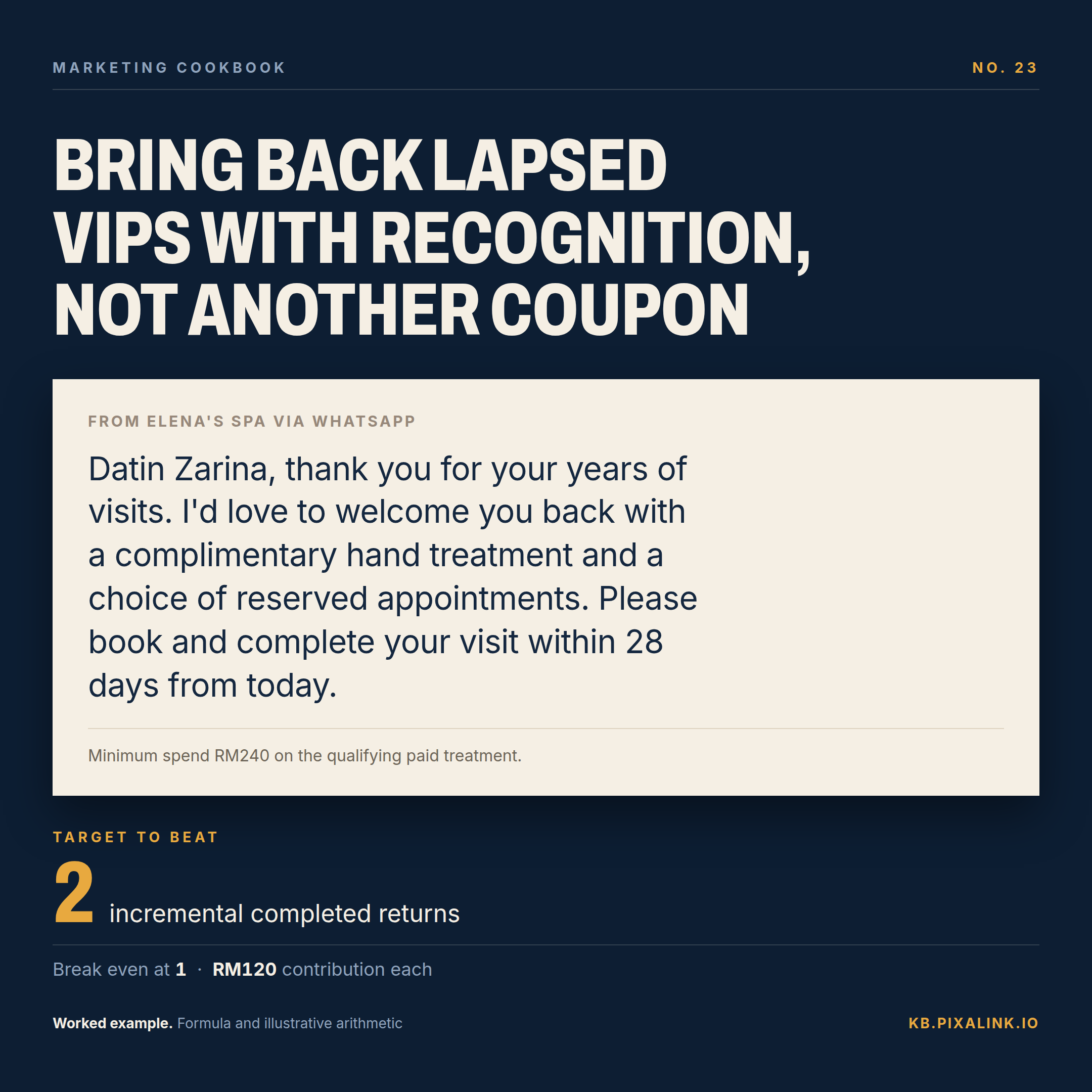
The same card at four sizes. Every figure on it comes from this article, and the message is the one written above — nothing on the card is generated.
Alt text for your post
Bring Back Lapsed VIPs with Recognition, Not Another Coupon. Prior VIP value and 90 quiet days qualify a client for a personal invitation. A RM240 paid treatment completed within 28 days includes a hand treatment costing Elena RM20, with at most 20 benefits. Formula and illustrative arithmetic
Closing invitation
Start with Elena's four quiet relationships and one invitation worth receiving. Measure whether clients such as Datin Zarina return profitably and choose to stay before expanding the offer.