
Win Back & Recovery
Turn Expiring Points into a Planned Hardware-Store Visit
How can Lim help people use what they earned without making the deadline feel like a punishment?

A worked example
- RM60
- Contribution per incremental action
- 4
- Break-even actions
- 6
- Minimum target
Formula: cash collected - variable fulfilment cost - reward cost
additional visits. Formula: campaign operating cost / contribution per incremental action
additional visits, rounded up
At a glance
The business problem
Lim has two connected problems: unused rewards and customers who no longer plan visits. Letting points disappear may reduce outstanding balances, but it does not create a sale or repair an unclear promise.
Rosnah needs a useful reason to return. A reminder can connect her existing points to a household job, provided Lim first resolves the policy explanation she should already have received.
Why the usual promotion falls short
A general discount gives everyone another offer while ignoring value members already hold. On a RM212 basket, a fresh RM20 discount would cost Lim RM20 in reduced takings without necessarily bringing back someone new.
Earned points can feel like the customer's own property, so a genuine deadline may prompt attention. That is a reason to test two courteous notices, not to manufacture urgency or assume everyone will buy.
What you set up in Pixalink
Opening scenario
Lim stands behind his hardware-store counter in Sungai Petani, wondering what to do about RM40,000 of unredeemed points on his books. Customers have forgotten their balances, and he has never explained the expiry policy clearly. Rosnah last bought paint in April; she has 3,200 points and no idea they are there.
Lim and Rosnah are fictional, and all figures in this article are illustrative. Another sale banner might bring shoppers through the door, but it would leave that forgotten value untouched. How can Lim help people use what they earned without making the deadline feel like a punishment?
The recipe
The campaign recipe
Use existing redemption terms and a genuine expiry date. The following example assumes Lim already offers RM32 of purchase value for 3,200 points; this is his illustrative reward, not a universal conversion rate.
| Recipe element | Recommended starting point |
|---|---|
| Suitable industries | Hardware stores and retailers with useful repeat purchases |
| Primary goal | Turn expiring balances into additional planned visits |
| Customer segment | Members with points expiring within 30 days, after policy communication is resolved |
| Offer | Existing 3,200-point reward worth RM32 toward a purchase; no new bonus |
| Validity | Existing expiry date; two notices, 30 days and 7 days before it |
| Minimum spend | No additional campaign minimum; retain existing reward terms |
| Quantity or budget limit | Lim manually selects 20 members; RM240 operating budget and RM640 maximum existing reward value in this sample; no cap on members' existing rights |
| Main success metric | Redemption rate, compared with a baseline to estimate additional visits |
Rosnah's example basket is RM212: RM32 in points value plus RM180 cash. The new bonus costs RM0; the existing RM32 benefit reduces cash collected and must still be budgeted.
The message your customer receives
This message is fictional, like the merchant and customer. All figures are illustrative.
From Lim's hardware store via WhatsApp
Rosnah, your 3,200 points expire in 7 days. You can use them for RM32 toward a purchase. Ask our staff about using your reward when you visit.
No additional campaign minimum spend. Existing reward terms apply.
The journey
Follow the customer
- Discover the balance. Rosnah receives a notice that her 3,200 points expire next month. It gives the exact date and explains the RM32 value under Lim's existing reward.
- See a useful purchase. The notice suggests putting the reward toward paint for her postponed touch-up job. It tells her to ask staff about that reward when visiting.
- Plan the job. Rosnah decides which weekend suits the work. If her balance remains unused, the second notice arrives seven days before expiry.
- Use the points. Rosnah spends the points and RM180 of her own money alongside them. She leaves with her supplies; her next purchase follows the usual loyalty terms.
Use case: how the merchant applies it
Lim first explains the existing policy and resolves any disputed dates before selecting this test group. For a manageable comparison, he chooses 20 members with the same 3,200-point expiring balance and reward access, without changing anyone else's redemption rights.
He names the paint purchase as an example, not a required basket. He checks availability, records each notice manually and rechecks balances before the second notice, so Rosnah is not chased after spending hers.
Lim compares the 30-day window with a similar, properly informed past group receiving the usual policy notice. This is a practical baseline, not a randomised trial; seasonal repair demand may affect the result.
How the platform helps
How Pixalink supports the strategy
Pixalink enforces point expiry, maintains the ledger balance, and supports points and credit redemption rewards. Lim remains responsible for explaining the policy and writing a courteous message.
This recipe does not establish an automatic two-notice sequence, automatic audience cap or automatic cancellation after redemption. Lim manages those checks himself; the proposed schedule must not be treated as a ready-made automation.
Configure this in Pixalink
Read How to Set Up Point Expiry Rules to check the expiry arrangement before planning notices. Keep the campaign on the existing terms rather than changing the deadline to fit the test.
The economics
ROI taste test
Assume Rosnah's RM212 basket costs RM120 to fulfil and brings in RM180 cash after using RM32 of points value. Additional reward cost is RM0: the RM32 reduction is already reflected in cash, so subtracting it again would double-count it.
- Contribution per incremental action = RM180 - RM120 - RM0 = RM60. Formula: cash collected - variable fulfilment cost - reward cost.
- Break-even actions = RM240 / RM60 = 4 additional visits. Formula: campaign operating cost / contribution per incremental action.
- Minimum target = 4 × 1.5 = 6 additional visits, rounded up.
The RM240 covers staff and sending costs, not a Pixalink price quote. If the baseline suggests 2 visits and Lim observes 8 comparable visits, the estimated 6 additional visits contribute RM360, leaving RM120 after operating costs.
Redemptions and delivered messages are not automatically profit: Rosnah might have bought anyway. Replace every assumption with your own prices, costs and behaviour, allow for extra reward use on purchases that would happen anyway, and do not count expired balances as campaign earnings.
Measure it
What to watch
- Redemption rate: members using expiring points divided by members selected; compare visits with the baseline to estimate the additional share.
- Cash basket alongside points: average cash collected per redemption visit; check against the RM180 assumption.
- Expiry complaints: number of members reporting an unclear or disputed deadline, with the reason recorded.
Common mistake: counting the whole basket, including points value, as fresh cash. Lim must separate Rosnah's RM180 payment from her RM32 benefit.
Safeguard: do not launch against an unexplained or disputed expiry policy. Lim explains the existing terms, resolves disputes and pauses further notices if an expiry complaint arises; this is his responsibility.
Keep when at least 6 estimated additional visits arrive and the safeguard holds. Improve a successful but uneven test by changing only the suggested purchase in another bounded group. Stop if contribution is non-positive, the safeguard fails or the test misses its minimum target; results are not guaranteed.
Your first test
Try this first
- Define the expiring-points group and record a comparable, properly informed baseline.
- Select 20 members manually and reserve RM240 operating cost plus RM640 existing reward exposure.
- Retain one reward and measure 30 days, with notices at 30 and 7 days before expiry.
- Record cash, fulfilment costs and complaints; confirm the policy safeguard before sending.
- Compare estimated additional visits with the target of 6 and apply the keep, improve or stop rule.
Questions
Frequently asked questions
Does every point balance equal RM32?
No. That value belongs to Lim's illustrative 3,200-point reward; quote your own actual redemption terms.
Should I impose a minimum purchase now?
Keep the existing reward conditions. Rosnah's RM180 cash payment is an example, not a new minimum for using earned points.
Can I send five reminders instead?
This recipe tests two spaced notices. Recheck the balance before the second and avoid turning a courtesy into repeated pressure.
What if customers never knew about expiry?
Resolve that before running the rescue campaign. Do not use the test to justify silently shortening validity or promise that expired points will be restored automatically.
Share this recipe
A card you can post
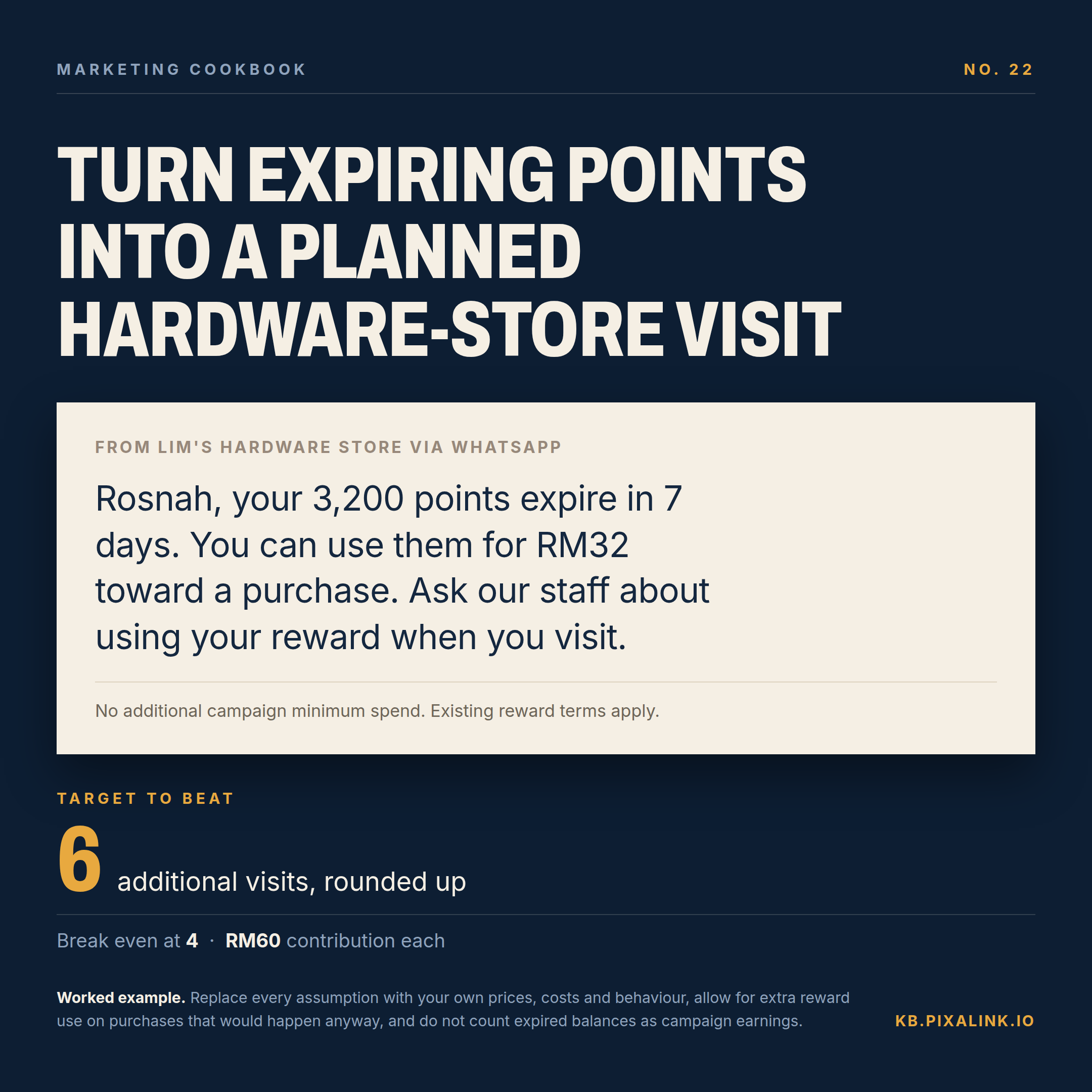
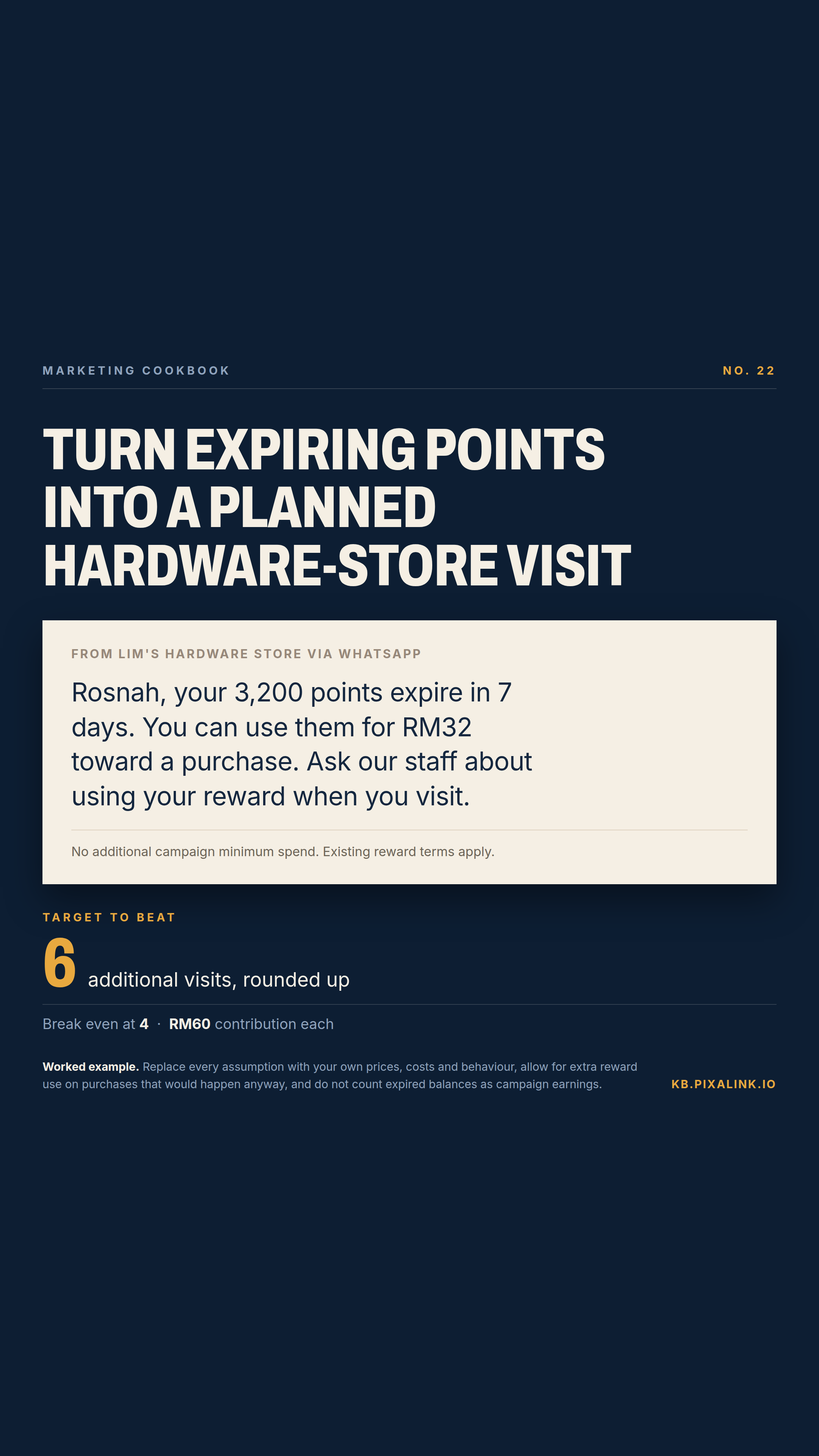
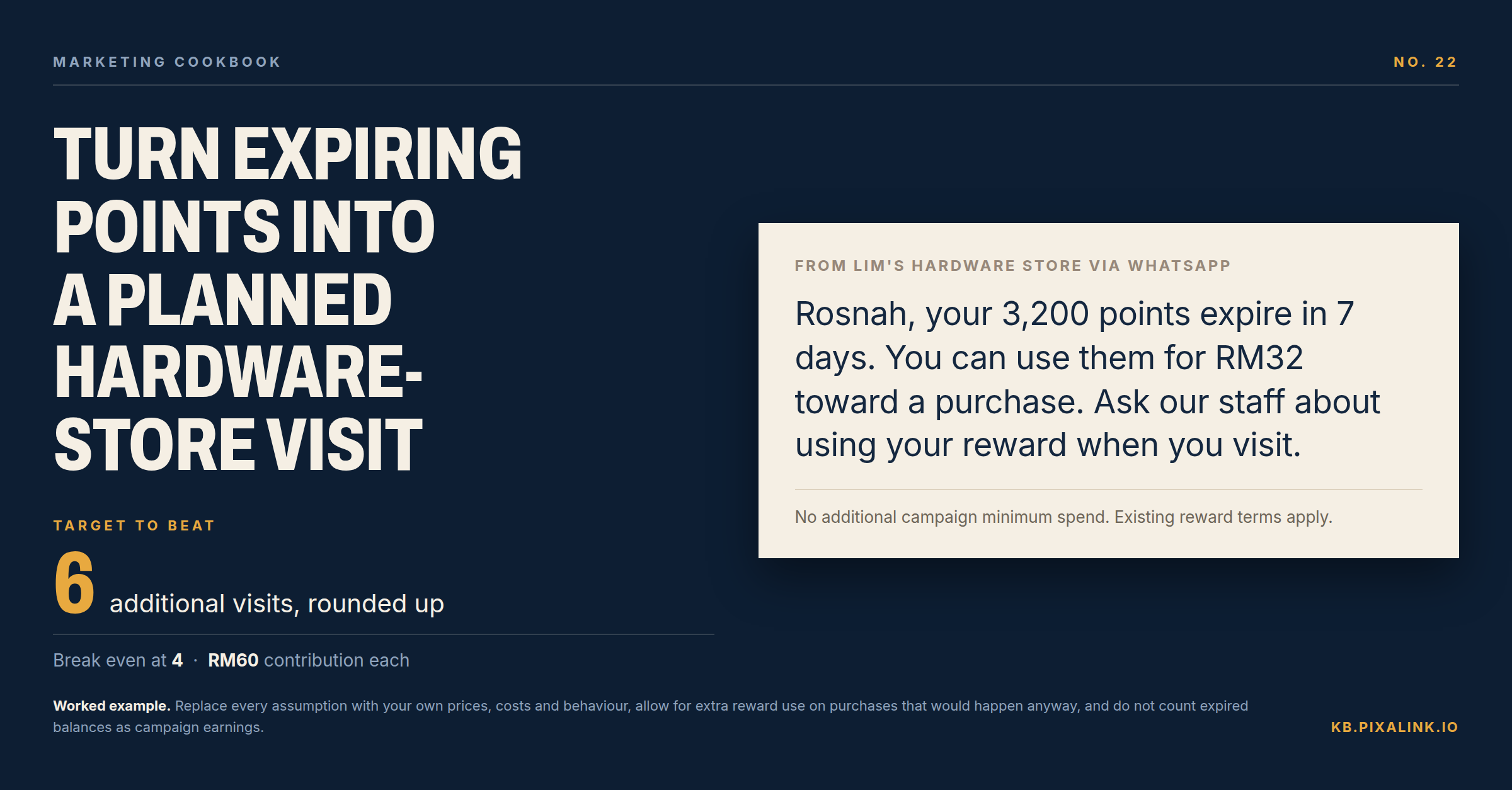
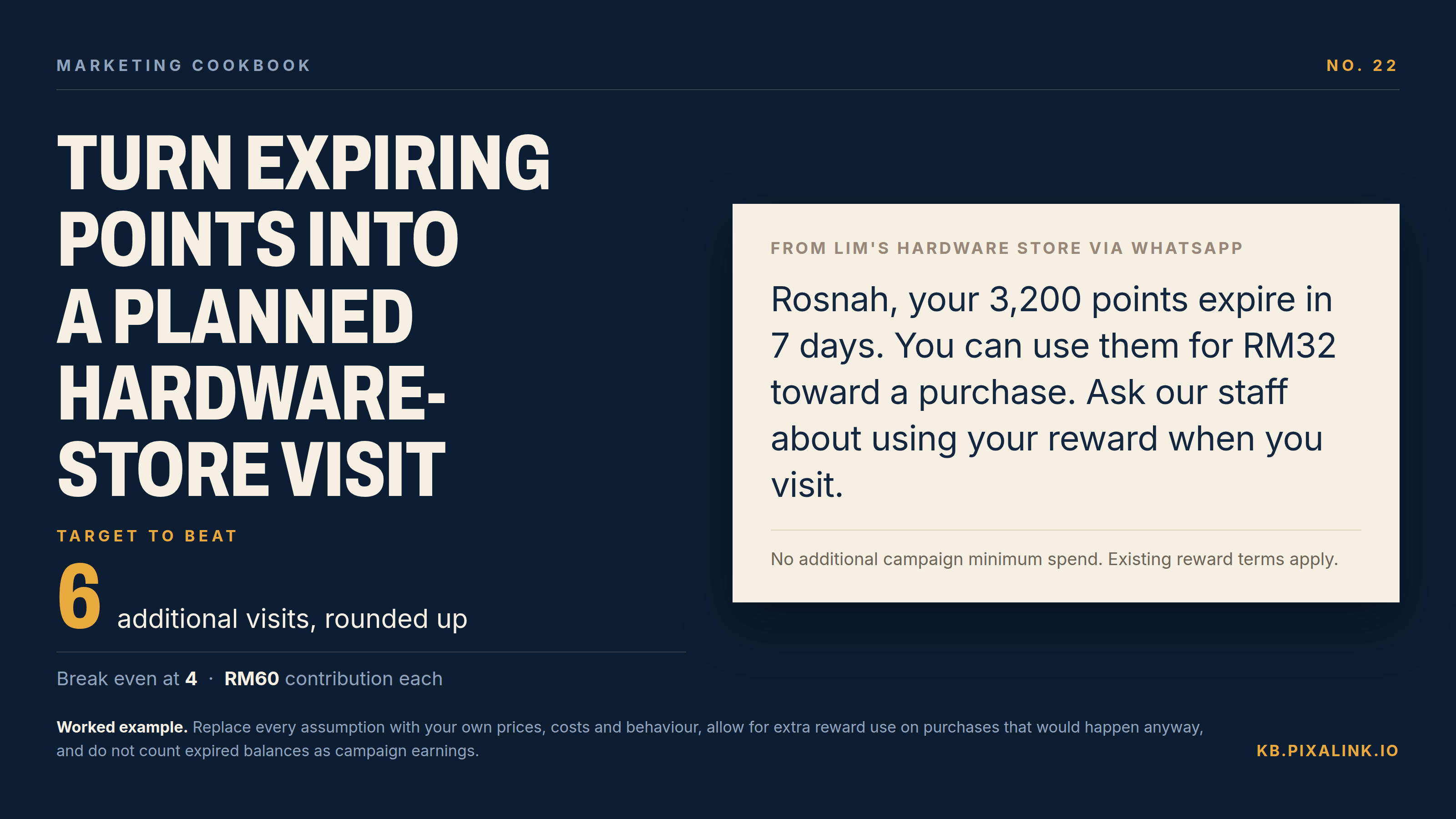
The same card at four sizes. Every figure on it comes from this article, and the message is the one written above — nothing on the card is generated.
Alt text for your post
Turn Expiring Points into a Planned Hardware-Store Visit. Two notices at thirty and seven days before expiry explain an existing 3,200-point reward worth RM32. Redeeming before expiry puts RM32 toward an RM212 basket, leaving RM180 cash to pay, with no new bonus. Replace every assumption with your own prices, costs and behaviour, allow for extra reward use on purchases that would happen anyway, and do not count expired balances as campaign earnings.
Closing invitation
Choose one small group whose points can still be useful, as Lim does for Rosnah. Make the value clear, offer time to plan and measure whether the additional visits justify another test.