
Habit Builders
Fill One Quiet Afternoon Without Losing Lunch Trade
Can Sofia give him a reason to come at three without losing his lunch business?
A worked example
- RM9
- Contribution per incremental action
- 3
- Break-even actions
- 5
- Minimum target
per additional paid cover
additional covers
additional covers, rounded up from 4.5
At a glance
The business problem
An empty chair cannot earn yesterday’s revenue tomorrow. Sofia has spare kitchen capacity, but filling it only helps if the additional cash covers the food, reward and campaign costs.
Her real target is extra paid covers: customers served during the quiet window, less visits shifted away from peak periods. If Haziq merely delays his usual lunch to collect a free drink, Sofia has paid to move the same sale.
Why the usual promotion falls short
A discount available all day gives regular lunch customers the easiest opportunity to use it. A standing weekly happy hour can also teach them to wait for the cheaper slot.
Sofia instead tests one dated afternoon with a real quantity limit. That makes the invitation specific and the result measurable before she commits another month’s reward budget.
What you set up in Pixalink
Opening scenario
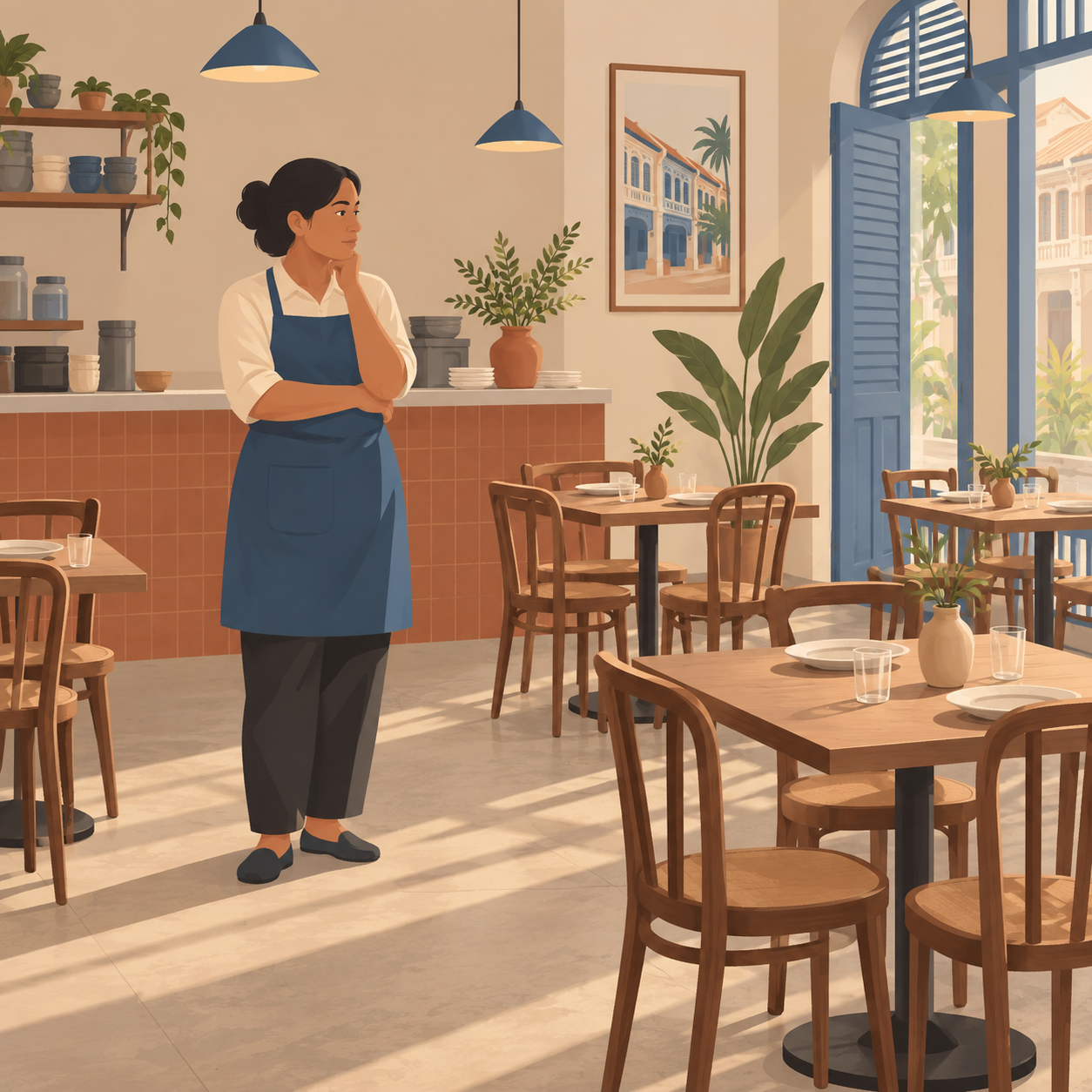
Sofia straightens an untouched table in her Georgetown bistro. Tuesday and Wednesday afternoons are empty from two until five, although staff are rostered and rent is paid. Her previous RM2 lunch discount cost RM12 across six meals that regulars might have bought anyway. It gave nobody a reason to arrive later.
Haziq works nearby and eats out most days, always at lunch. An afternoon meal here has never crossed his mind. Sofia, Haziq and this bistro are fictional; all figures and dates are illustrative. Can Sofia give him a reason to come at three without losing his lunch business?
The recipe
The campaign recipe
Start with capacity the existing shift can comfortably serve. These are test assumptions for Sofia, not promised results.
| Recipe element | Recommended starting point |
|---|---|
| Suitable industries | Bistros, cafés and casual dining with idle afternoon tables |
| Primary goal | Add paid covers during one quiet stretch without losing peak trade |
| Customer segment | Nearby customers like Haziq who usually visit at lunch; manually select a small invitation group |
| Offer | Buy a RM20 meal and receive one free iced tea; tea costs Sofia RM2 |
| Validity | Tuesday 15 September 2026 only, 2pm–5pm; Pixalink controls the day, staff enforce the hours |
| Minimum spend | RM20 meal purchase, checked by staff before serving the tea |
| Quantity or budget limit | Six rewards total, one claim per customer; maximum RM12 tea cost plus RM27 campaign operating cost = RM39 exposure |
| Main success metric | Additional quiet-window covers minus peak visits lost; minimum target five net additional covers |
The message your customer receives
This message is fictional, like the merchant and customer. All figures are illustrative.
From Sofia's bistro via WhatsApp
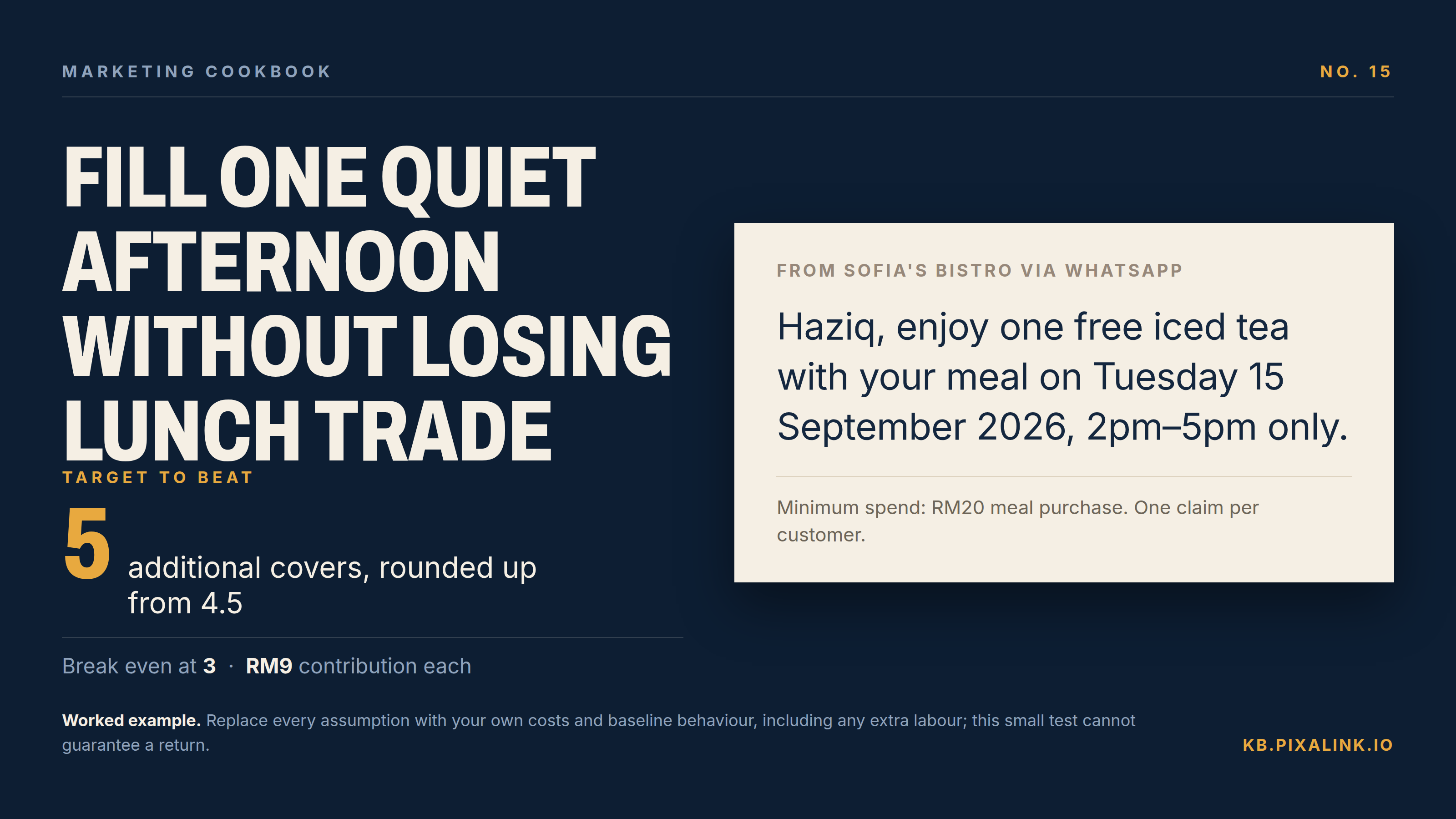
Haziq, enjoy one free iced tea with your meal on Tuesday 15 September 2026, 2pm–5pm only.
Minimum spend: RM20 meal purchase. One claim per customer.
The journey
Follow the customer
- A specific invitation. Haziq receives a message naming Tuesday 15 September, 2pm–5pm, a free iced tea with a RM20 meal, and six available rewards. He can judge whether that afternoon suits him.
- A believable limit. Haziq claims one of the limited rewards on the dated day. Sofia has genuinely allowed only six, with one claim per customer.
- A different visit. Haziq arrives at 3pm and buys the meal. Staff check the time and purchase before honouring his reward.
- A measured next step. In the successful example, Sofia fills six covers in a previously dead hour. Haziq returns to ordinary pricing afterwards; Sofia schedules a fresh window next month only if the test passes.
Use case: how the merchant applies it
Sofia chooses Tuesday alone, leaving Wednesday outside this test. The earlier lunch discount has ended: both baseline Tuesdays and the test use the ordinary RM20 lunch price, with RM9 variable meal cost. Her invitation explains that claiming a reward does not extend its hours or reserve a table; the team plans space for all six possible arrivals.
She uses a simple till tally to record arrival time, meal payment and tea served. She also compares lunch covers against similar Tuesdays and asks returning customers whether they shifted an intended lunch visit. Six afternoon diners are encouraging, but she waits until the fortnight’s review before deciding whether the offer added business.
How the platform helps
How Pixalink supports the strategy
Pixalink enforces reward start and end dates at whole-day level, total availability and one claim per customer. Sofia sets the dated reward’s total availability to six and limits each customer to one claim.
The 2pm–5pm restriction is a staff rule. Hour-by-hour reward validity and a repeating weekly happy-hour rule are not supported here. Staff also check the RM20 meal purchase; this recipe does not rely on automatic spend validation, seat reservations or an automatic repeat schedule.
Configure this in Pixalink
Use What Are Rewards and How to Create Them for the reward setup. Brief the shift separately on the time and purchase checks.
The economics
ROI taste test
For each additional Haziq-like diner, assume RM20 cash collected, RM9 variable meal fulfilment cost and RM2 tea cost. Sofia budgets RM27 for campaign preparation and outreach; existing rent and roster costs remain unchanged.
- Contribution per incremental action = cash collected - variable fulfilment cost - reward cost. Contribution per incremental action = RM20 - RM9 - RM2 = RM9 per additional paid cover.
- Break-even actions = campaign operating cost / contribution per incremental action. Break-even actions = RM27 / RM9 = 3 additional covers.
- Minimum target = break-even actions × 1.5, rounded up. Minimum target = 3 × 1.5 = 5 additional covers, rounded up from 4.5.
Six extra covers with no displaced visits leave RM54 - RM27 = RM27 after campaign cost. If one lunch sale disappears, subtract its normal RM11 contribution: RM54 - RM11 - RM27 = RM16. Check both net covers and actual contribution; shifted visits do not have the same economics as new ones.
Messages, claims and redemptions alone do not prove extra profit. Replace every assumption with your own costs and baseline behaviour, including any extra labour; this small test cannot guarantee a return.
Measure it
What to watch
- Net additional covers: quiet-window gain over baseline minus peak visits lost; Sofia’s target is five.
- Peak covers lost: compare lunch trade with matched Tuesdays and customer explanations. If the loss exceeds the quiet-window gain, stop.
- Campaign contribution: collected cash less fulfilment, tea, operating costs and displaced peak contribution. Count every tea served, even on a shifted visit.
Common mistake: calling every afternoon redemption a new customer visit. Haziq changing his lunch time is not automatically growth.
Safeguard: the shift lead checks and records the stated hours and qualifying meal before serving each promotional tea. A claim on the right day is insufficient outside the afternoon window.
Keep when five net additional covers, positive contribution and the safeguard hold. Improve a passing test with a weak signal by changing only invitation timing next time. Stop this version if contribution is non-positive, the safeguard fails or it misses five net additional covers.
Your first test
Try this first
- Select a small nearby customer group; record matched Tuesday lunch and afternoon baselines before inviting anyone.
- Cap rewards at six and preparation/outreach spending at RM27; reserve enough operating capacity for those arrivals.
- Fix the RM20 meal-plus-tea offer for 15 September, 2pm–5pm, and review within a fortnight.
- Record RM9 meal cost, RM2 tea cost, actual payments, displaced visits and the shift lead’s time-and-purchase checks.
- Apply the five-cover keep/improve/stop rule before Sofia schedules another window next month.
Questions
Frequently asked questions
Can this run every Tuesday automatically?
No; a repeating weekly happy-hour reward rule is not supported here. Choose a fresh dated window after reviewing the previous test.
What if Haziq claims at lunch or arrives after five?
Claiming does not override the stated hours. Staff honour the offer only during 2pm–5pm on the named date and explain that condition in advance.
Do six claims mean six occupied seats?
No; someone may claim and never arrive. The reward limit controls availability, while Sofia plans seating and measures actual paid covers herself.
What if lunch gets quieter too?
Subtract displaced lunch visits and their lost contribution before judging success. Stop if peak covers fall by more than the quiet window gains, even if every tea was used.
Share this recipe
A card you can post
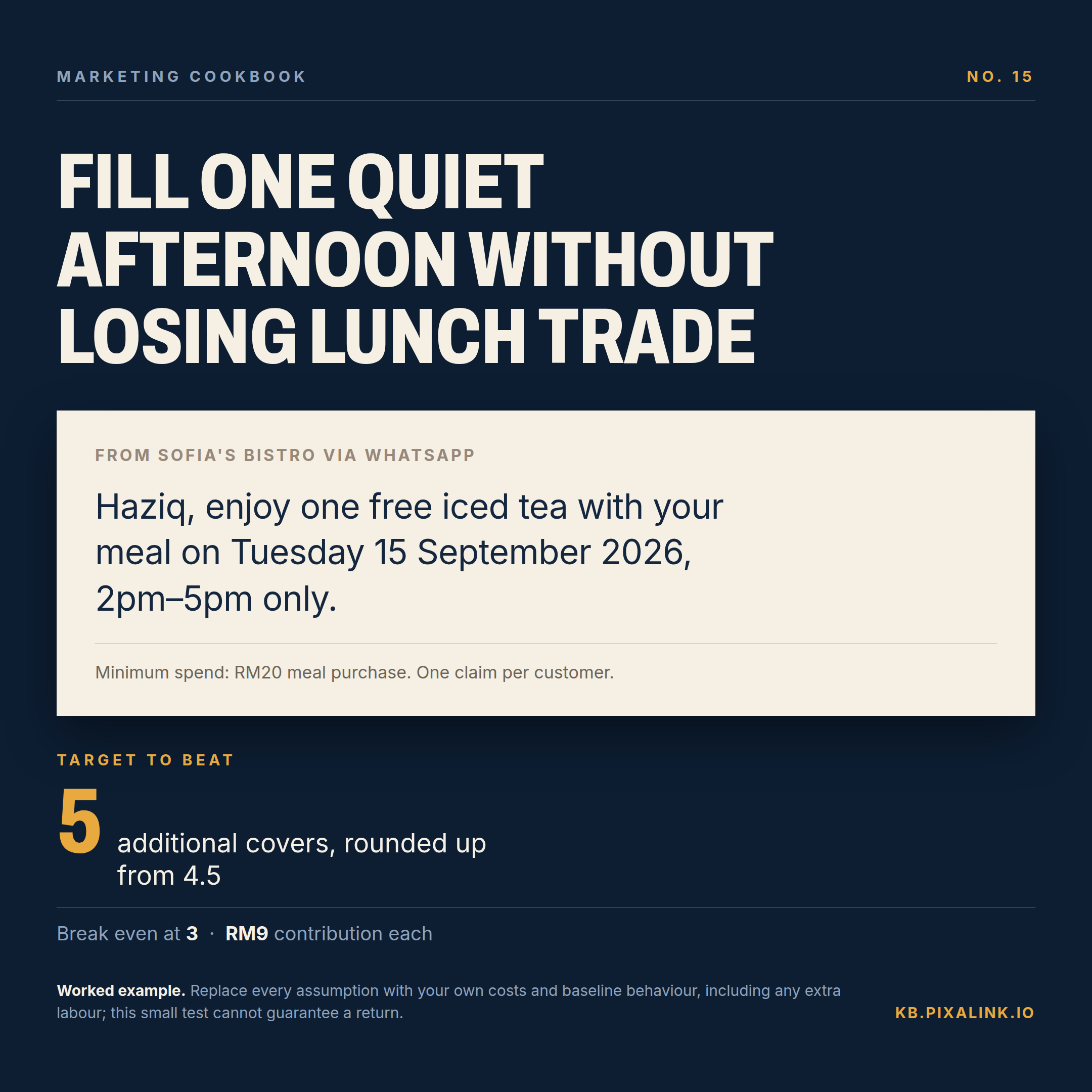
The same card at four sizes. Every figure on it comes from this article, and the message is the one written above — nothing on the card is generated.
Alt text for your post
Fill One Quiet Afternoon Without Losing Lunch Trade. One afternoon only: six customers can each buy a RM20 meal and receive a free iced tea costing RM2, on 15 September 2026 from 2pm to 5pm. Staff enforce the hours. Replace every assumption with your own costs and baseline behaviour, including any extra labour; this small test cannot guarantee a return.
Closing invitation
Choose one quiet afternoon and an offer your team can honour consistently. Let Sofia’s small test be a starting point: measure the extra customer value before giving another date the same budget.