
Habit Builders
Reward Repeat Spending Without Counter Arguments
Could the reward stay locked until Ganesh has actually earned it, giving him a reason to return afterwards?

A worked example
- RM12
- Contribution per incremental action
- 10
- Break-even actions
- 15
- Minimum target
incremental return visits
incremental return visits
At a glance
The business problem
Mei’s leak is inconsistent eligibility: customers receive value before meeting the intended condition. Suppose each exception costs RM4; two a week lose RM8 before counting the time spent arguing.
Her useful goal is contribution from a return visit after a spending milestone. Ganesh’s ordinary monthly purchase is the starting point, so moving that same purchase forward is not automatically growth.
Why the usual promotion falls short
Writing a minimum spend in voucher terms leaves Mei’s cashiers defending a rule at redemption. A cumulative unlock changes the decision: purchases build towards eligibility before the customer can claim the reward.
This controls who can claim, not how they spend when using it. Mei removes the redemption minimum from this offer rather than expecting the unlock condition to enforce one.
What you set up in Pixalink
Opening scenario
Mei is behind her pharmacy counter in Cheras when Ganesh questions another voucher. She has written “minimum spend RM150”, but he buys supplements monthly and knows a complaint can soften the rule. Her cashiers have this argument twice a week, and each exception gives away margin without earning anything extra.
Mei, Ganesh and this pharmacy are fictional; all figures in this article are illustrative. She wants to recognise repeat spending without asking staff to negotiate who deserves a benefit. Could the reward stay locked until Ganesh has actually earned it, giving him a reason to return afterwards?
The recipe
The campaign recipe
Use these assumptions for a small pharmacy trial. Replace the earning conversion and costs with the pharmacy’s actual figures before launch.
| Recipe element | Recommended starting point |
|---|---|
| Suitable industries | Pharmacies and repeat-purchase retail |
| Primary goal | Earn an additional profitable visit after a spending milestone |
| Customer segment | Existing members who buy regularly and are approaching the threshold |
| Offer | Accumulate 150 points to unlock one fixed benefit: a toiletries gift worth RM10, costing Mei RM4; customer still taps to claim |
| Validity | 21 days from unlock; a 7-day distribution window for the trial |
| Minimum spend | None at redemption; assume RM1 earns 1 point, making the cumulative threshold equivalent to RM150 across purchases |
| Quantity or budget limit | Forecast 20 benefits and reserve RM80 for gifts; this is a planning budget, not a verified automatic quantity cap |
| Main success metric | Second-visit contribution after unlock, adjusted for visits that would happen anyway |
The message your customer receives
This message is fictional, like the merchant and customer. All figures are illustrative.
From Mei's pharmacy via WhatsApp
Ganesh, you've claimed your toiletries gift worth RM10. Collect it at the pharmacy within 21 days of unlock.
No minimum spend to collect your gift. One gift per customer.
The journey
Follow the customer
- Buy as normal. Ganesh makes his usual purchase, with no extra counter rule to dispute. The offer does not require a larger single basket.
- Build towards the threshold. His purchases accumulate towards 150 points. This example assumes RM1 earns 1 point, not that points always equal ringgit.
- Unlock, then claim. On reaching the threshold, Ganesh can claim the benefit in his portal. He still taps to claim; the offer is valid for 21 days from unlock.
- Return and use it. Ganesh comes back for his gift and perhaps buys something he needs. Afterwards, he resumes ordinary shopping; this trial offers one claim, not a fresh reward after every milestone.
Use case: how the merchant applies it
Mei replaces her negotiable voucher with the toiletries gift, available to claim during the 7-day distribution window once the cumulative condition is met. Ganesh reaches 150 points, claims, then returns within the 21-day validity period. There is no redemption minimum and no promise that he must purchase to collect it.
Mei forecasts 20 benefits at RM4 each and reserves RM80. She observes returns through the last benefit’s expiry, then checks the following monthly buying cycle for purchases merely brought forward. Returning later is the campaign intention; the threshold alone does not enforce a separate visit.
How the platform helps
How Pixalink supports the strategy
Pixalink checks the cumulative points or wallet-credit threshold and unlocks the voucher for the customer to claim. It also enforces the configured distribution window, expiry and one claim. Staff do not decide whether Ganesh has earned eligibility.
The condition counts points or credits, not ringgit directly. An automatic overall budget cap and compulsory later-visit use are not established for this recipe; do not advertise either as enforced. Mei’s RM80 reserve is a forecast, so a business requiring a hard quantity ceiling should not launch on that assumption.
Configure this in Pixalink
Use How to Set Up Conditional Reward Distribution for the threshold setup. Keep the distinction between unlocking and claiming in the customer explanation.
The economics
ROI taste test
Suppose Ganesh’s genuinely additional return brings RM40 cash, with RM24 variable fulfilment cost and a separate RM4 gift cost. The gift is additional stock, so subtracting its cost does not double-count a discount already deducted from cash.
Campaign operating cost is RM120: RM100 for preparation and measurement, plus RM20 for five gifts on visits expected anyway. Using that allowance prevents ordinary returning customers’ rewards from disappearing from the calculation.
- Contribution per incremental action = cash collected - variable fulfilment cost - reward cost. Contribution per incremental action = RM40 - RM24 - RM4 = RM12.
- Break-even actions = campaign operating cost / contribution per incremental action. Break-even actions = RM120 / RM12 = 10 incremental return visits.
- Minimum target = break-even actions × 1.5, rounded up. Minimum target = 10 × 1.5 = 15 incremental return visits.
Claims and gift collections alone are not profit: a gift-only return costs RM4 without contributing cash. Replace every assumption with actual baskets, costs and baseline behaviour; increase costs for extra non-incremental gifts. These figures do not guarantee results.
Measure it
What to watch
- KPI 1 — Incremental return visits: compare post-unlock returns with the baseline for similar regulars, then check the next monthly cycle for a matching dip.
- KPI 2 — Second-visit contribution: total return cash less fulfilment and gift costs, adjusted for expected ordinary visits and campaign operating cost.
- KPI 3 — Reward cost: record actual gift cost against Mei’s RM80 reserve, including gifts collected without a purchase.
Common mistake: treating an unlocked or claimed reward as an additional sale. Ganesh might simply collect it during his usual shopping trip.
Safeguard: reserve stock and funding for every benefit made available, including gift-only returns. The forecast must not leave customers with an earned promise Mei cannot honour.
Keep when at least 15 incremental returns, positive net contribution and the safeguard hold. Improve a promising result with one bounded change to threshold or timing in a new test. Stop expansion if contribution is non-positive, the safeguard fails or the completed test misses its preset target; honour existing promises.
Your first test
Try this first
- Define regular members like Ganesh and their usual return pattern before the trial; retain a comparable baseline without claiming an automatic control-group feature.
- Limit exposure to the 7-day distribution window and reserve stock and funding; do not treat the 20-benefit forecast as a software cap.
- Set one 150-point offer, 21-day validity and a measurement window covering expiry plus the next monthly cycle.
- Record cash, fulfilment, all gift costs and operating cost; confirm the funding safeguard before making the offer available.
- Apply the 15-return keep/improve/stop rule and check whether purchases were additional before widening the campaign.
Questions
Frequently asked questions
Does RM150 in terms create this condition?
No. The condition checks earned points or credits; Mei’s RM150 equivalence depends on her illustrative earning rate.
Is the benefit issued automatically?
No. Ganesh must tap to claim after eligibility unlocks, during the distribution window; he then uses it before expiry.
Must Ganesh buy on the return visit?
Not in this offer. Mei budgets for gift-only collections and measures whether enough customers make additional profitable purchases.
Can Mei guarantee only 20 gifts?
Not from the verified controls described here. The 20-benefit figure forecasts exposure; a hard total cap needs separate verification before launch.
Share this recipe
A card you can post
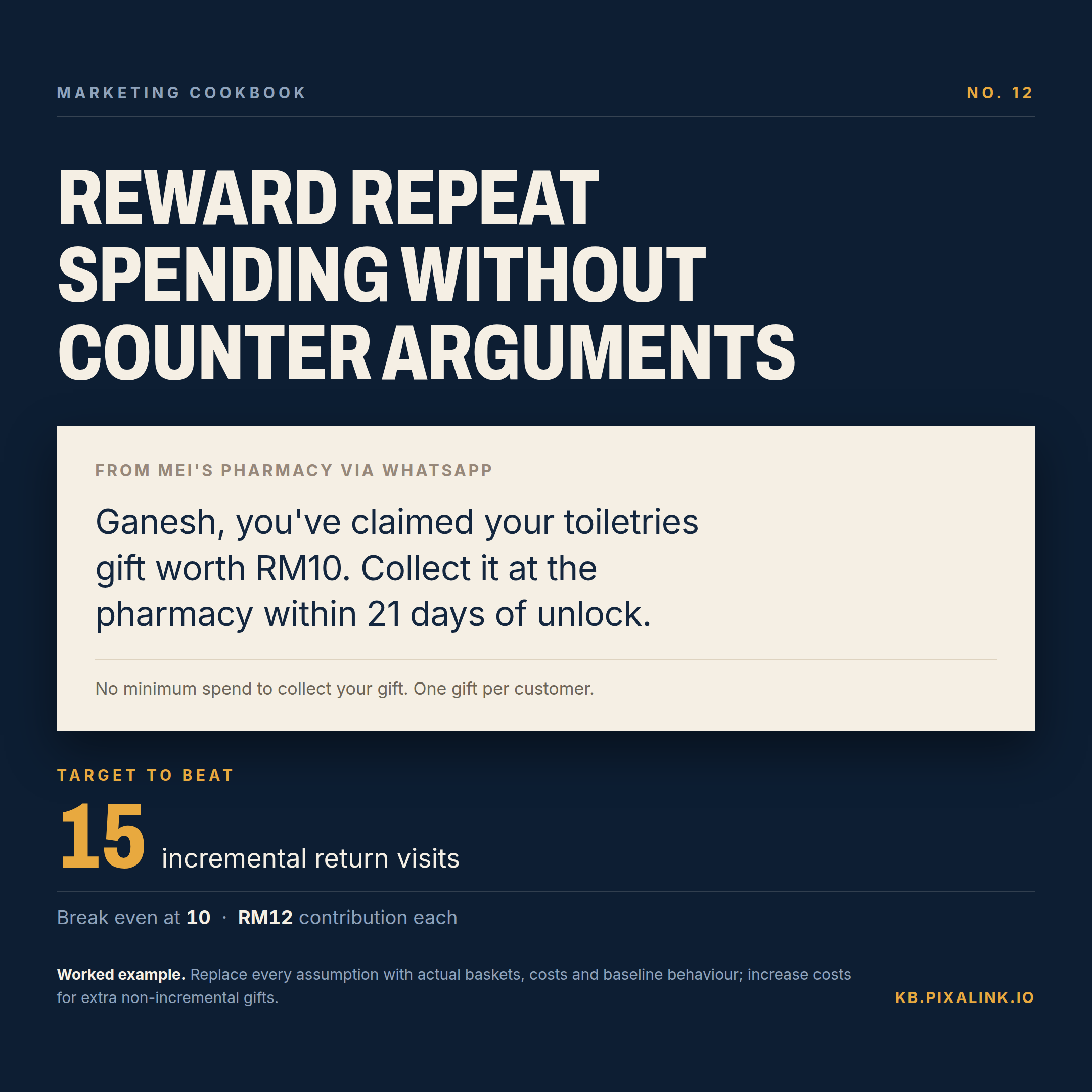
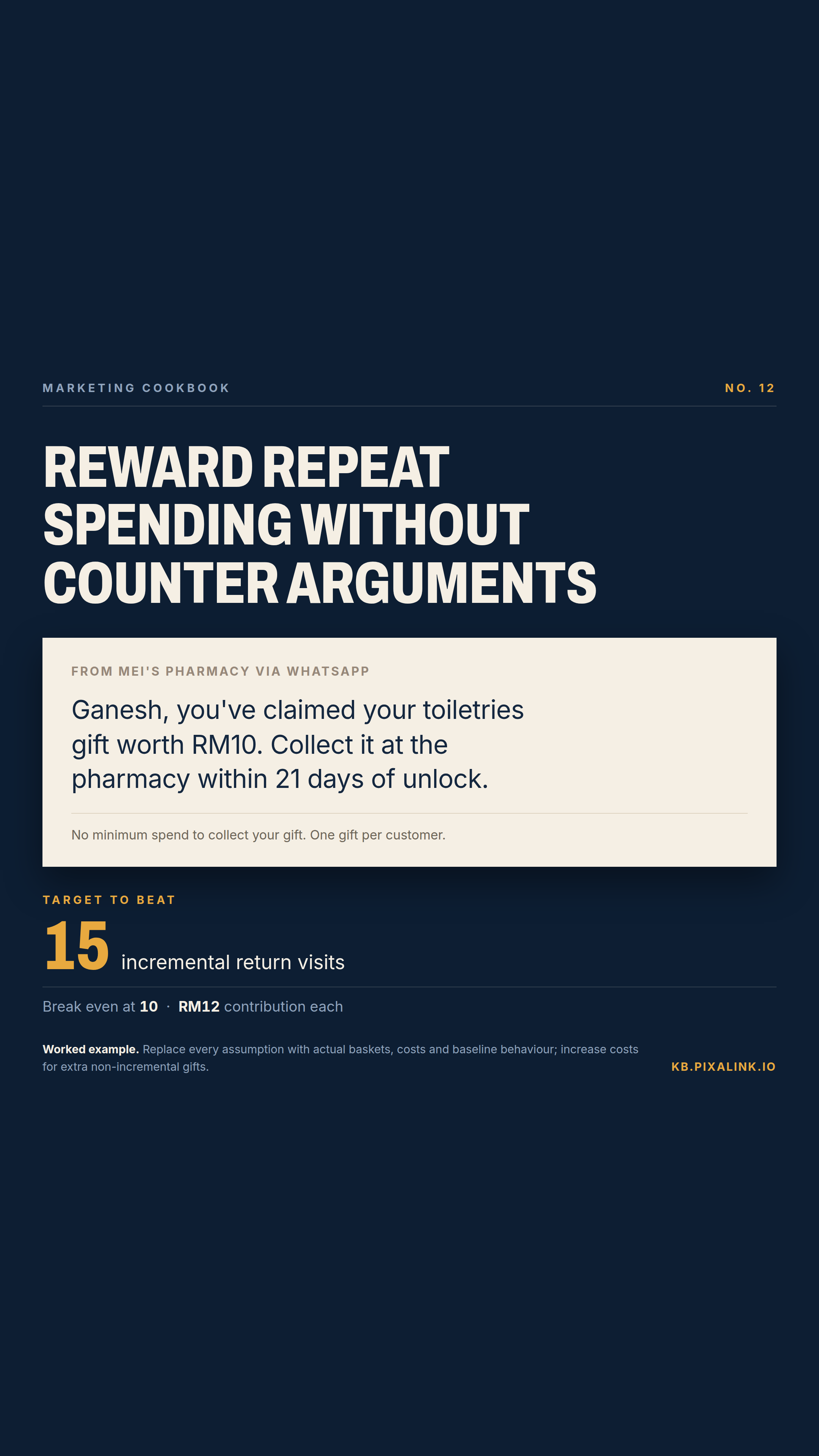
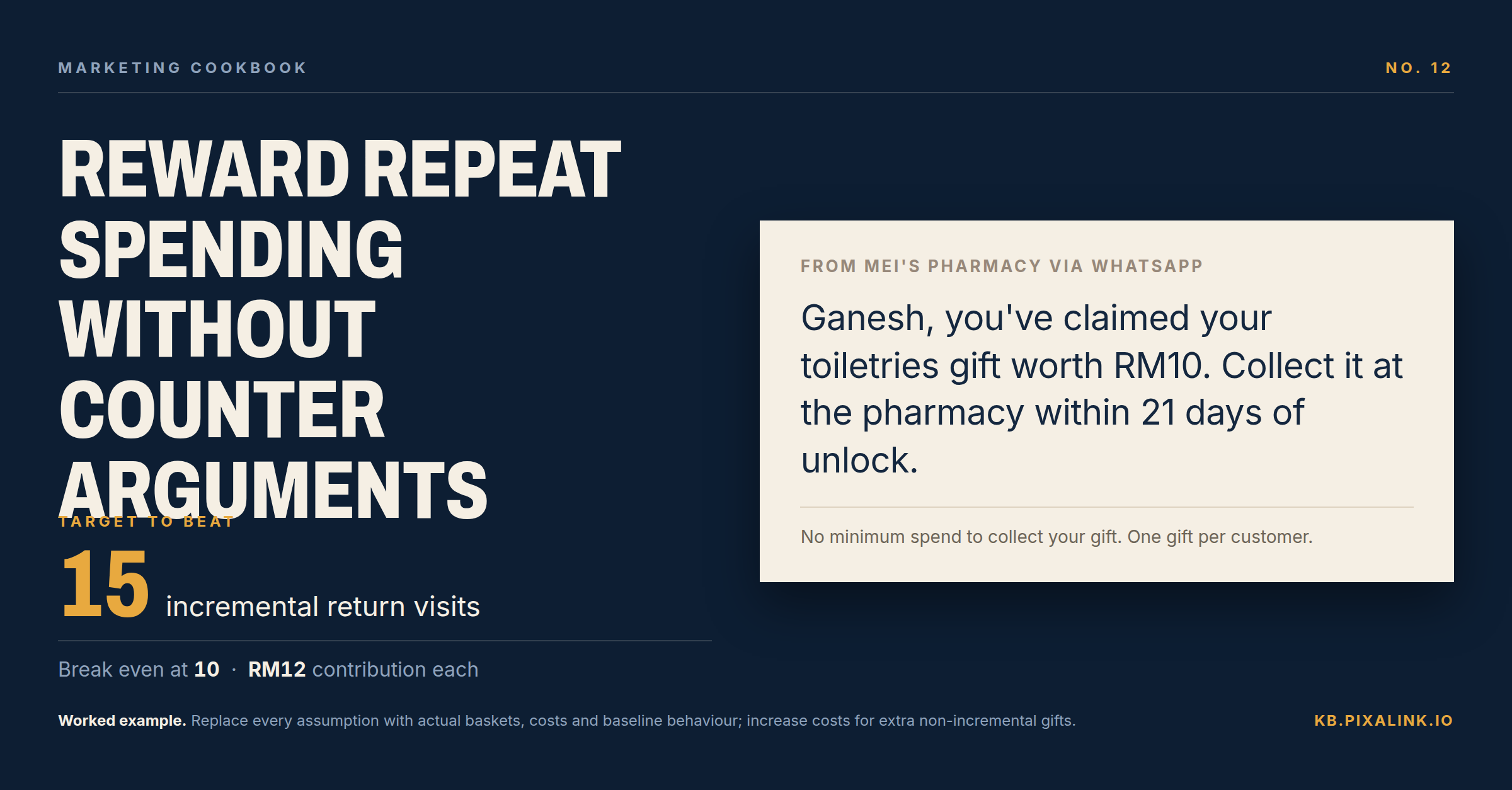
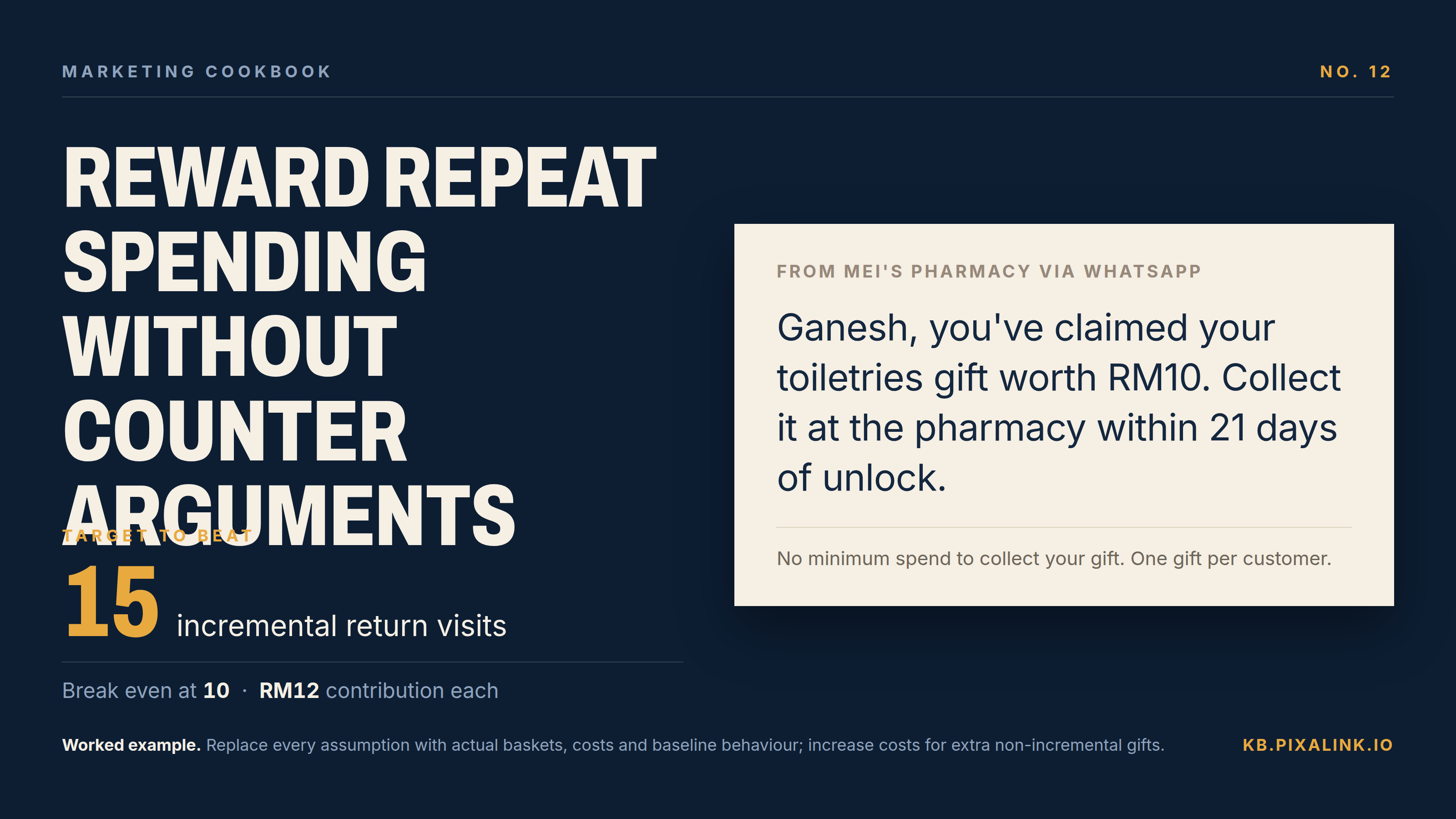
The same card at four sizes. Every figure on it comes from this article, and the message is the one written above — nothing on the card is generated.
Alt text for your post
Reward Repeat Spending Without Counter Arguments. Accumulate 150 points, equivalent to RM150 under the example earning rate, then tap to claim a gift worth RM10 costing the merchant RM4. Intended for a return within 21 days, with no redemption minimum spend. Replace every assumption with actual baskets, costs and baseline behaviour; increase costs for extra non-incremental gifts.
Closing invitation
Try one spending milestone with one affordable benefit and a short distribution window. Like Mei, judge it by additional customer value and promises kept before deciding whether to run it again.