
Habit Builders
Turn “I’ll Book Later” into an Attended Visit
Before Yasmin leaves the chair, could a specific appointment and a small benefit turn that intention into an attended visit?

A worked example
- RM90
- Contribution per incremental action
- 4
- Break-even actions
- 6
- Minimum target
additional attended visits
additional attended visits, rounded up
At a glance
The business problem
Amelia loses the next visit between agreement and action. A client can like the service without making space for it in her week. The useful outcome is an additional attended, paid visit; a fuller booking diary can still leave empty chairs after cancellations.
Why the usual promotion falls short
A discount offered immediately rewards today’s purchase, even when Yasmin never returns. A gift released simply for booking can also cost Amelia money on a cancelled appointment. Holding a modest add-on for attendance keeps the expense attached to the behaviour she wants to test.
What you set up in Pixalink
Opening scenario
Amelia finishes Yasmin’s treatment at her aesthetics clinic in Damansara. Yasmin reaches for her handbag and says she will message to book again, although she has meant to arrange a follow-up since February. Amelia knows the afternoon routine: chasing clients who intended to return but never chose a date.
Her next round of follow-up work could absorb RM260 in staff time. Amelia, Yasmin and the clinic are fictional, and all figures in this article are illustrative. Before Yasmin leaves the chair, could a specific appointment and a small benefit turn that intention into an attended visit?
The recipe
The campaign recipe
Ask while the client is still there and offer a specific date. Six weeks is this fictional clinic’s starting point for clients whose follow-up is already appropriate then, not a treatment recommendation.
| Recipe element | Recommended starting point |
|---|---|
| Suitable industries | Aesthetics clinics and appointment businesses with suitable repeat visits |
| Primary goal | Convert intentions into additional attended, paid visits |
| Customer segment | Existing clients due a suitable follow-up in six weeks who have not booked |
| Offer | Book before leaving; receive one take-home care-pack add-on worth RM25, costing RM10, only at the attended visit |
| Validity | Appointment six weeks out; usable from day 42, expires at the end of day 49 after enrolment; staff verify actual voucher dates |
| Minimum spend | RM180 paid follow-up visit; no separate add-on charge; staff check the purchase |
| Quantity or budget limit | 20 offered clients and 20 packs; RM200 reward provision plus RM260 staff time = RM460 maximum outlay, controlled by staff |
| Main success metric | Additional attended, paid visits compared with an equal comparison group |
The message your customer receives
This message is fictional, like the merchant and customer. All figures are illustrative.
From Amelia's clinic via WhatsApp
Yasmin, book your follow-up before leaving and receive one take-home care pack worth RM25 when you attend. Valid from day 42 until the end of day 49 after you join this offer.
Minimum spend RM180 on your paid follow-up visit. No separate charge for the care pack.
The journey
Follow the customer
- Choose an occasion. Amelia asks Yasmin, “Same time in six weeks?” They check that the proposed follow-up suits her needs and schedule.
- Book before leaving. Yasmin agrees the date and time while still in the chair. Staff record the appointment and explain the RM180 qualifying visit.
- Have something waiting. Staff reserve the care pack against that appointment in their register. Yasmin understands that it is not usable early and attendance is required.
- Attend and receive. Yasmin returns for the paid visit, and staff check eligibility before releasing the pack. Afterwards, they discuss her next appropriate visit without promising another automatic reward.
flowchart LR
    A[Agree a suitable time] --> B[Book before leaving]
    B --> C[Add-on waits for attendance]
    C --> D[Attend and receive]
Use case: how the merchant applies it
Amelia selects 40 comparable clients and randomly splits them into 20 offered clients and 20 comparison clients receiving usual follow-up. She records their previous attendance before starting. Both groups keep normal care; only the offered group receives the booking ask plus add-on package being tested.
Yasmin books six weeks ahead and joins the offer group. Amelia’s staff record enrolment, appointment, voucher dates and collection, reserving a pack costing RM10. The RM25 benefit accompanies the RM180 visit once, within the day 42–49 window; it is not a cash discount.
If Yasmin cancels, the pack stays at the clinic. A rescheduled visit qualifies only within the original window; staff explain this before enrolment and handle exceptions themselves. They do not promise that changing an appointment moves voucher dates or restores a used benefit.
How the platform helps
How Pixalink supports the strategy
Pixalink supports tag-based assignment, activation delay, expiry and one-time use. Amelia’s team applies the campaign tag after the booking agreement and checks the resulting usable-from and expiry dates. Automatic appointment-linked release, attendance verification and cancellation handling are not supported controls for this recipe; staff manage them.
An activation delay is a time lock, not an attendance check. The hold must apply at the till too: staff must not accept the add-on before its usable-from date or mark it already redeemed to bypass the wait. Staff also enforce the RM180 purchase condition and the 20-client budget cap.
Configure this in Pixalink
Use Auto-Assign Rewards by Customer Tag, How the Reward Activation Delay Works and What Voucher Expiry Dates Mean in Pixalink. Confirm the displayed dates cover the promised appointment before inviting clients.
The economics
ROI taste test
For Amelia, the incremental action is an additional attended, paid follow-up. Assume RM180 cash collected, RM80 variable fulfilment cost and RM10 care-pack cost, including handling; keep the pack out of fulfilment cost to avoid counting it twice.
Campaign operating cost is RM360: RM260 staff time plus RM100 for packs on ten expected baseline returns. Those clients would attend anyway, so their gifts remain a campaign expense. The RM460 maximum provision covers all 20 packs and staff time.
- Contribution per incremental action = cash collected - variable fulfilment cost - reward cost.
- Contribution per incremental action = RM180 - RM80 - RM10 = RM90.
- Break-even actions = campaign operating cost / contribution per incremental action.
- Break-even actions = RM360 / RM90 = 4 additional attended visits.
- Minimum target = 4 × 1.5 = 6 additional attended visits, rounded up.
Count what changed
If 16 offered clients attend and ten comparison clients attend by day 49, estimated uplift is six visits: RM540 contribution less RM360 leaves RM180. Bookings, claims and redemptions are not automatically profit, and Yasmin might have returned anyway. Replace every price, cost and behaviour assumption, recalculate baseline gift costs from the comparison result, and treat this small test as uncertain evidence without guaranteed results.
Measure it
What to watch
- KPI 1 — Incremental attended visits: offered-group paid attendance minus comparison-group paid attendance within the same window.
- KPI 2 — Attendance rate: qualifying attended visits divided by bookings made before leaving.
- KPI 3 — Net incremental contribution: uplift contribution less staff time and reward costs on baseline visits.
Common mistake: celebrating bookings made as though they were completed visits. Amelia should wait for Yasmin’s attendance before counting the return.
Safeguard: keep one staff-controlled appointment-and-benefit register covering eligibility, dates, cancellations, pack collection and budget. Pause invitations if staff cannot honour or enforce its terms.
Keep when at least six additional visits and the safeguard hold. Improve in a fresh test if the target holds but cancellations remain high, changing only the timing of the ask. Stop expansion if contribution is non-positive, the safeguard fails or the test misses six.
Your first test
Try this first
- Define 40 comparable eligible clients, record baseline attendance and randomly allocate equal offered and comparison groups.
- Cap exposure at 20 offered clients, 20 packs and RM460 maximum outlay.
- Fix the add-on, six-week appointment and day 49 measurement deadline before enrolment.
- Record cash, fulfilment and every reward cost; check the appointment-and-benefit register throughout.
- Apply the pre-set keep, improve or stop rule after both groups finish observation.
Questions
Frequently asked questions
Does booking alone earn the pack?
No, it reserves the promise. Yasmin receives it only after the qualifying attended, paid visit and staff check.
What happens after cancellation?
Staff retain the pack and record the cancellation. Rebooking must fit the original window; automatic cancellation or deadline changes are not supported here.
Can the add-on be used before the appointment?
Staff must refuse early use, even after the time lock opens. A usable voucher does not prove that the qualifying appointment happened.
Must every client return in six weeks?
No, use this pilot only where that follow-up is already suitable. A reward should not determine a client’s treatment schedule.
Share this recipe
A card you can post
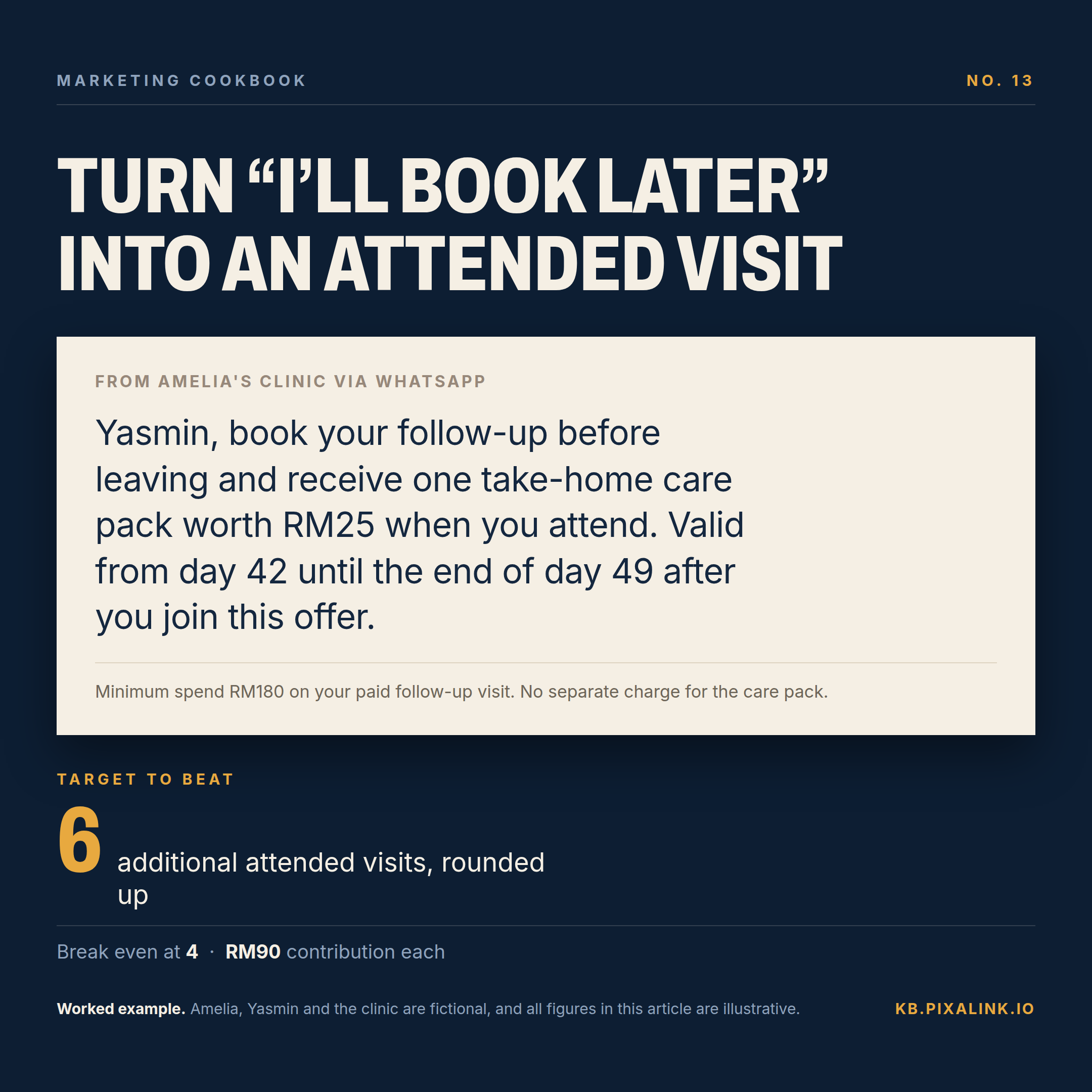
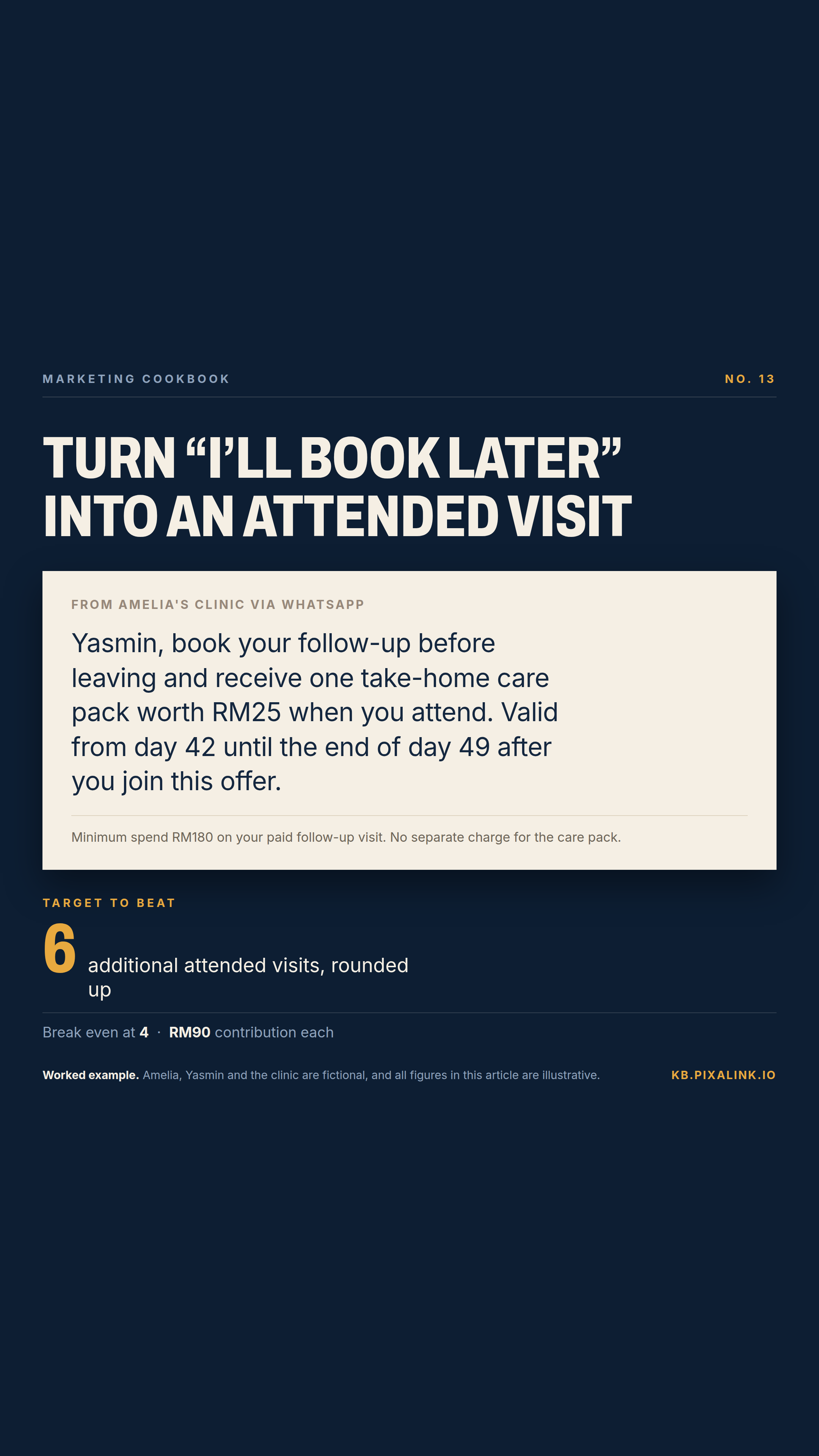
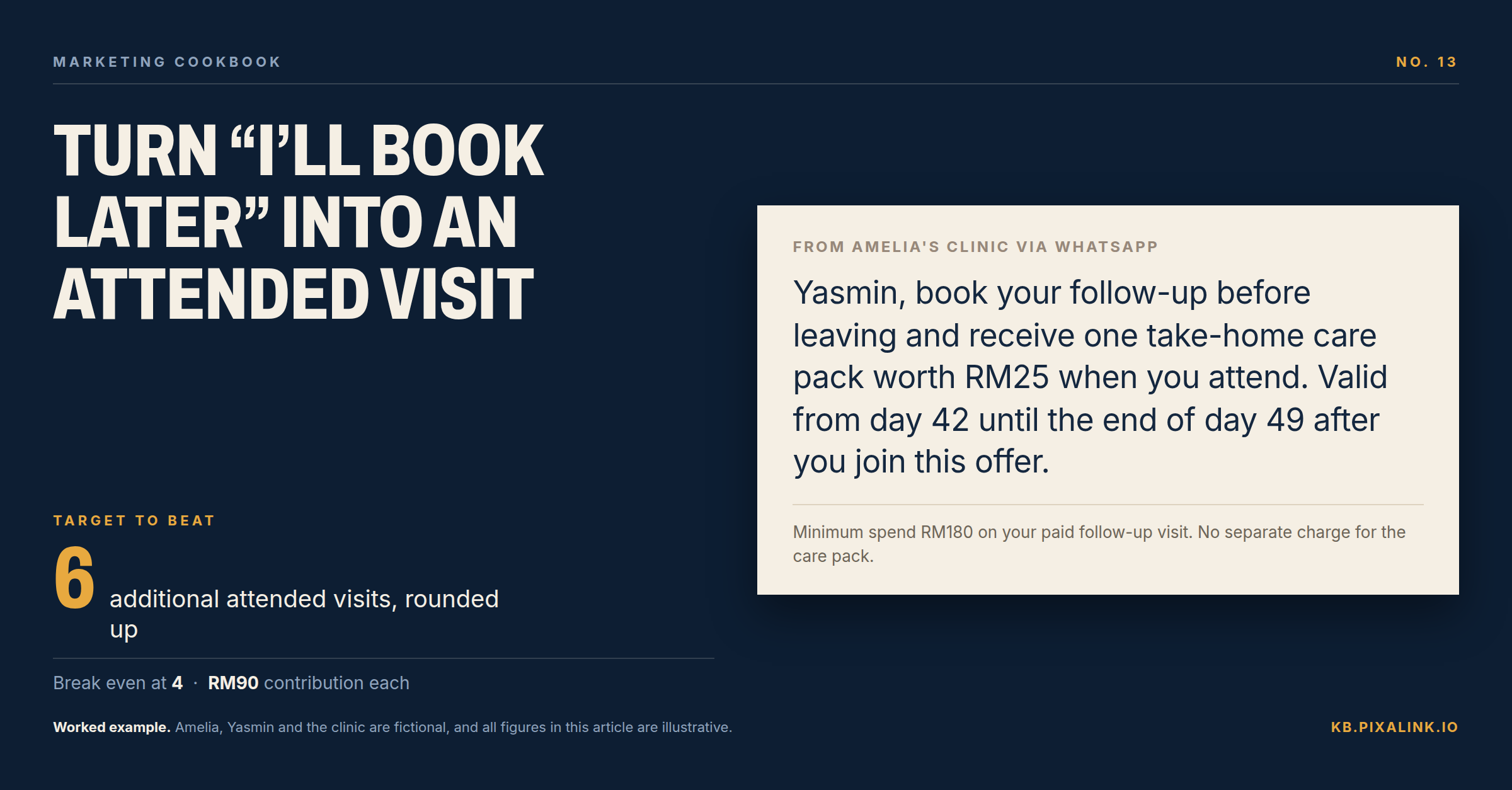
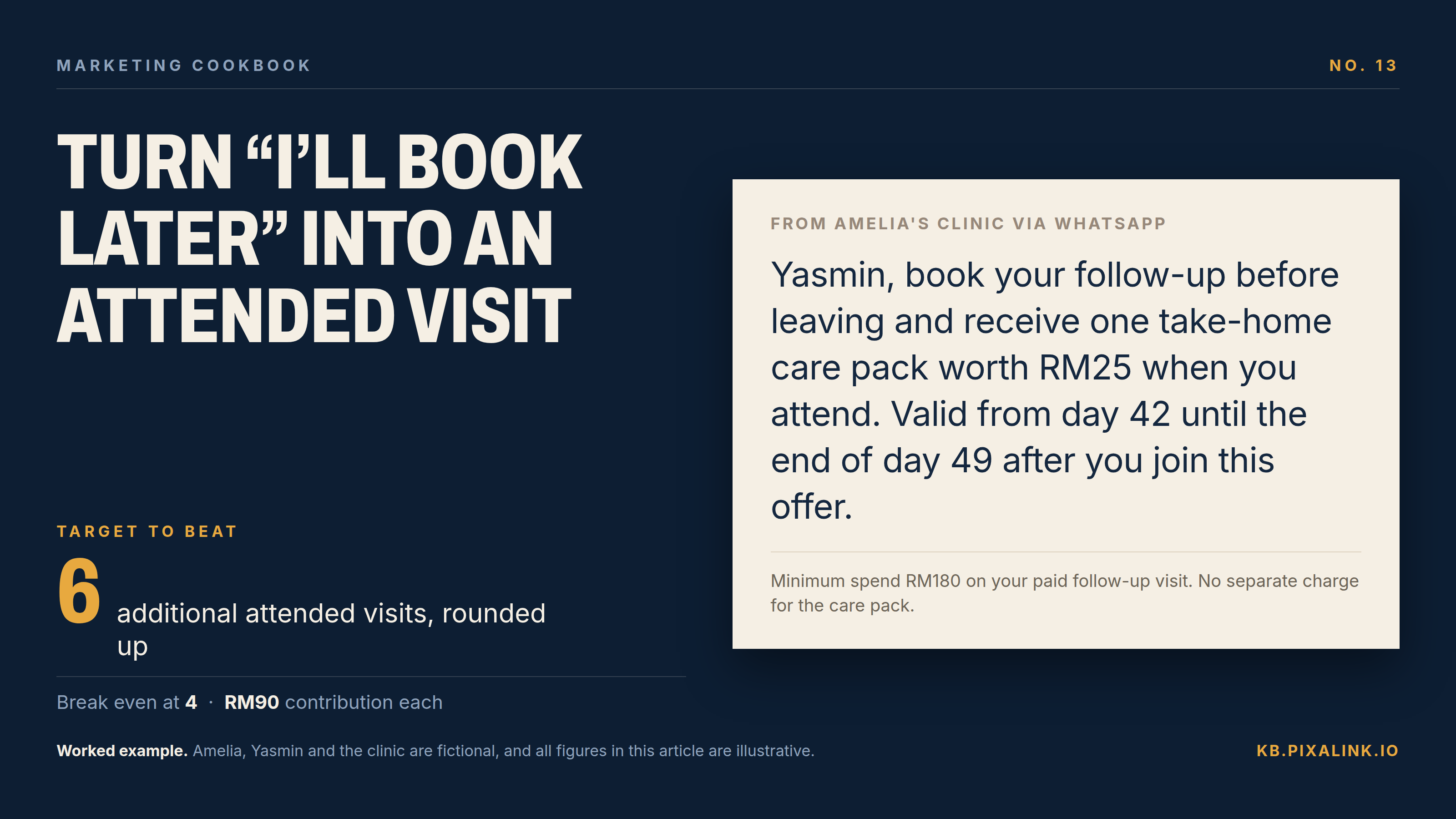
The same card at four sizes. Every figure on it comes from this article, and the message is the one written above — nothing on the card is generated.
Alt text for your post
Turn “I’ll Book Later” into an Attended Visit. Book before leaving for six weeks out. The RM25 care pack is held until attendance, usable from day 42 through day 49. Staff confirm the RM180 paid visit before releasing the pack, which costs the clinic RM10. Amelia, Yasmin and the clinic are fictional, and all figures in this article are illustrative.
Closing invitation
Choose one suitable group and an add-on Amelia can afford to honour. Give the next Yasmin a clear occasion to return, then let additional attended visits decide whether the offer deserves another run.