
Habit Builders
Give Car Wash Customers a Reason to Return with Prepaid Credit
Could a prepaid balance give her a reason to return without another counter discount?

A worked example
- RM45
- Contribution per incremental action
- 5
- Break-even actions
- 8
- Minimum target
additional four-wash packages
additional four-wash packages, rounded up from 7.5
At a glance
The business problem
Farid’s leak is repeated price competition for customers whose next visit is still undecided. Discounting 20 washes by RM3 gives away RM60, including reductions for people who would have come anyway.
He wants Michelle to commit spending to his wash before her next price comparison. That brings cash forward, but also commits him to delivering future service.
Why the usual promotion falls short
A cheaper wash leaves Michelle free to choose the cheapest rival next time. A prepaid bonus changes the timing: pay RM100 now and receive RM110 of wash credit to spend here.
The incentive still has a cost, even though Farid keeps the wash’s listed price unchanged. The test is whether the balance brings back enough business to justify that cost; prepayment cannot guarantee four visits.
What you set up in Pixalink
Opening scenario
Michelle collects her keys at Farid’s car wash in Kuantan, already wondering which wash will be cheapest next week. Farid competes with three others on the same road; whenever he cuts his price, someone matches it within a fortnight. His latest RM3 reduction brings cars through the bay but leaves less money from each wash.
Farid, Michelle and this business are fictional, and all figures in this article are illustrative. Michelle needs regular washes, yet Farid keeps paying to win her back one visit at a time. Could a prepaid balance give her a reason to return without another counter discount?
The recipe
The campaign recipe
| Recipe element | Recommended starting point |
|---|---|
| Suitable industries | Car washes with regular repeat demand; Farid tests at his Kuantan wash |
| Primary goal | Collect upfront payment and encourage four return washes |
| Customer segment | Regular car washers who currently alternate between Farid and competitors |
| Offer | Load RM100, receive RM110 of wash credit: RM10 bonus, equivalent to 10% of the load |
| Validity | No expiry for this pilot; introduce one only if defensible and clearly explained |
| Minimum spend | RM100 load; no extra minimum basket for spending the balance; example wash RM27.50 |
| Quantity or budget limit | Staff control: 20 loads, one per customer; RM200 face-value bonus exposure; RM225 operating budget |
| Main success metric | Incremental contribution after comparison with normal visits; aim for eight fully incremental four-wash equivalents |
Four washes at RM27.50 use RM110. Assume RM13.75 variable cost per wash: RM55 total, allocated as RM50 for paid credit and RM5 for bonus credit fulfilment.
The message your customer receives
This message is fictional, like the merchant and customer. All figures are illustrative.
From Farid's car wash via WhatsApp
Michelle, load RM100 and receive RM110 of wash credit for future visits. Your credit has no expiry.
Minimum load RM100. No extra minimum spend when using your balance. One promotional load per customer.
The journey
Follow the customer
- Discover: While Michelle pays separately for today’s wash, Farid offers RM110 of future wash credit for RM100. He explains the bonus and the unspent-balance refund policy.
- Load: Michelle accepts because she washes regularly and understands the value. Her new balance is available for future washes here.
- Return: Next time, Michelle has a balance with Farid and none at the rival wash. She chooses Farid and uses RM27.50, leaving RM82.50; two more identical washes leave RM55, then RM27.50.
- Choose again: After the fourth RM27.50 wash, Michelle’s balance is gone. Farid offers the top-up again if the test supports continuing, and she decides whether to accept.
flowchart LR
    A[Hear the offer] --> B[Load wash credit]
    B --> C[Return and spend]
    C --> D[Balance gone: choose again]
    D -. If offered and accepted .-> B
Use case: how the merchant applies it
Farid offers the pilot at the counter for two weeks, stopping after 20 customers each buy one load. He follows their return visits for 12 weeks after loading; this measurement window does not expire their balances.
Michelle pays RM100 for future spending, receiving RM10 extra credit without another purchase condition. There is no extra reward after each wash, and reloading is a fresh choice, not automatic renewal.
Farid budgets for all 80 possible washes, even if some happen after the review. Staff keep the participant list and stop further pilot sales manually; neither the customer limit nor the campaign budget is presented as a Pixalink-enforced cap.
How the platform helps
How Pixalink supports the strategy
Pixalink handles the top-up amount, bonus amount, wallet balance and spend deduction. Farid uses those controls for the RM100 load and RM10 bonus, then records wash visits separately for the pilot comparison.
Farid enforces the refund policy on unspent balances. Automatic pilot enrolment limits, renewal offers and campaign ROI reporting are not established for this recipe; plan those tasks manually and confirm the offer cannot remain available outside the controlled pilot before starting.
Configure this in Pixalink
Use How to Set Up Credit Top-Up Settings for the amount and bonus configuration. Keep the campaign decision and staff instructions alongside the setup.
The economics
ROI taste test
Count one incremental action as a fully additional four-wash package, not a wallet load alone. Michelle’s RM100 pays for all four washes; the RM55 fulfilment cost splits into RM50 for paid value and RM5 for bonus value, so the bonus is not counted twice.
- Contribution per incremental action = cash collected - variable fulfilment cost - reward cost. Contribution per incremental action = RM100 - RM50 - RM5 = RM45.
- Break-even actions = campaign operating cost / contribution per incremental action. Break-even actions = RM225 / RM45 = 5 additional four-wash packages.
- Minimum target = break-even actions × 1.5, rounded up. Minimum target = 5 × 1.5 = 8 additional four-wash packages, rounded up from 7.5.
Allow for visits you already had
Twenty fully used loads contribute RM900 before campaign operating cost. If those customers would otherwise have bought 36 full-price washes, their baseline contribution is 36 × RM13.75 = RM495; the campaign adds RM405 before operating cost, or nine RM45 package equivalents, leaving RM180 after RM225 operating cost.
That example clears the eight-equivalent target, but it is not a forecast. Compare with a similar group receiving no offer, reserve fulfilment costs for unspent balances, and replace every assumption with actual prices, costs, fees, refunds and behaviour; earlier cash collection alone is not extra profit.
Measure it
What to watch
- Visits per loaded customer: Compare Farid’s pilot with baseline and a similar group receiving no offer over the same period.
- Balance burn-down: Track how much of Michelle’s and the group’s original credit is spent, and what remains owed in service.
- Incremental contribution: Deduct displaced normal contribution and campaign costs; translate the pre-operating-cost uplift into RM45 package equivalents.
Common mistake: Counting every load as new business. Michelle may simply prepay visits she would already have made.
Safeguard: Explain and record the unspent-balance refund policy before accepting payment, including how bonus credit is treated. Farid must administer it and retain enough funds to honour it.
Keep when at least eight incremental package equivalents and the safeguard hold. Improve a promising result above that threshold by changing one timing or segment assumption in the next capped test; stop if contribution is non-positive, the safeguard fails or the test misses the threshold.
Your first test
Try this first
- Select regular car washers who shop around; record their baseline and choose a comparable group receiving no offer.
- Cap the pilot manually at 20 customers, one load each, and RM200 bonus face value.
- Use one RM100-to-RM110 offer for two weeks and measure each customer for 12 weeks without expiring balances.
- Record cash, fulfilment costs, remaining balances and refund-policy compliance against the RM225 operating budget.
- Apply the eight-equivalent keep/improve/stop rule before offering Michelle another promotional load.
Questions
Frequently asked questions
Must customers finish within 12 weeks?
No; that is the review window, not an expiry date. Farid continues to honour the pilot balance afterwards.
Does RM110 always mean four washes?
Only at the illustrative RM27.50 price. Different services or prices change the number of visits the balance covers.
Can Pixalink stop after 20 loads?
An automatic campaign cap is not verified for this recipe. Staff must control participation and close the offer when the limit is reached.
What happens if Michelle wants her money back?
Farid follows the unspent-balance refund policy explained before purchase. The wallet does not decide that policy for him, and the RM10 bonus should not be described as cash.
Share this recipe
A card you can post
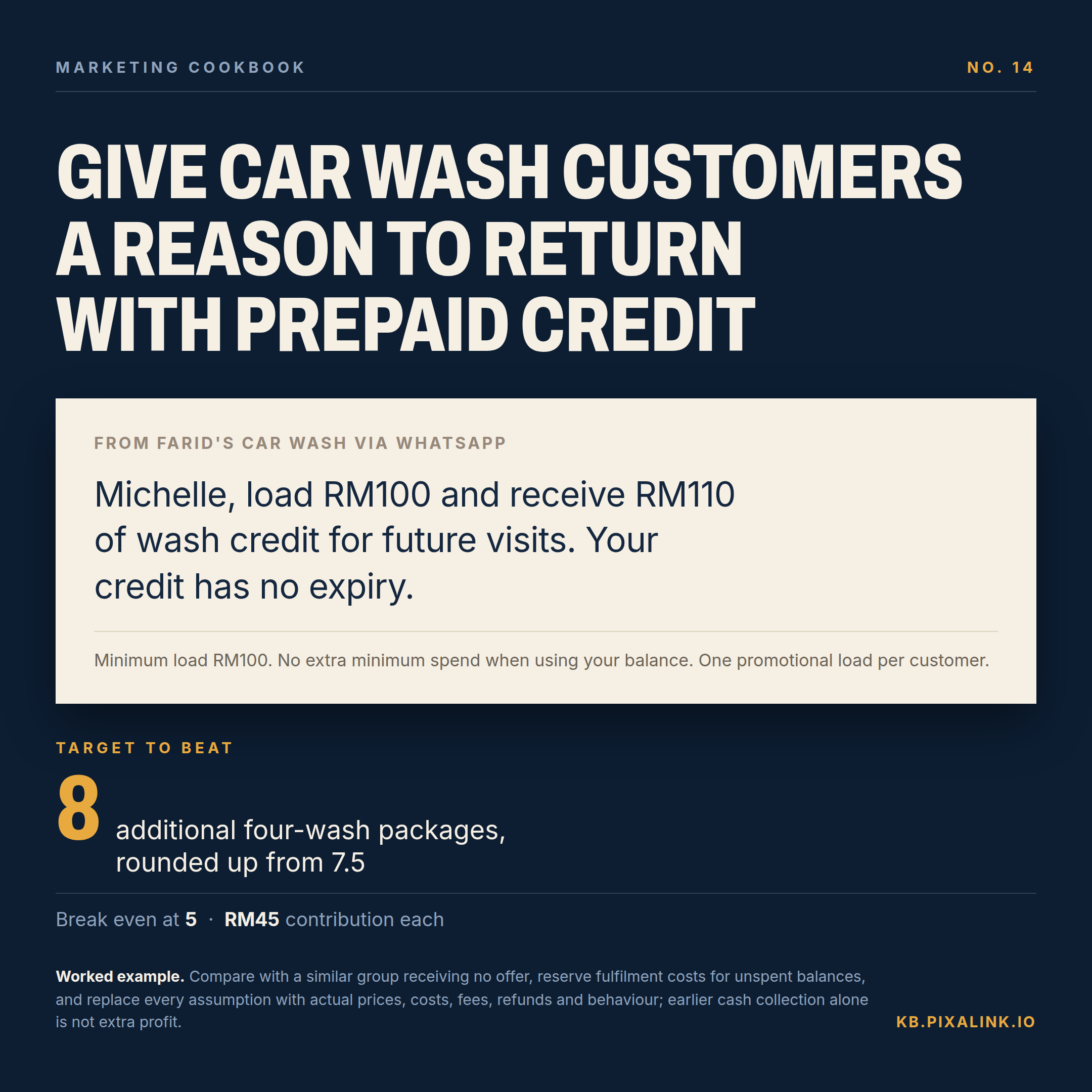
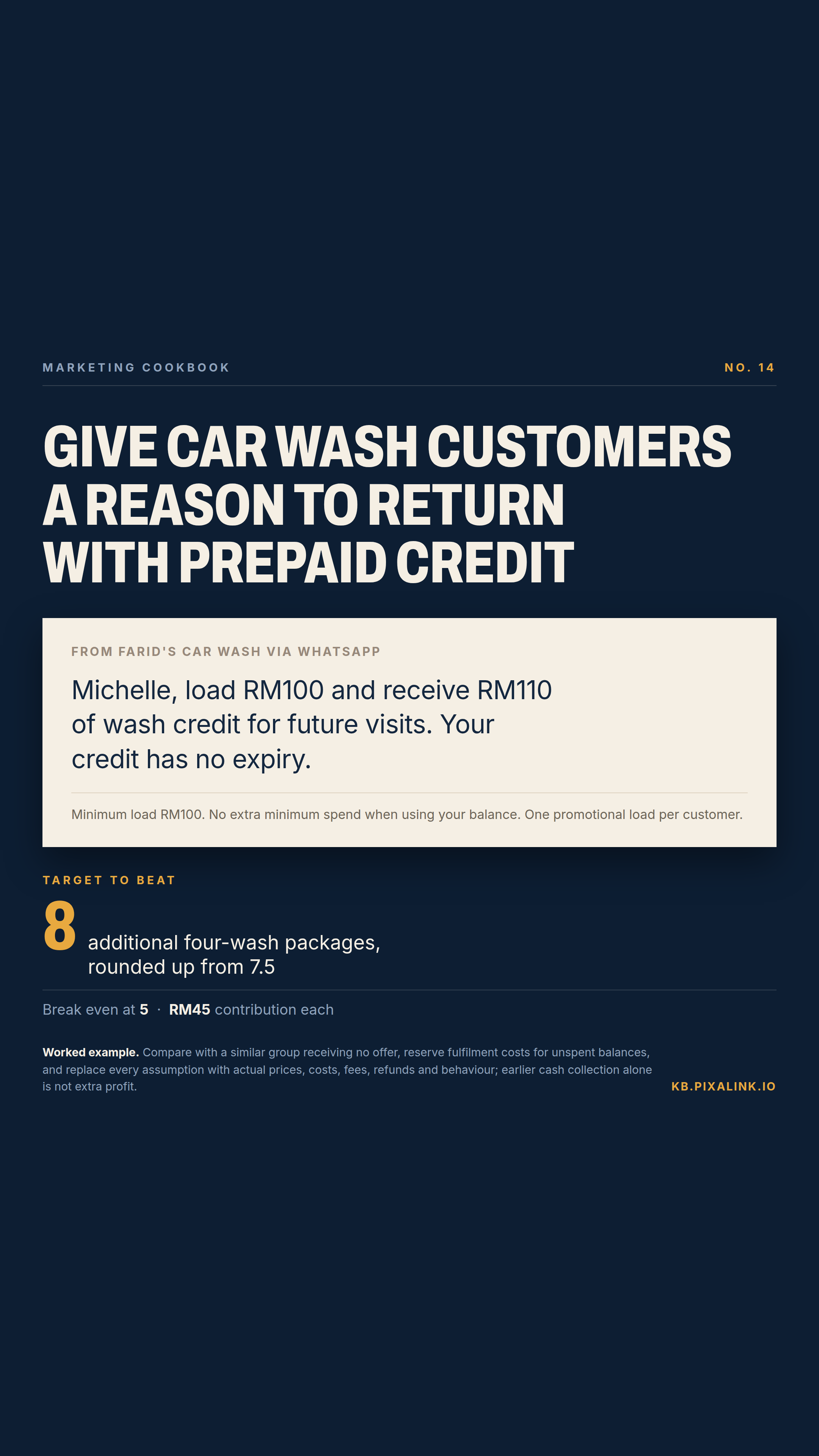
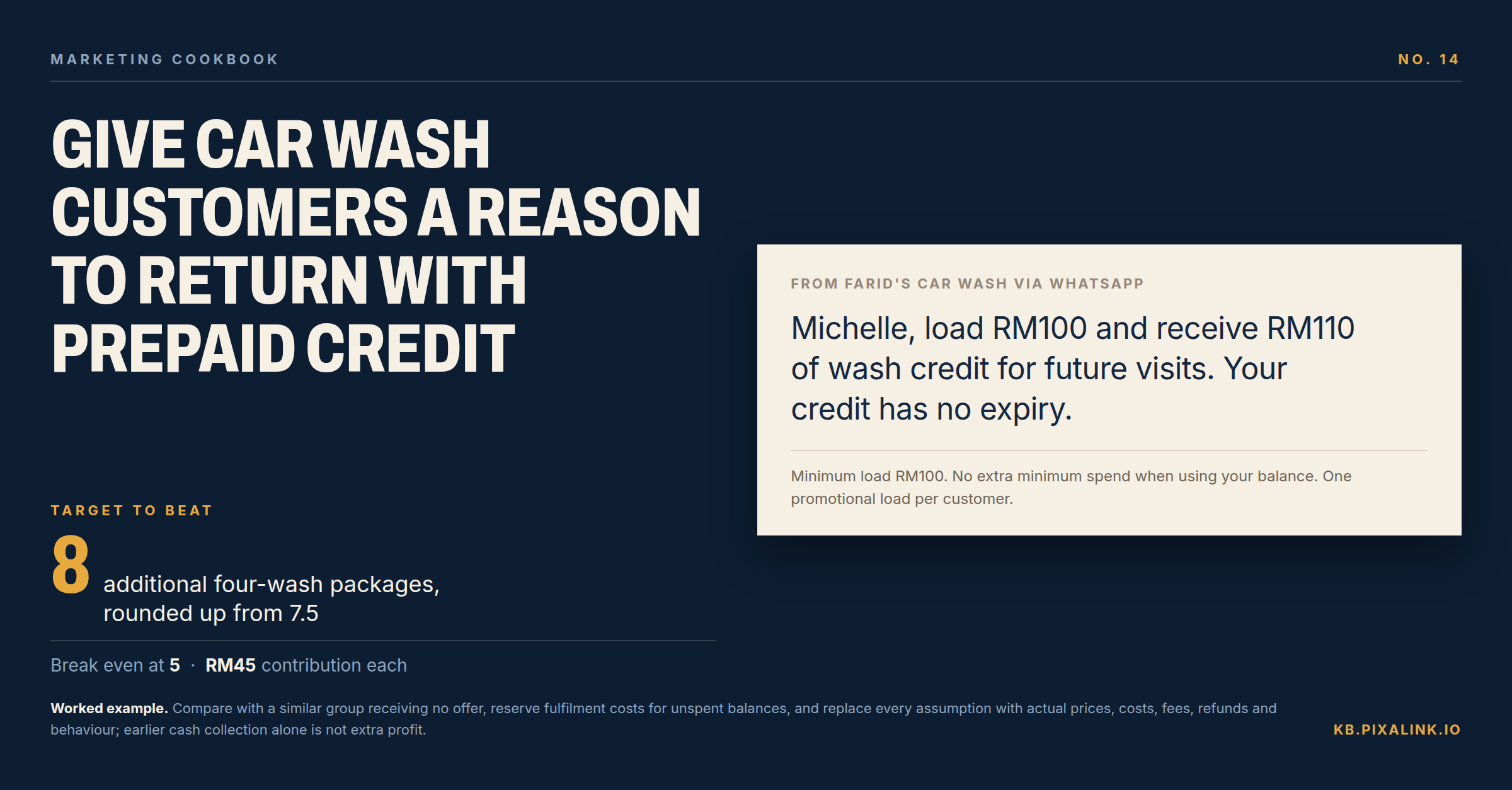
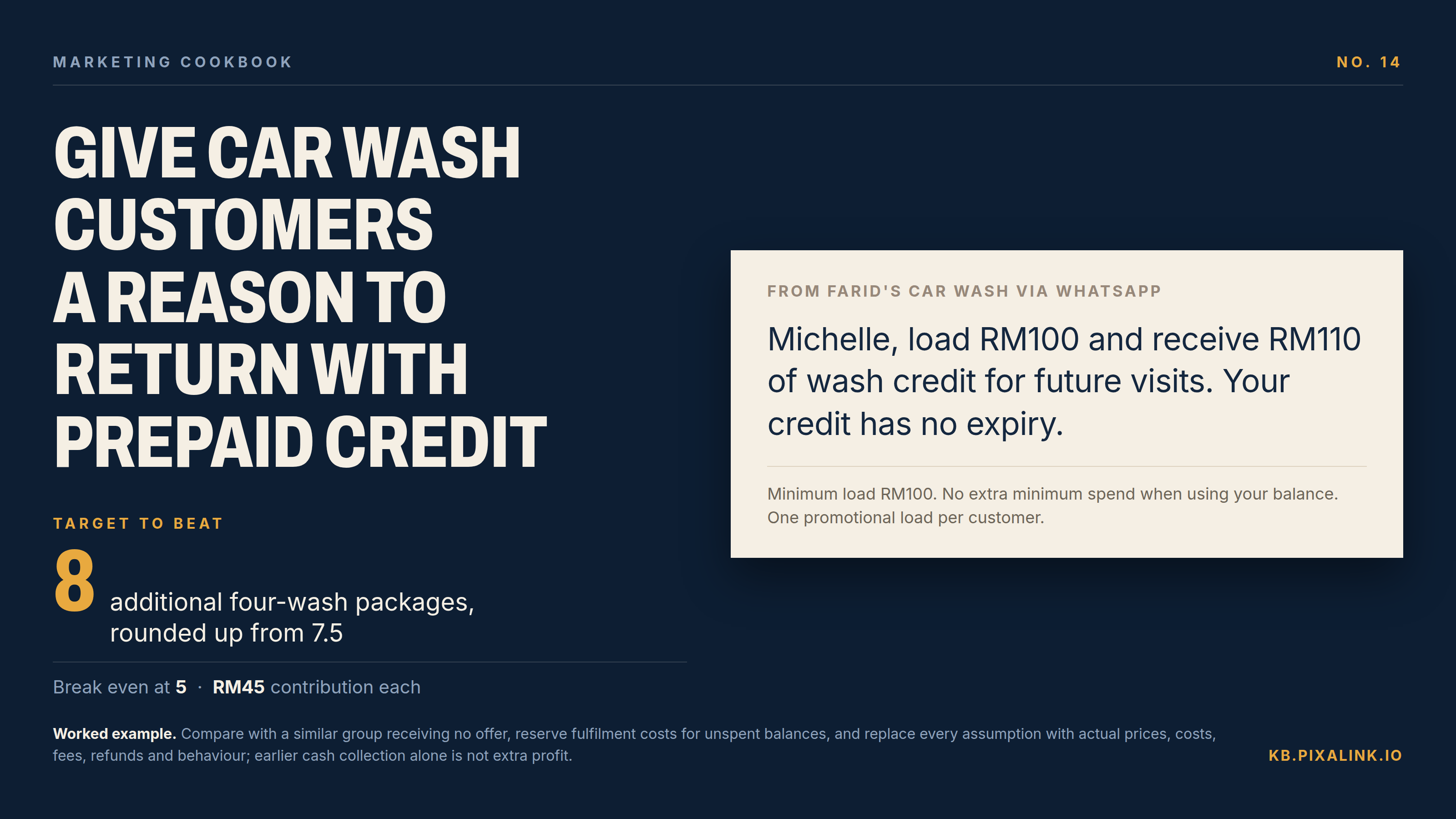
The same card at four sizes. Every figure on it comes from this article, and the message is the one written above — nothing on the card is generated.
Alt text for your post
Give Car Wash Customers a Reason to Return with Prepaid Credit. Pay RM100 to receive RM110 of wash credit, including a RM10 bonus. Four RM27.50 washes use the balance, costing Farid RM55 to fulfil. Then consider another load. Compare with a similar group receiving no offer, reserve fulfilment costs for unspent balances, and replace every assumption with actual prices, costs, fees, refunds and behaviour; earlier cash collection alone is not extra profit.
Closing invitation
Start with one offer and a group Farid can follow carefully. Let Michelle’s actual return visits, remaining balance and incremental contribution decide whether another top-up offer is worthwhile.