
Habit Builders
Bring Coffee Regulars Back More Often with a Stamp Card
Could a card that already looks started bring her back sooner?
A worked example
- RM8
- Contribution per incremental action
- 35
- Break-even actions
- 53
- Minimum target
additional paid visits
additional paid visits, rounded up
At a glance
The business problem
Raj's regulars already like his shop. The commercial leak is the time between purchases: two monthly visits from 400 people means about 800 visits, while three would mean 1,200.
That difference is an ambition, not a forecast. Raj needs evidence of additional paid visits before paying to extend a promotion across the whole group.
Why the usual promotion falls short
Taking RM2 off 800 planned purchases would cost RM1,600 without necessarily creating another visit. A stamp card instead makes the next small step visible and puts the free item at completion.
The research behind this recipe links approaching a reward with faster purchasing, a head start with persistence, and rewards with activity after redemption.1 Those findings justify a test; they do not guarantee that Amira will change her routine.
What you set up in Pixalink
Opening scenario
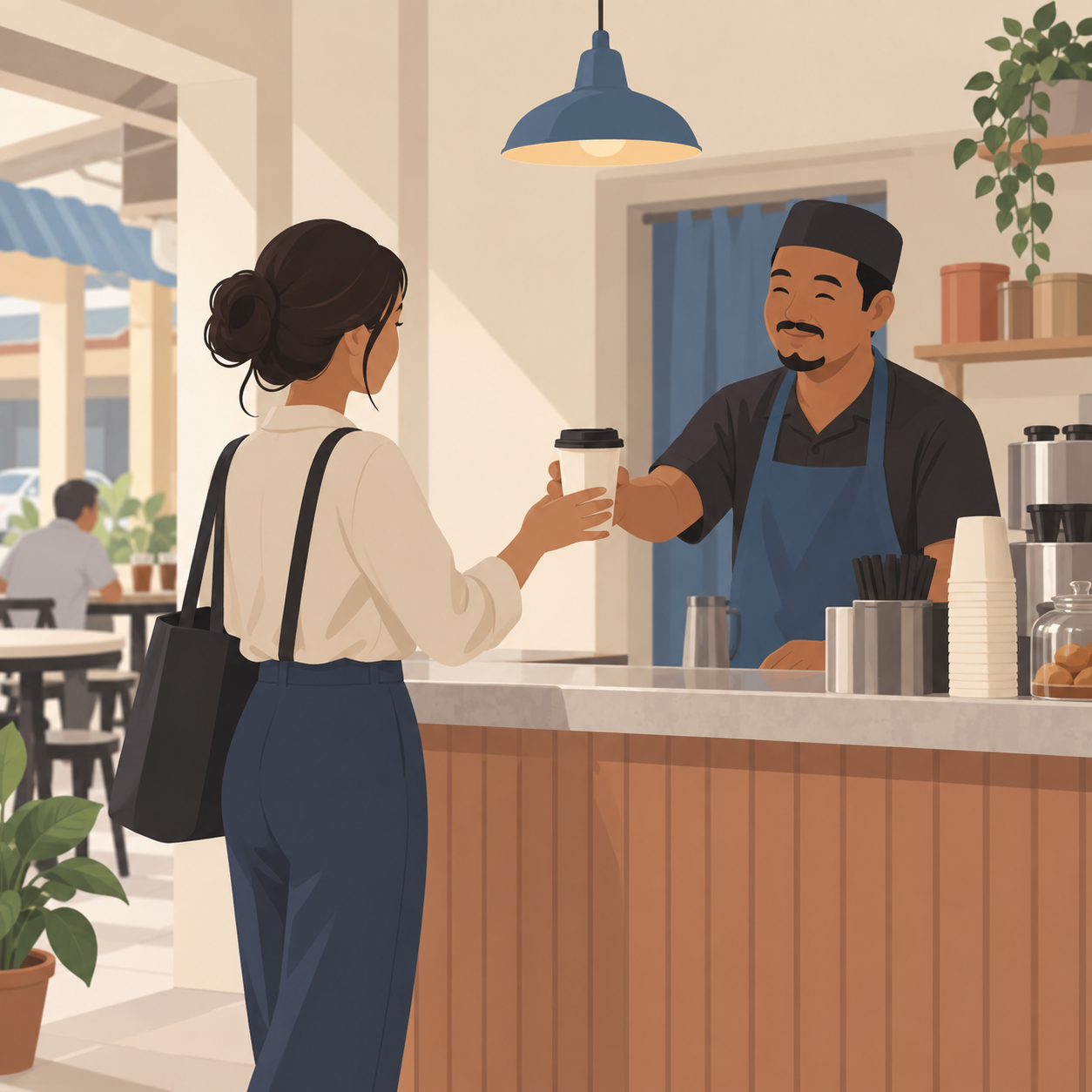
Raj hands Amira her usual latte at his coffee shop in Subang. She stops here on her way to work roughly every fortnight, likes the coffee, and sees no particular reason to come sooner. Raj recognises the same pattern among his 400 regulars: about two visits a month, when three would make a difference.
Raj, Amira and this shop are fictional; all figures are illustrative. A RM2 discount would make Amira's next planned latte cheaper without changing her routine. Raj wants a reason for another visit, not another discounted bill. Could a card that already looks started bring her back sooner?
The recipe
The campaign recipe
Use six stamps for one free regular latte, with one courtesy stamp on joining the pilot. That means five paid qualifying purchases on the first card, not six; explain the head start plainly.
| Recipe element | Recommended starting point |
|---|---|
| Suitable industries | Coffee shops and other frequent-purchase food outlets |
| Primary goal | Increase paid visit frequency among existing regulars |
| Customer segment | 40 regulars visiting about twice monthly |
| Offer | One courtesy stamp, then five earned stamps; six stamps unlock one regular latte worth RM12, costing RM4 to fulfil |
| Validity | Earn during an eight-week pilot; collect the latte within 14 days of completion, a staff-enforced deadline |
| Minimum spend | RM12 per qualifying bill; one earned stamp per visit, checked by staff; no purchase needed for the gift |
| Quantity or budget limit | One completed card each; 40 participants capped manually; RM160 gift reserve plus RM120 operating cost |
| Main success metric | Gap between paid visits, first half versus second half of the card |
The message your customer receives
This message is fictional, like the merchant and customer. All figures are illustrative.
From Raj's coffee shop via WhatsApp
Amira, join our eight-week stamp card pilot with one courtesy stamp. Earn five more stamps to enjoy a free regular latte. Collect it within 14 days of completing your card.
Minimum spend RM12 per qualifying bill; one earned stamp per visit. One completed card per customer. No purchase needed to collect the free latte.
The journey
Follow the customer
- Join with progress. Amira joins the pilot and staff immediately issue one courtesy stamp before any purchase. Her card shows one of six.
- See the next step count. Her next RM12 latte earns another stamp. Two of six feels a third done.
- Choose the familiar counter. At four stamps, Amira starts choosing Raj's shop over the nearer alternative. In this fictional journey, completing the card makes that small detour worthwhile.
- Finish, then keep returning. Amira completes six stamps, claims her free latte and maintains the higher frequency for the following weeks. Raj measures whether this actually happens; the pilot offers no second card.
flowchart LR
    A[Join with a courtesy stamp] --> B[Buy and see progress]
    B --> C[Choose the shop again]
    C --> D[Enjoy the reward and keep returning]
Use case: how the merchant applies it
Raj randomly divides 80 comparable regulars into 40 offered the card and 40 continuing normally. He keeps an eight-week baseline and follows both groups through the eight-week pilot plus four weeks afterwards, so an earlier purchase is not automatically counted as an extra purchase.
Amira receives her joining stamp from staff. They then check a paid bill of at least RM12 and issue one stamp per visit; all items qualify in this pilot, and split bills earn no extra stamps.
Raj sets one completion per customer and leaves automatic spend stamping off for this capped test. Staff control the participant list and 14-day gift deadline, checking that the configured reward remains usable throughout that window; total reserved campaign cost is RM280.
How the platform helps
How Pixalink supports the strategy
Pixalink counts stamps, displays progress, supports spend triggers, issues a configured completion reward and enforces the repeat limit. Manual stamp issuance supports Raj's courtesy stamp and this pilot; automatic issuance on joining is not established here.
A spend threshold is not an item filter or a participant cap. If Raj later limits qualifying purchases to particular drinks, staff must enforce that restriction; the manual pilot also needs staff review of refunds and voids rather than assuming automatic reversal.
Changing the stamp target recalculates active cards and may complete them. Keep six fixed throughout this test so Amira's goal and Raj's measurement stay consistent.
Configure this in Pixalink
Use How to Set Up a Stamp Card Campaign for the card, manual stamps and completion settings. Confirm the full earning and reward-collection experience before inviting regulars.
The economics
ROI taste test
Assume each incremental paid latte collects RM12 and costs RM4 to fulfil. Reserve RM160 for all 40 possible free lattes, including gifts to people who would return anyway, plus RM120 for staff time and administration.
Count the whole campaign cost
Contribution = cash collected - variable fulfilment cost - reward cost. Break-even = campaign operating cost / contribution; minimum target = break-even x 1.5, rounded up.
- Contribution per incremental action = RM12 - RM4 - RM0 = RM8.
- Break-even actions = RM280 / RM8 = 35 additional paid visits.
- Minimum target = 35 x 1.5 = 53 additional paid visits, rounded up.
Reward cost is RM0 in the per-visit formula because the full RM160 reserve is already included in RM280. At 53 extra visits, RM424 contribution less RM280 leaves RM144.
Compare the groups' change in paid visits, adjusting for baseline differences. Amira's planned purchases and free-only collections are not incremental sales; replace every assumption with actual costs and behaviour, including any paid latte displaced by the gift.
Measure it
What to watch
- Paid-visit gap: compare intervals in the first and second halves of each card, excluding the courtesy stamp.
- Incremental paid visits: compare baseline-adjusted changes between groups through the follow-up window; target at least 53.
- Post-reward frequency: compare paid visits after collection with prior frequency and the comparison group.
Common mistake: calling every completed card new revenue. Amira could finish through purchases she already intended to make.
Safeguard: reconcile one staff register of participants, qualifying bills, refunds, completion dates and gifts daily. Keep exposure within 40 participants and preserve the RM160 reserve for promised gifts.
Keep if at least 53 additional paid visits materialise with positive contribution and the safeguard holds. Improve a promising result with one bounded timing change in a fresh test; stop expansion if contribution is non-positive, the safeguard fails or the completed test misses its threshold.
Your first test
Try this first
- Select comparable regulars, randomise the two groups and record baseline visits.
- Cap the offer at 40 participants and reserve RM280 before invitations.
- Fix the six-stamp offer, eight-week earning window and four-week follow-up.
- Record actual costs and reconcile the staff register, including refunds and gift deadlines.
- Apply the preset keep, improve or stop rule before expanding.
Questions
Frequently asked questions
Does the customer buy six coffees?
Not on this first card: one courtesy stamp leaves five earned stamps. Describe that clearly rather than advertising six required purchases.
Is eight weeks enough for occasional customers?
Five qualifying purchases may be a stretch at Amira's old pace. Check the real purchase cycle and test a longer window separately if customers cannot plausibly finish.
What happens after a refund or void?
This manual pilot needs staff reconciliation of the affected stamp and any completion reward. Do not promise that reversing a stamp automatically withdraws a coffee already served.
Can we reduce the target halfway through?
Active cards recalculate when the target changes. Keep this test unchanged and evaluate a different target with a fresh group.
Share this recipe
A card you can post
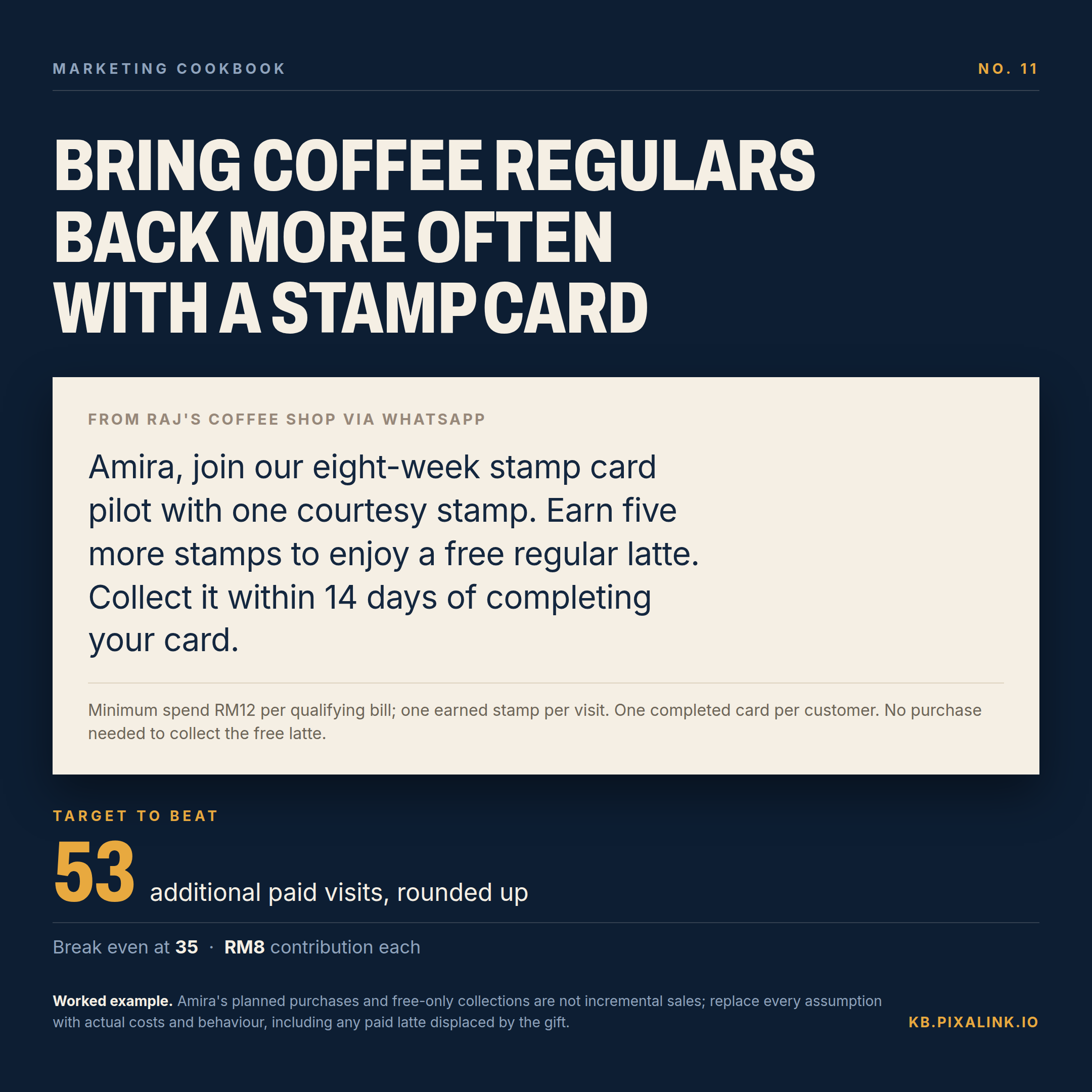
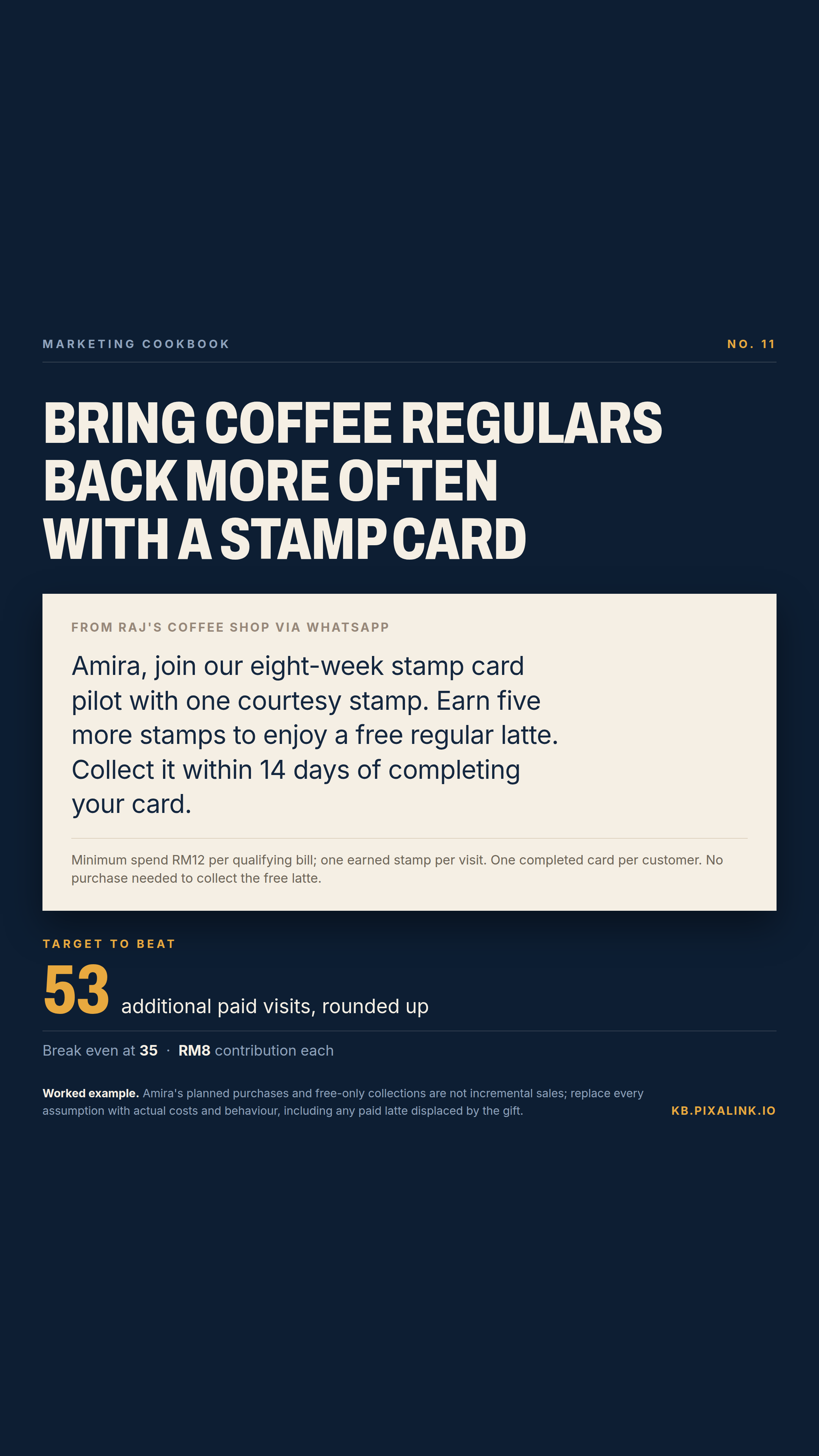
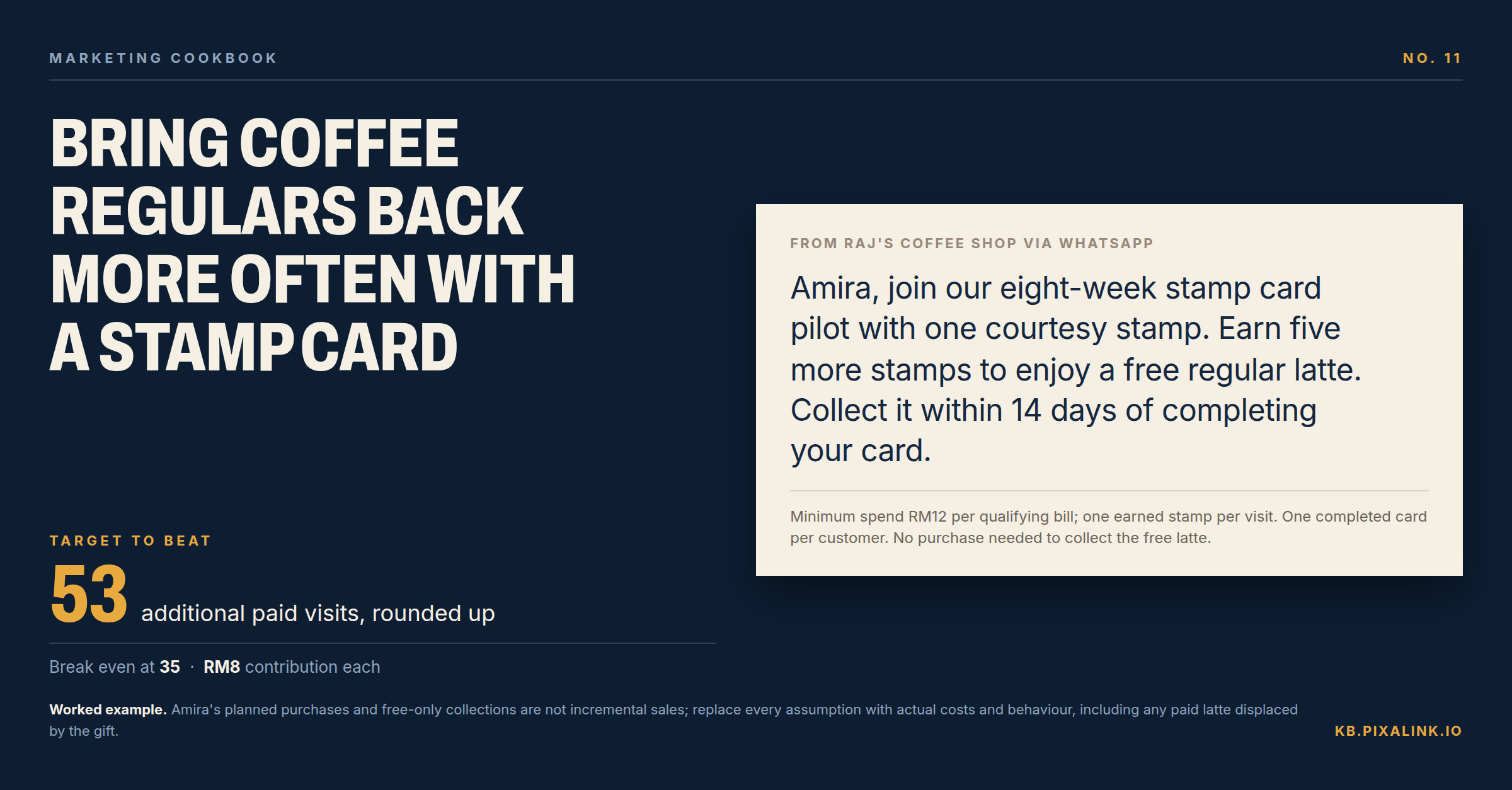
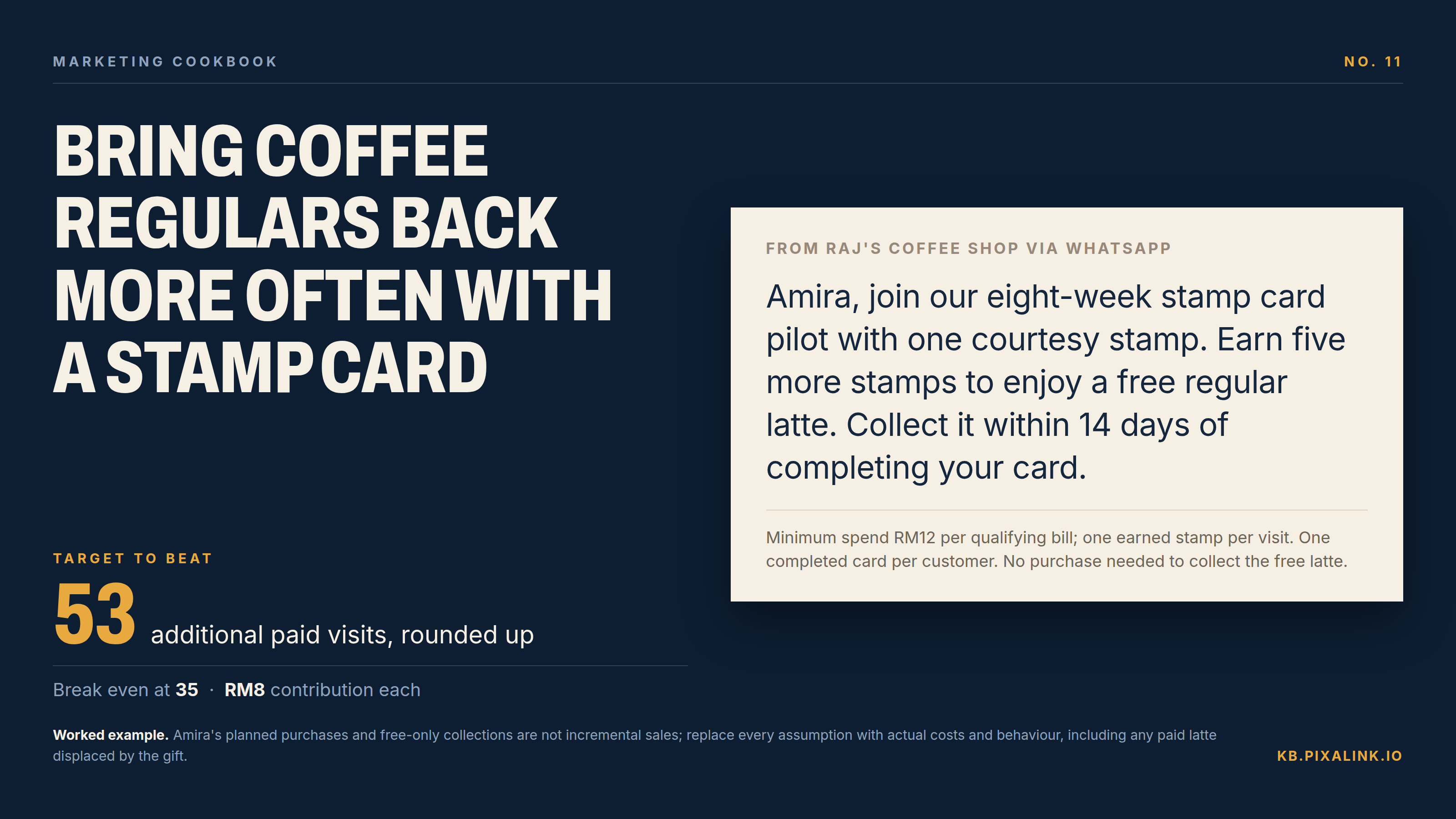
The same card at four sizes. Every figure on it comes from this article, and the message is the one written above — nothing on the card is generated.
Alt text for your post
Bring Coffee Regulars Back More Often with a Stamp Card. One courtesy stamp plus five earned stamps unlocks a free regular latte worth RM12, costing RM4 to fulfil. Each earned stamp needs a RM12 qualifying bill on a separate visit. Amira's planned purchases and free-only collections are not incremental sales; replace every assumption with actual costs and behaviour, including any paid latte displaced by the gift.
Closing invitation
Choose one regular-customer group and make the next visit feel attainable. Follow Raj and Amira's example as a test, then let additional paid visits decide whether the card earns a wider place in your shop.
Goal gradient — Kivetz, Urminsky & Zheng (2006). Head start — Nunes & Drèze (2006). Lift during and after — Taylor & Neslin (2005). ↩