
Referral & Membership
Reward Your Best Advocates Without an Open-Ended Commission Bill
Anusha wants to recognise that continuing value, but how can she make a repeatable promise without creating a bill she cannot control?

A worked example
- RM98
- Contribution per incremental action
- 4
- Break-even actions
- 6
- Minimum target
using cash collected - variable fulfilment cost - reward cost
incremental retained purchases, using campaign operating cost / contribution per incremental action
incremental retained purchases, rounded up
At a glance
The business problem
Anusha's leak is an undefined reward commitment. Three RM20 thank-yous cost RM60, yet neither she nor Rina knows what earns the next one. Replacing discretion with an ongoing percentage makes the cost measurable, provided Anusha also defines eligibility and a ceiling.
Why the usual promotion falls short
A one-off bonus treats a brief introduction and a lasting customer relationship alike. Simply making that bonus bigger still pays before Anusha knows whether the friend will return. A small recurring commission follows qualifying purchases, while a monthly cap limits each advocate's reward bill.
What you set up in Pixalink
Opening scenario
Rina brings another friend into Anusha's wellness studio in Petaling Jaya, then stays to explain what the classes feel like. She has introduced eleven members over two years. Anusha knows three clients generate a steady stream of introductions, but her occasional RM20 thank-you feels improvised.
Anusha, Rina and this studio are fictional, and all figures in this article are illustrative. A bonus for the introduction says little about the months of purchases that follow. Anusha wants to recognise that continuing value, but how can she make a repeatable promise without creating a bill she cannot control?
The recipe
The campaign recipe
Test 1% in store credit on qualifying purchases above RM100, capped at RM50 per inviter per calendar month. A RM200 purchase gives Rina RM2 credit; Anusha budgets its full RM2 value as reward cost.
| Recipe element | Recommended starting point |
|---|---|
| Suitable industries | Wellness studios with repeat purchases and known advocates |
| Primary goal | Reward continuing referred sales within a defined budget |
| Customer segment | Three genuine existing advocates, including Rina; eligibility managed by Anusha |
| Offer | 1% store credit for each qualifying referred purchase; no cash promise |
| Validity | One calendar-month pilot; continuation reviewed by Anusha, with no assumed automatic end date or credit expiry |
| Minimum spend | Above RM100 per purchase; use RM100.01 to express this strict floor |
| Quantity or budget limit | RM50 per inviter monthly; RM150 across three advocates only if Anusha controls participation |
| Main success metric | Net referred sales after commission and reversals |
The message your customer receives
This message is fictional, like the merchant and customer. All figures are illustrative.
From Anusha's wellness studio via WhatsApp
Rina, earn 1% in store credit on each qualifying purchase by a friend you refer. This is a one-calendar-month pilot; I'll confirm any continuation with you.
Qualifying purchases must be above RM100 each. Maximum RM50 store credit per inviter per calendar month.
The journey
Follow the customer
- Know the terms. Rina's introductions are tracked against her. She understands the 1% rate and RM50 monthly ceiling before inviting anyone.
- See continuing value. Each qualifying purchase above RM100 earns commission visible in her account. Her friend's RM200 purchase earns RM2, subject to remaining cap capacity.
- Understand reversals. If that friend refunds half the purchase, the matching reversal is RM1 when enough commission remains unspent. Spent commission cannot be fully recovered.
- Continue with clarity. Rina becomes a valued advocate with clear terms instead of occasional favours. After using credit, she remains a customer; further qualifying purchases can earn more within the ceiling.
flowchart TD
 A[Rina knows the terms] --> B[Friend makes a qualifying purchase]
 B --> C[Rina sees capped credit earnings]
 C --> D{Purchase refunded?}
 D -->|Yes| E[Matching unspent commission reversed]
 D -->|No| F[Continue as a valued advocate]
 E --> F
Use case: how the merchant applies it
Anusha invites Rina and two other advocates into a one-calendar-month pilot. She writes down which introductions qualify, the purchase floor, credit value, monthly ceiling and continuation terms. The RM150 total is her participation budget, not a platform-wide campaign cap.
Before launch, Anusha must establish how to enforce that small group and close participation operationally. She must not assume enabling commission restricts it to those three people or automatically stops at month-end. Credit expiry and outstanding commitments need explicit terms before Rina receives the offer; this recipe assumes no automatic expiry.
How the platform helps
How Pixalink supports the strategy
Pixalink enforces percentage, minimum spend and monthly cap, including when purchases arrive together, and provides commission history. Refunds, cancellations and voids recorded through the supported reversal flow claw back proportionally, limited to unspent commission. Anusha manages eligibility and the arrangement's legal structure.
Commission is store credit. The verified purchase path requires a recorded purchase amount; reservation sales and credit-spend purchases are not supported by that path. The minimum is inclusive, so RM100.01 implements “above RM100”. Confirm feature availability and the studio's purchase flow before making promises.
Configure this in Pixalink
Start with How to Set Up Referrals. Use Referral Commission and Act 500: What Merchants Should Know for the recurring-commission settings and wording considerations.
The economics
ROI taste test
For a retained RM200 purchase, assume RM100 variable fulfilment cost and RM2 commission cost. Anusha budgets RM300 operating effort plus RM92 commission on 46 similar purchases expected anyway: RM392 to cover before incremental value counts. These are planning assumptions, not observed results.
- Contribution per incremental action = RM200 - RM100 - RM2 = RM98, using cash collected - variable fulfilment cost - reward cost.
- Break-even actions = RM392 / RM98 = 4 incremental retained purchases, using campaign operating cost / contribution per incremental action.
- Minimum target = 4 x 1.5 = 6 incremental retained purchases, rounded up.
Compare against usual referred purchases and a comparable group without the offer, then reconcile refunds after the normal refund window. Credit claims, sign-ups and purchases that would happen anyway are not incremental profit. Charge unrecovered commission and extra baseline rewards to the test; replace every price, cost and behaviour assumption with your own and recalculate the target.
Measure it
What to watch
- Net referred sales: referred sales less refunds and commission still charged after reversals.
- Incremental retained purchases: qualifying purchases above the baseline after refund reconciliation; Anusha's target is six.
- Unrecovered commission cost: commission linked to reversed purchases that could not be clawed back because it was spent.
Common mistake: treating all Rina's friends' spending as new value. Their established purchasing would partly continue without commission.
Safeguard: review written eligibility and arrangement terms before launch using Referral Commission and Act 500: What Merchants Should Know, obtaining advice where needed. Describe Rina as a customer advocate, not a sales partner, and do not promise cash income.
Keep when at least six incremental retained purchases, positive net contribution and the safeguard hold. Improve a promising signal through one bounded change in a new test; stop this version if it misses six, contribution is non-positive or the safeguard fails.
Your first test
Try this first
- Choose three advocates and a comparable unoffered group; record usual referred purchasing.
- Establish participation control and reserve RM150; do not launch until the limited scope is workable.
- Fix the 1% offer for one calendar month, with a review after the normal refund window.
- Record fulfilment, commission, operating costs and reversals; complete the written-terms safeguard.
- Apply the six-purchase keep/improve/stop rule before extending the offer to Rina or anyone else.
Questions
Frequently asked questions
Does Rina receive cash?
She receives store credit. Do not describe the reward as a cash payout or guaranteed income.
Does a purchase of exactly RM100 qualify?
Not under this offer's “above RM100” wording. The platform minimum includes its boundary, so use RM100.01 and verify it before launch.
Does a refund recover every commission ringgit?
No; reversal is proportional and limited to unspent commission. Anusha must retain any unrecovered amount as a campaign cost.
Does the monthly cap end the arrangement?
No; a monthly ceiling is not a pilot end date. Anusha must manage continuation terms and outstanding commitments explicitly.
Share this recipe
A card you can post
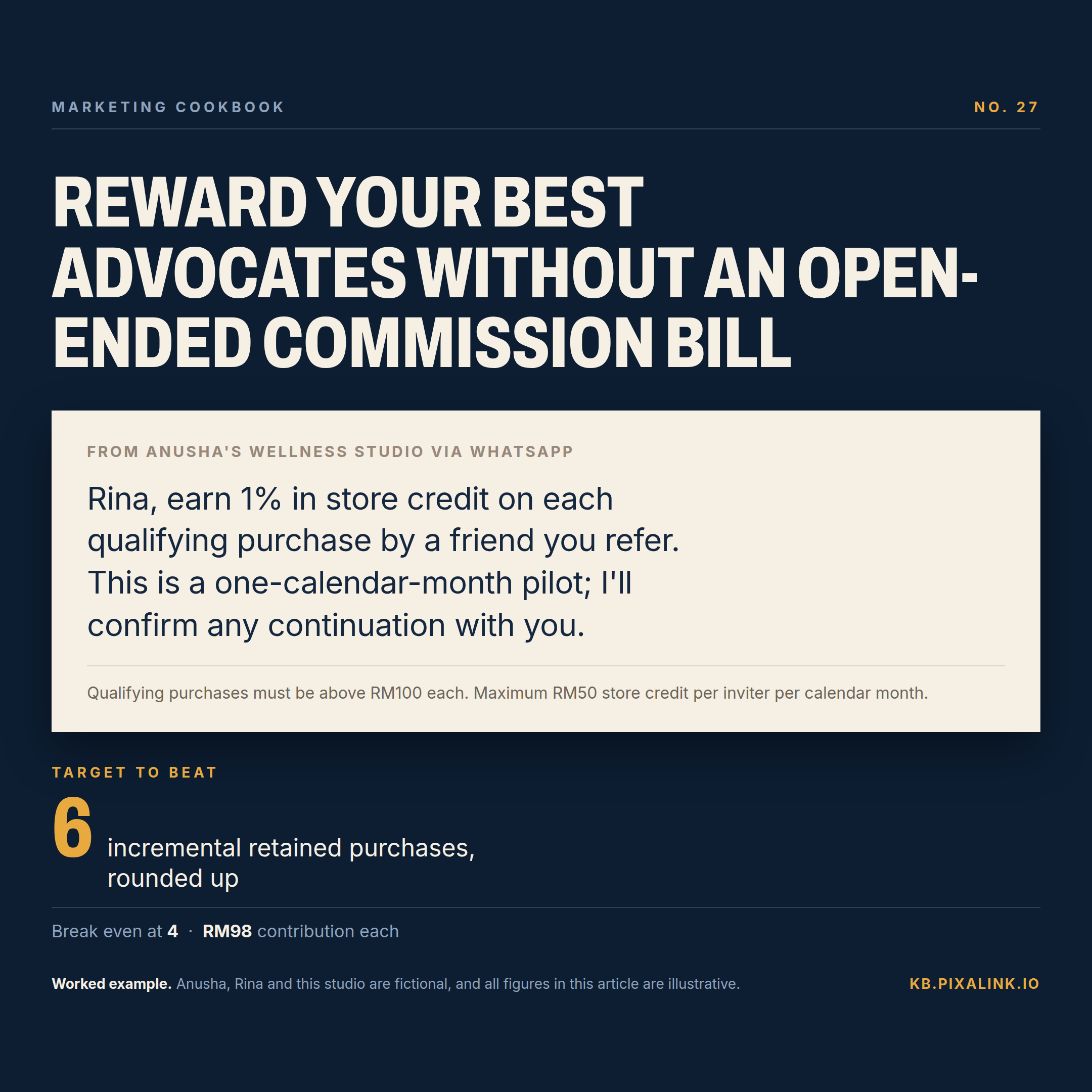
The same card at four sizes. Every figure on it comes from this article, and the message is the one written above — nothing on the card is generated.
Alt text for your post
Reward Your Best Advocates Without an Open-Ended Commission Bill. A qualifying purchase above RM100 earns 1% store credit. A RM200 purchase gives RM2, budgeted at RM2 cost. Each inviter can earn up to RM50 per calendar month. Anusha, Rina and this studio are fictional, and all figures in this article are illustrative.
Closing invitation
Choose this specialist recipe only if a small group already creates continuing customer value. Test one clear offer with advocates like Rina, and let incremental contribution decide whether Anusha continues.