
Referral & Membership
Ask Members to Renew While Their Benefits Still Matter
With his benefits still live, can she make renewal feel worthwhile before it becomes another bill?

A worked example
- RM80
- Contribution per incremental action
- 4
- Break-even actions
- 6
- Minimum target
per additional renewal
additional renewals
additional renewals, rounded up
At a glance
The business problem
Silent lapses waste an existing relationship and leave Cheryl replacing members she already paid to acquire. A 60% renewal rate means 40 of every 100 expiring members leave. Before spending on replacement customers, she needs to learn whether earlier evidence of value changes that decision.
Why the usual promotion falls short
An expiry-day discount answers a price objection Haziq may never have raised. It also reduces income from readers who would renew at RM120 anyway. Start with benefits actually used, then offer a useful next step; test a price change separately only if the value argument fails.
What you set up in Pixalink
Opening scenario
Cheryl looks across her quiet Penang bookshop at the reading chair Haziq Rahman used to favour. He joined her RM120 reader's membership last October, used two benefits in November, and has not visited since March. Roughly 60% of members renew; the rest disappear without saying why.
Her usual renewal email takes RM120 in staff time and messaging per batch, yet often reaches people who stopped caring months ago. Cheryl, Haziq and the bookshop are fictional, and all figures in this article are illustrative. With his benefits still live, can she make renewal feel worthwhile before it becomes another bill?
The recipe
The campaign recipe
This is a value-first renewal invitation, with no extra gift. The RM90 recap describes value Haziq already used, not cash or a new voucher.
| Recipe element | Recommended starting point |
|---|---|
| Suitable industries | Bookshops and other businesses with paid, expiring memberships |
| Primary goal | Increase paid renewals before membership expiry |
| Customer segment | Current readers expiring in the next 30 days; compare members with similar benefit usage |
| Offer | Recap two benefits worth RM90, mention an unused benefit, then invite renewal at RM120; RM0 extra reward cost |
| Validity | Personal recap 30 days before expiry; reminder 7 days before; renew before the recorded expiry date |
| Minimum spend | RM120 renewal payment; no additional book purchase required |
| Quantity or budget limit | Staff cap: 50 campaign recipients and RM320 operating budget, including preparation and messaging |
| Main success metric | Renewal rate before expiry, split by benefits used and compared with usual reminders |
The message your customer receives
This message is fictional, like the merchant and customer. All figures are illustrative.
From Cheryl's bookshop via WhatsApp
Haziq, you've used two membership benefits worth RM90. There is also a benefit you haven't tried yet. Renew before your membership expires to enjoy another term.
Renewal payment RM120. No additional book purchase required.
The journey
Follow the customer
- Recognise past value. Thirty days before expiry, Haziq receives Cheryl's checked recap: two benefits used, worth RM90. It reminds him of something concrete rather than claiming the membership has already paid for itself.
- See a reason to return. The same note mentions a benefit he has not tried. Cheryl presents it as an invitation, without blaming him for being absent.
- Notice the real deadline. Seven days before expiry, Haziq receives a short reminder stating the exact date his membership benefits end. There is no invented countdown or escalating discount.
- Choose the next term. Haziq pays RM120 before expiry if the benefits suit his plans. Cheryl then helps him choose the next benefit to use, so renewal leads back to participation.
Use case: how the merchant applies it
Cheryl chooses 100 readers with upcoming expiry dates and randomly splits them into two groups of 50, balanced by previous benefit usage. Both retain the usual seven-day reminder; only the campaign group receives the additional personalised 30-day note. She manages the groups and RM320 campaign budget herself.
For Haziq, she checks the two redemptions behind the RM90 figure and names an unused benefit that is actually available under his plan. The offer remains RM120 for another term, with no added purchase or gift. She confirms the recorded expiry and available benefit capacity before making the invitation, then records his renewal and next intended visit.
How the platform helps
How Pixalink supports the strategy
Pixalink enforces membership expiry dates and, once the reminder is enabled on the plan, sends it the configured number of days ahead and records that it was sent. Cheryl must enable that reminder for each relevant plan. She pulls the expiring-soon list from membership analytics; there is no expiring-soon filter.
The verified reminder is not an automatic personalised benefit statement or a complete 30-and-7-day sequence. Cheryl prepares the usage recap, manages the additional contact and checks renewed members before further outreach. Recipient limits, offer wording and the comparison groups remain her operational controls.
Configure this in Pixalink
Use Paid Memberships and Paid Membership Expiry Dates Explained. Enable the plan reminder explicitly; do not read the expiry guide's seven-day example as proof that it is already switched on.
The economics
ROI taste test
Use one incremental paid renewal as the action. Assume RM120 cash collected and RM40 variable fulfilment cost for the entire renewed term, including expected benefit use; the historical RM90 customer value is not Cheryl's fulfilment cost.
- Contribution per incremental action = cash collected - variable fulfilment cost - reward cost.
- Contribution per incremental action = RM120 - RM40 - RM0 = RM80 per additional renewal.
- Break-even actions = campaign operating cost / contribution per incremental action.
- Break-even actions = RM320 / RM80 = 4 additional renewals.
- Minimum target = 4 × 1.5 = 6 additional renewals, rounded up.
Compare equivalent expiry windows
If 36 of 50 campaign readers renew and 30 of 50 comparison readers renew, estimated uplift is six renewals. That gives RM480 contribution less RM320 campaign cost, leaving RM160. The operating budget covers campaign preparation and messaging; ordinary reminder costs shared by both groups are outside this incremental comparison.
Haziq's renewal alone does not prove the campaign worked: he might have renewed anyway. Sent reminders and benefit redemptions are not automatically profit, and this small comparison cannot guarantee results. Replace every price, cost and behaviour assumption with your own records.
Measure it
What to watch
- KPI 1 — Renewal rate by benefits used: compare campaign and comparison readers within similar usage groups.
- KPI 2 — Incremental renewals before expiry: estimate the additional renewals using equal group sizes and the same deadline.
- KPI 3 — Incremental contribution after campaign cost: include full-term fulfilment and all additional contact costs.
Common mistake: describing RM90 of past benefit value as a new RM90 credit. Haziq needs an honest recap, not an unintended promise.
Safeguard: use one staff-checked contact register covering permission to contact, actual benefit use, current expiry, renewal status and available benefits. Pause outreach if those checks cannot be completed accurately.
Keep when at least six incremental renewals and the safeguard hold. Improve a promising result that meets the target by testing one clearer unused-benefit invitation next time; stop expansion if the target is missed, contribution is non-positive or the safeguard fails.
Your first test
Try this first
- Select 100 expiring readers, record baseline renewal and usage, then randomly allocate 50 to each group.
- Cap additional campaign exposure at 50 readers and RM320, controlled by staff.
- Fix the RM120 offer, 30-day recap and seven-day reminder; measure each renewal by its original expiry date.
- Record full-term costs and check the contact register before outreach.
- Apply the six-renewal threshold and pre-set keep, improve or stop rule after both groups finish.
Questions
Frequently asked questions
Does Pixalink send both messages automatically?
That complete sequence is not supported by the verified setup here. Use the enabled plan reminder for its configured timing and have staff manage the personalised additional contact.
Is RM90 a refund or renewal discount?
Neither: it describes benefits Haziq already used. The renewal price remains RM120, with RM0 extra reward cost.
What if a member has used nothing?
Do not invent a value recap. Lesson 30 is the companion approach: a member who never used a benefit needed help participating months earlier.
What if Haziq renews before the reminder?
Cheryl checks his current membership record before further outreach. She removes obsolete follow-ups from her contact plan instead of assuming a scheduled message will cancel itself.
Share this recipe
A card you can post
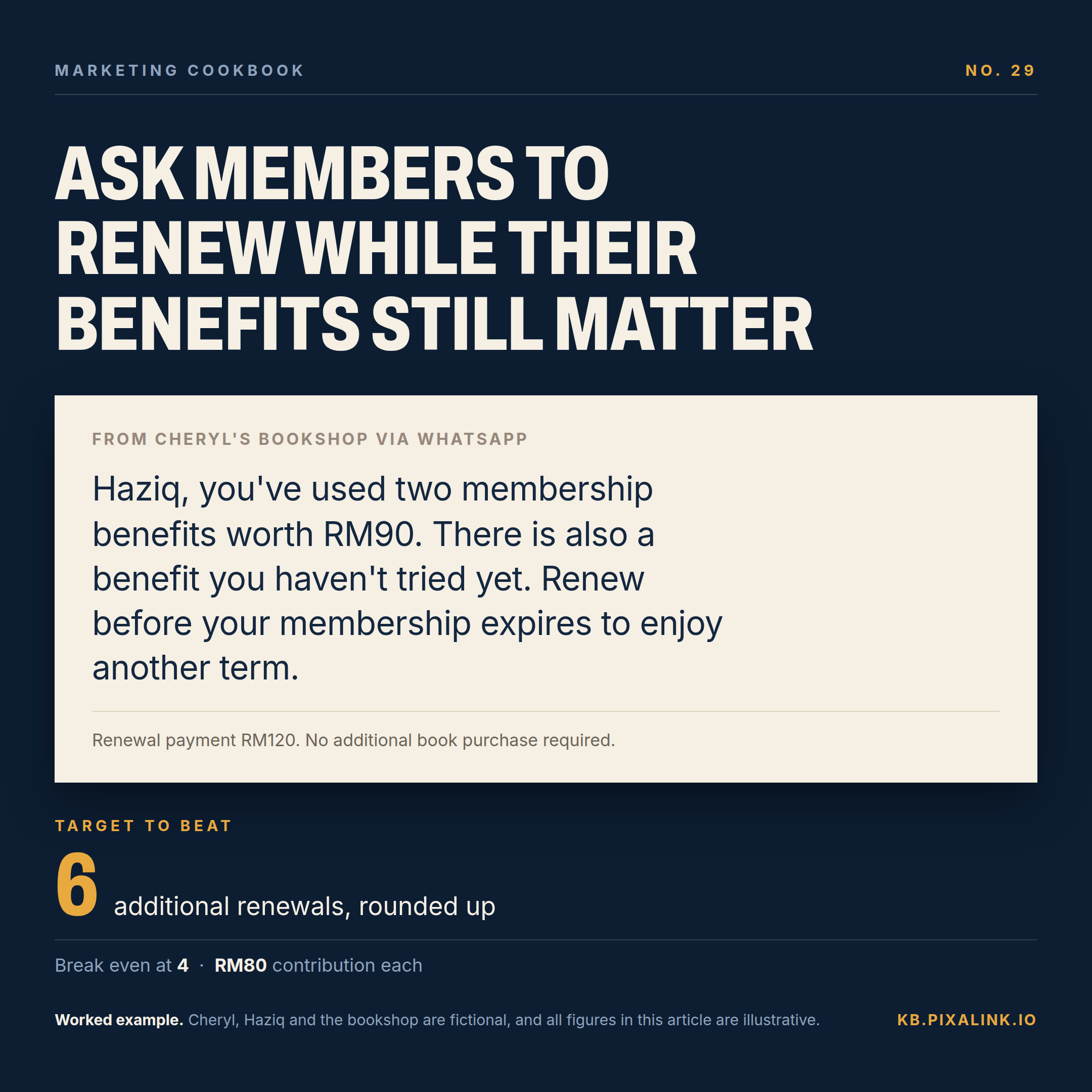
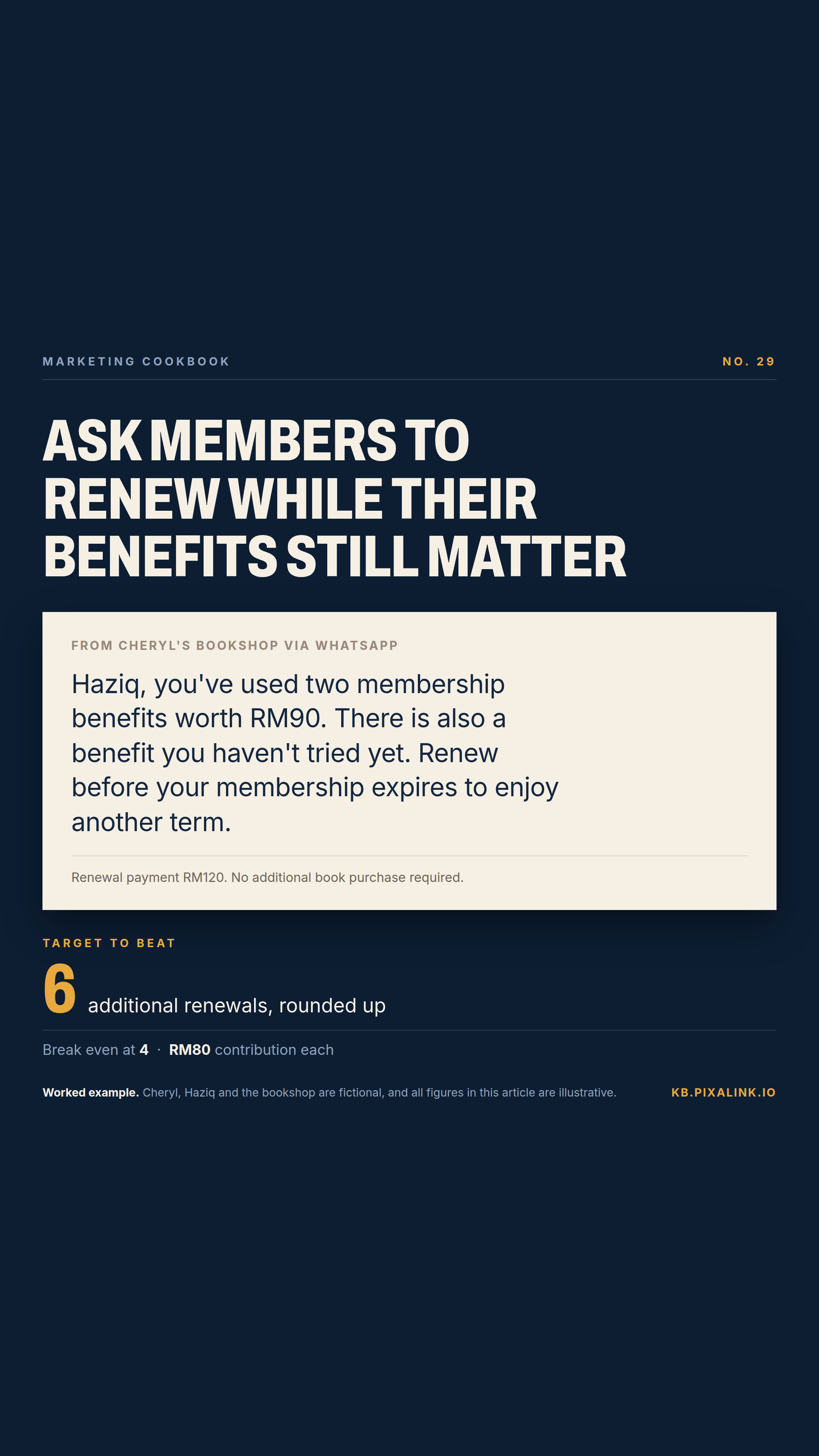
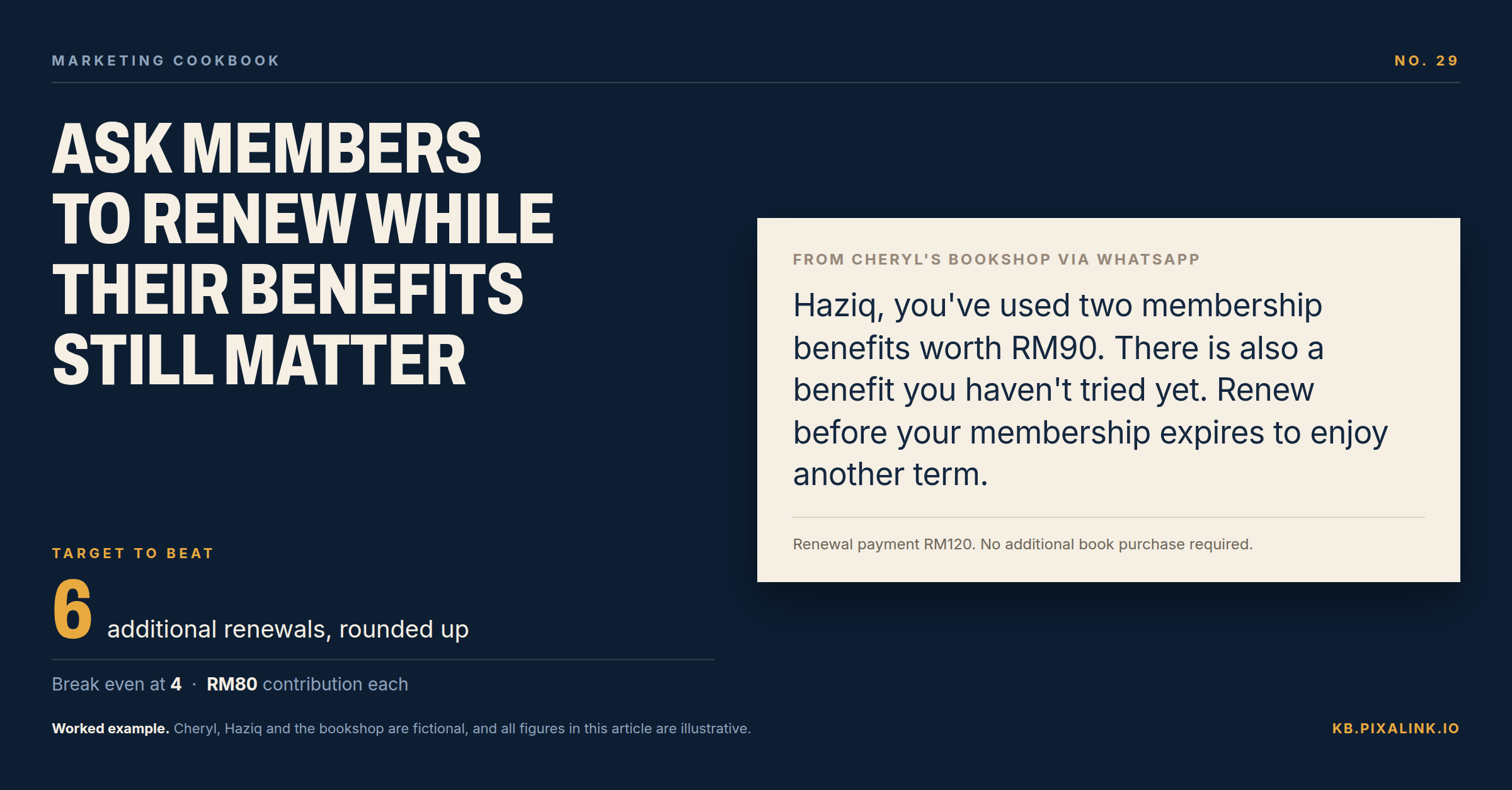
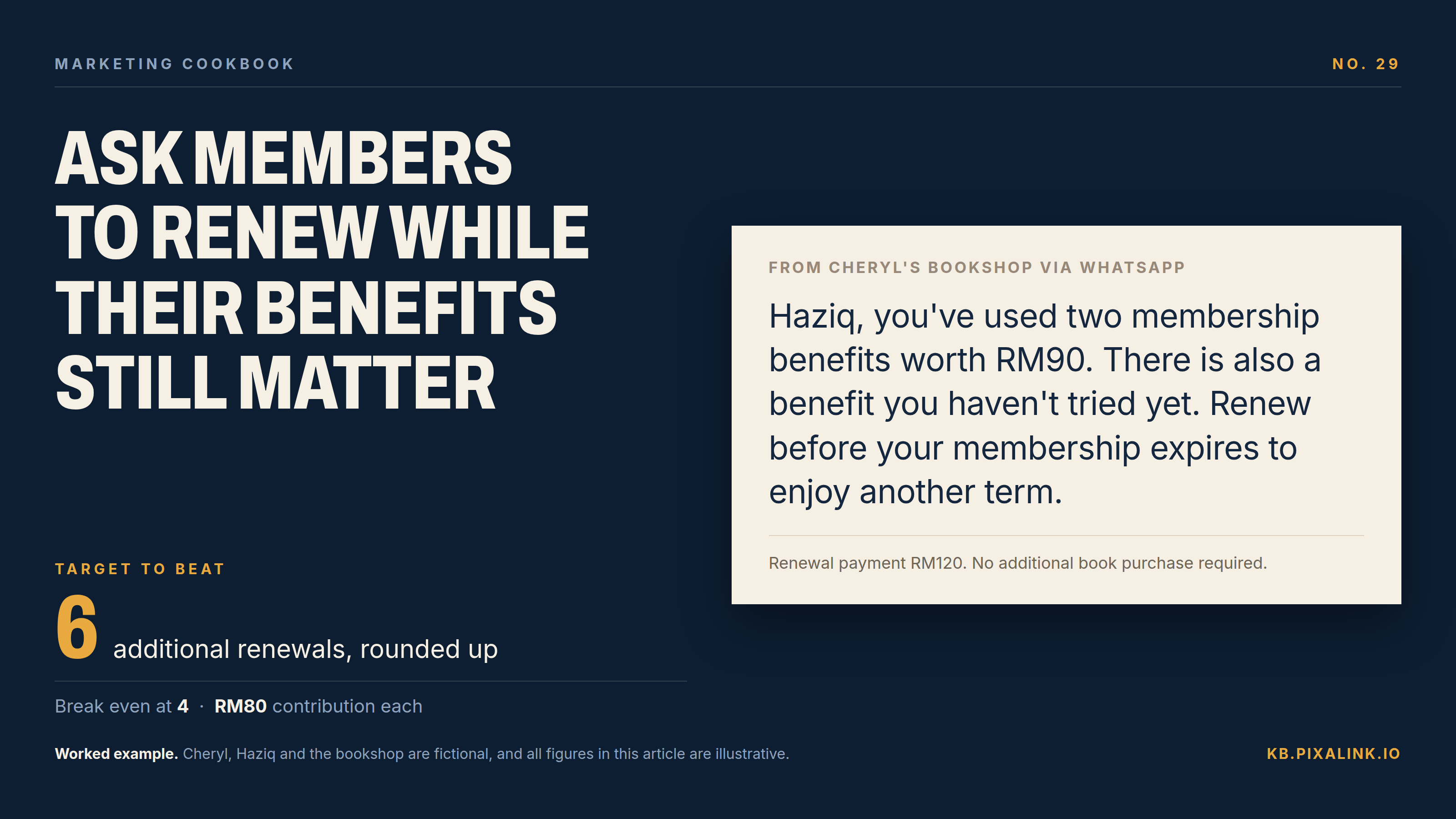
The same card at four sizes. Every figure on it comes from this article, and the message is the one written above — nothing on the card is generated.
Alt text for your post
Ask Members to Renew While Their Benefits Still Matter. Thirty days before expiry, recap two benefits worth RM90 already used. Seven days before expiry, remind the member of the end date. Renew for RM120 before expiry, with no extra gift. Merchant budgets RM320 operating cost and RM40 fulfilment per renewed term. Cheryl, Haziq and the bookshop are fictional, and all figures in this article are illustrative.
Closing invitation
Try one expiring cohort while members still recognise what they paid for. Let Cheryl's comparison, costs and Haziq's next use of a benefit guide whether this renewal invitation deserves another run.