
Referral & Membership
Help Paid Members Use Their First Benefit Before Renewal
The room is ready today; why wait months to help Sofia find a reason to use it?

A worked example
- RM120
- Contribution per incremental action
- 2
- Break-even actions
- 3
- Minimum target
per additional paid renewal
additional renewals
additional renewals, rounded up
At a glance
The business problem
An unused membership can look healthy because the payment arrived. Ivan has collected money, but Sofia has little experience to draw on when deciding whether to stay. Unused benefits are a reason to investigate early, not proof that any individual member will leave.
Why the usual promotion falls short
Another list of every perk gives Sofia more to sort through. A renewal discount also spends margin before Ivan knows whether price is the obstacle. His first experiment should make one existing benefit easy to use, without adding another reward.
What you set up in Pixalink
Opening scenario
Ivan pauses outside the empty meeting room at his Kuala Lumpur coworking café. Sofia Tan bought a membership in January, but forty-five days later she has not redeemed a single benefit. His past membership records suggest that people who use nothing in their first two months rarely renew.
He normally waits until renewal time to explain the perks again, spending staff time on people who may already have lost interest. Ivan, Sofia and the café are fictional, and all figures in this article are illustrative. The room is ready today; why wait months to help Sofia find a reason to use it?
The recipe
The campaign recipe
The offer is a reminder of something already included. Using it costs Sofia RM0 extra and Ivan an estimated RM8 in cleaning and utilities per meeting-room hour.
| Recipe element | Recommended starting point |
|---|---|
| Suitable industries | Coworking cafés and membership businesses with bookable benefits |
| Primary goal | Help an unused paid membership reach its first benefit use |
| Customer segment | Active members 45 days into their term, with no benefit redeemed; staff verify across all issued benefits |
| Offer | One included free meeting-room hour; staff confirm a booking, then record actual use |
| Validity | Invite use within 7 days; existing benefit expiry and membership terms still apply |
| Minimum spend | RM0 extra; no café purchase required |
| Quantity or budget limit | Staff cap: 20 recipients, 20 available off-peak room hours, RM240 total campaign budget |
| Main success metric | First-use rate within 7 days versus a comparison group; follow later renewal outcomes |
The message your customer receives
This message is fictional, like the merchant and customer. All figures are illustrative.
From Ivan's coworking café via WhatsApp
Sofia, your membership includes one free meeting-room hour. We'd love you to use it within the next 7 days. Reply with your preferred time so we can arrange your booking.
RM0 extra; no café purchase required. Existing benefit expiry and membership terms apply.
The journey
Follow the customer
- Become eligible. At day 45, Sofia has redeemed nothing. Ivan's staff identify her during their review; automatic day-45 detection is not supported by the verified workflow.
- See one useful invitation. Sofia receives a short message naming her free meeting-room hour. It asks her to reply with a preferred time so staff can confirm a booking.
- Make the first visit. She books an available slot and attends. Staff record use after the visit, because a booking alone is not a redeemed benefit.
- Have a reason to return. Sofia now knows how the space fits her working day, three months before Ivan plans to discuss renewal with her. After use, he helps her identify her next relevant benefit without promising another free hour.
Use case: how the merchant applies it
Ivan selects 40 eligible members and randomly assigns 20 to the nudge and 20 to usual communication. Both groups retain their existing entitlements and booking access. Staff reconcile membership start dates, voucher records and any offline benefit use before preparing the audience.
His message says: “Your membership includes a free meeting-room hour. Reply with a time that suits you this week, and we will check availability.” Sofia needs no café purchase; staff offer an available off-peak slot within seven days, subject to her existing entitlement and expiry.
Ivan reserves capacity for all 20 invited members and budgets RM160 for room use plus RM80 for preparation and messaging. The campaign cap limits additional outreach, not members' contractual rights. After Sofia attends, staff remove her from their unused-benefit follow-up list.
How the platform helps
How Pixalink supports the strategy
Pixalink records redemption status for issued benefits, filterable and exportable per voucher. That helps Ivan inspect unused vouchers; one unused voucher does not establish that a member has used nothing across the whole bundle.
Ivan manages the nudge: staff export or bulk-tag the verified unredeemed holders, then broadcast to the tag. They check membership age and other benefit use themselves. Automatic detection of this complete segment, room-capacity enforcement and booking-to-redemption synchronisation are not supported by the verified workflow here; staff handle them.
Configure this in Pixalink
Use How to See Who Redeemed a Reward Voucher to inspect redemption records and How to Send a Broadcast Campaign for the tagged audience. Keep the membership-age review and room booking in the staff process.
The economics
ROI taste test
A free first use brings in RM0 new cash. Measure its financial payoff through incremental paid renewals later, rather than counting January's membership payment again.
Assume a renewal collects RM240, with RM120 variable fulfilment cost covering the entire renewed term, including expected benefits. There is RM0 additional renewal reward; the current activation visits sit separately in the RM240 campaign budget.
- Contribution per incremental action = cash collected - variable fulfilment cost - reward cost.
- Contribution per incremental action = RM240 - RM120 - RM0 = RM120 per additional paid renewal.
- Break-even actions = campaign operating cost / contribution per incremental action.
- Break-even actions = RM240 / RM120 = 2 additional renewals.
- Minimum target = 2 × 1.5 = 3 additional renewals, rounded up.
Count the cost before the renewal arrives
The operating budget includes all 20 invited room hours at RM8, even if fewer members attend, plus RM80 preparation and messaging. This deliberately reserves the full activation cost and does not charge it again against each renewal.
If 8 nudged members renew versus 5 comparison members, estimated uplift is 3 renewals. Their RM360 contribution less RM240 campaign cost leaves RM120; a small test cannot establish certainty. Delivered messages, bookings and redemptions are not automatically profit, and Sofia might have renewed anyway.
Compare both groups through their respective expiry dates, using the same renewal definition. Replace every price, cost and behaviour assumption with your own records; these figures do not guarantee results.
Measure it
What to watch
- KPI 1 — First-use rate: members completing their first benefit use within seven days, divided by eligible members in each group.
- KPI 2 — Renewal rate by first use: compare later renewals for users and non-users within each group; association alone does not prove causation.
- KPI 3 — Incremental paid renewals: difference between the equal groups, measured through their respective expiry dates against the three-renewal target.
Common mistake: repeating reminders when most members still never activate. Ivan should reconsider the bundle's usefulness before sending more of the same message.
Safeguard: staff confirm genuine room availability and existing benefit terms before inviting anyone. Stop outreach if the café cannot honour what the message offers.
Keep when at least three incremental renewals and the safeguard hold. Improve a promising test by changing one booking instruction or benefit choice in a separately capped trial; stop expansion if the threshold is missed, contribution is non-positive or the safeguard fails.
Your first test
Try this first
- Verify 40 day-45 non-users, record baseline usage and renewal, then randomly split them into equal groups.
- Cap outreach at 20 members and reserve 20 off-peak hours within RM240.
- Use one room-hour invitation, measure first use for seven days and renewals through each member's expiry.
- Record full activation and renewal costs, and check availability and existing terms.
- Apply the three-renewal keep, improve or stop rule after both groups finish.
Questions
Frequently asked questions
Does this run automatically after 45 days?
Not in the verified workflow for this recipe. Ivan's team checks the records, prepares the tag and arranges the broadcast.
Is an unused room voucher enough to qualify?
No: Sofia must have used no benefits, not merely left this voucher unused. Check other vouchers and offline usage before adding her.
Does the seven-day invitation shorten her benefit validity?
No: it is the test's suggested visit window. Existing membership and voucher terms continue to apply.
What if Sofia books but cancels?
Do not count the booking as first use. Staff apply the existing cancellation terms and reconcile records; this recipe does not assume automatic voucher restoration.
Share this recipe
A card you can post
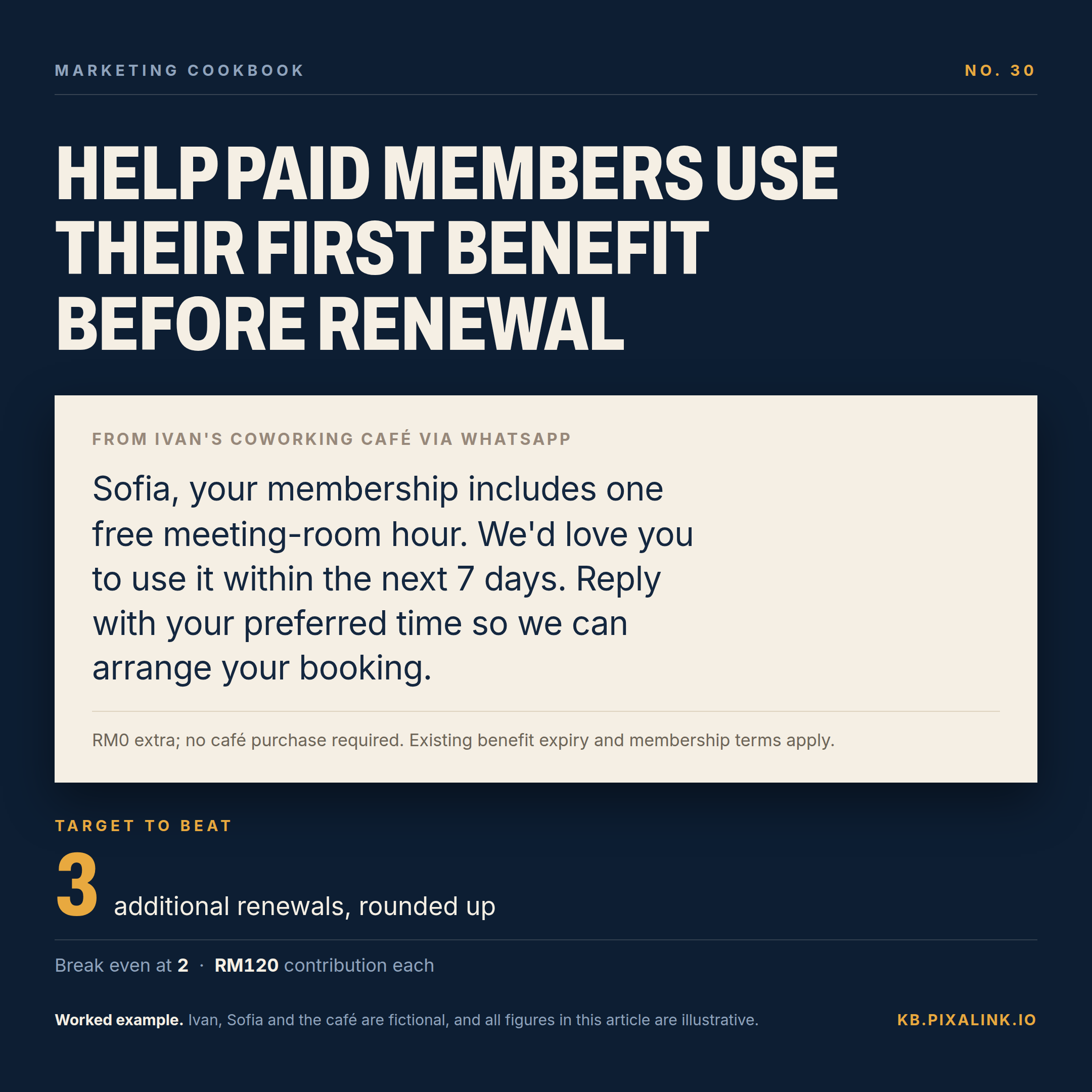
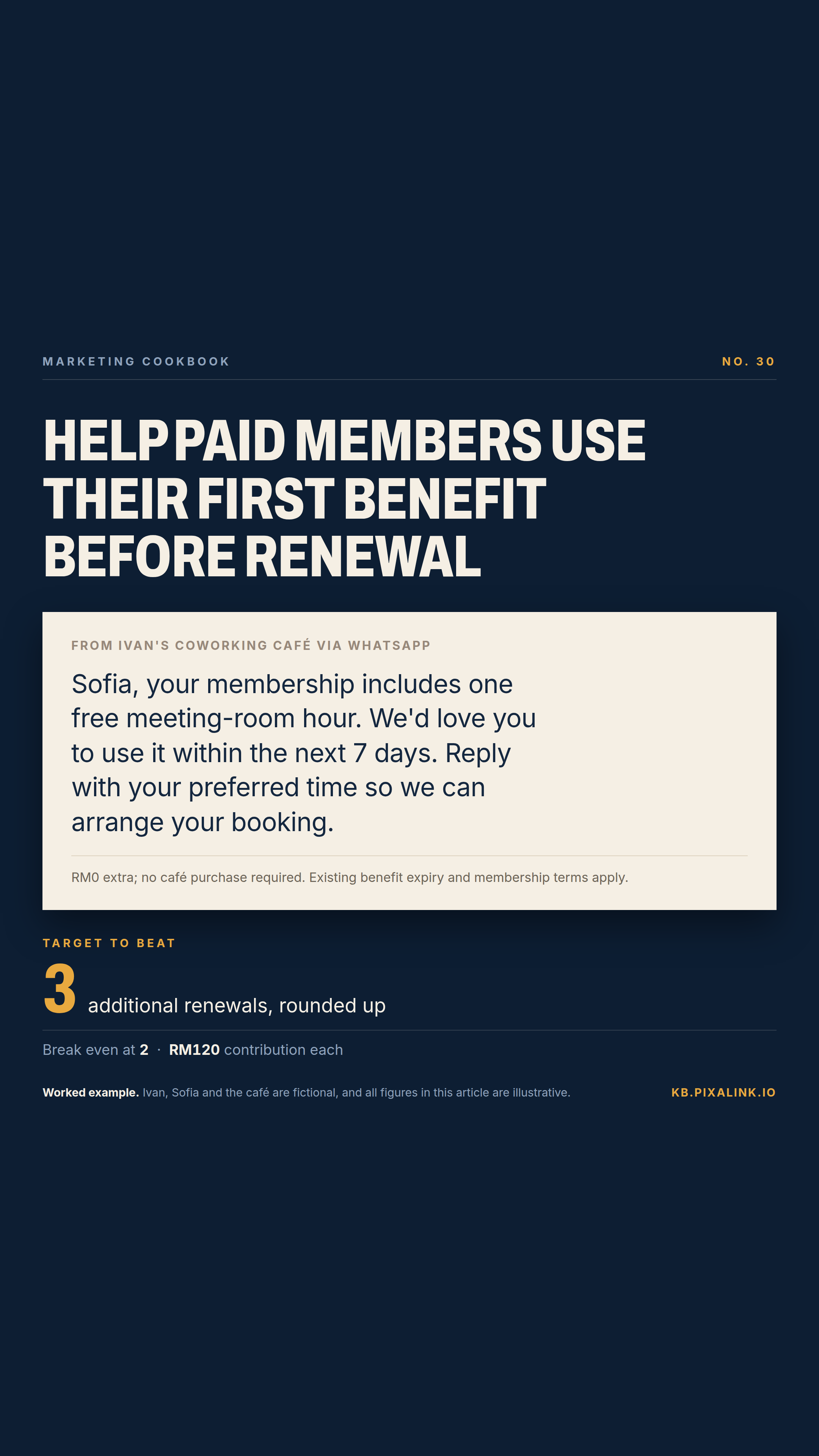
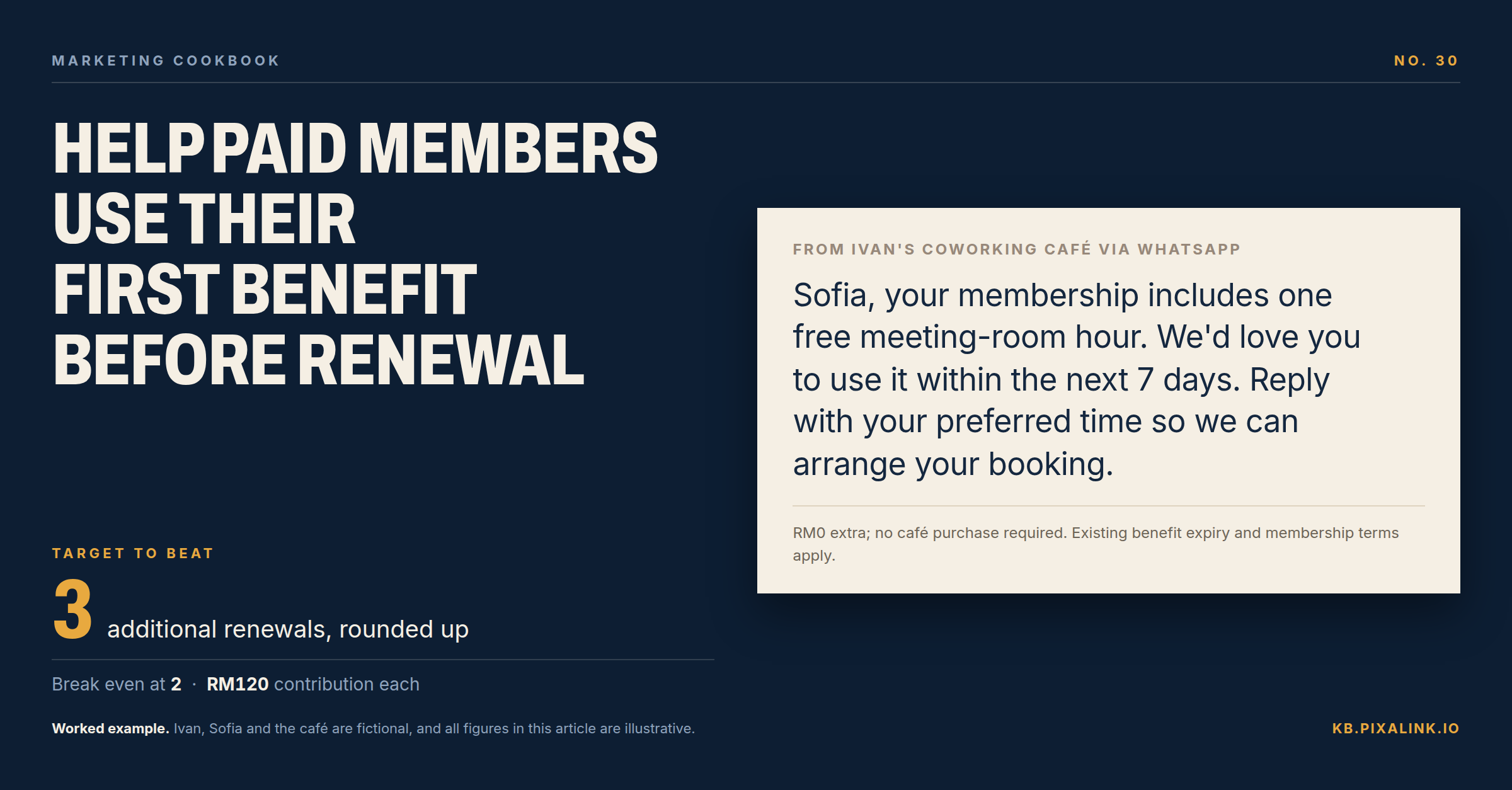
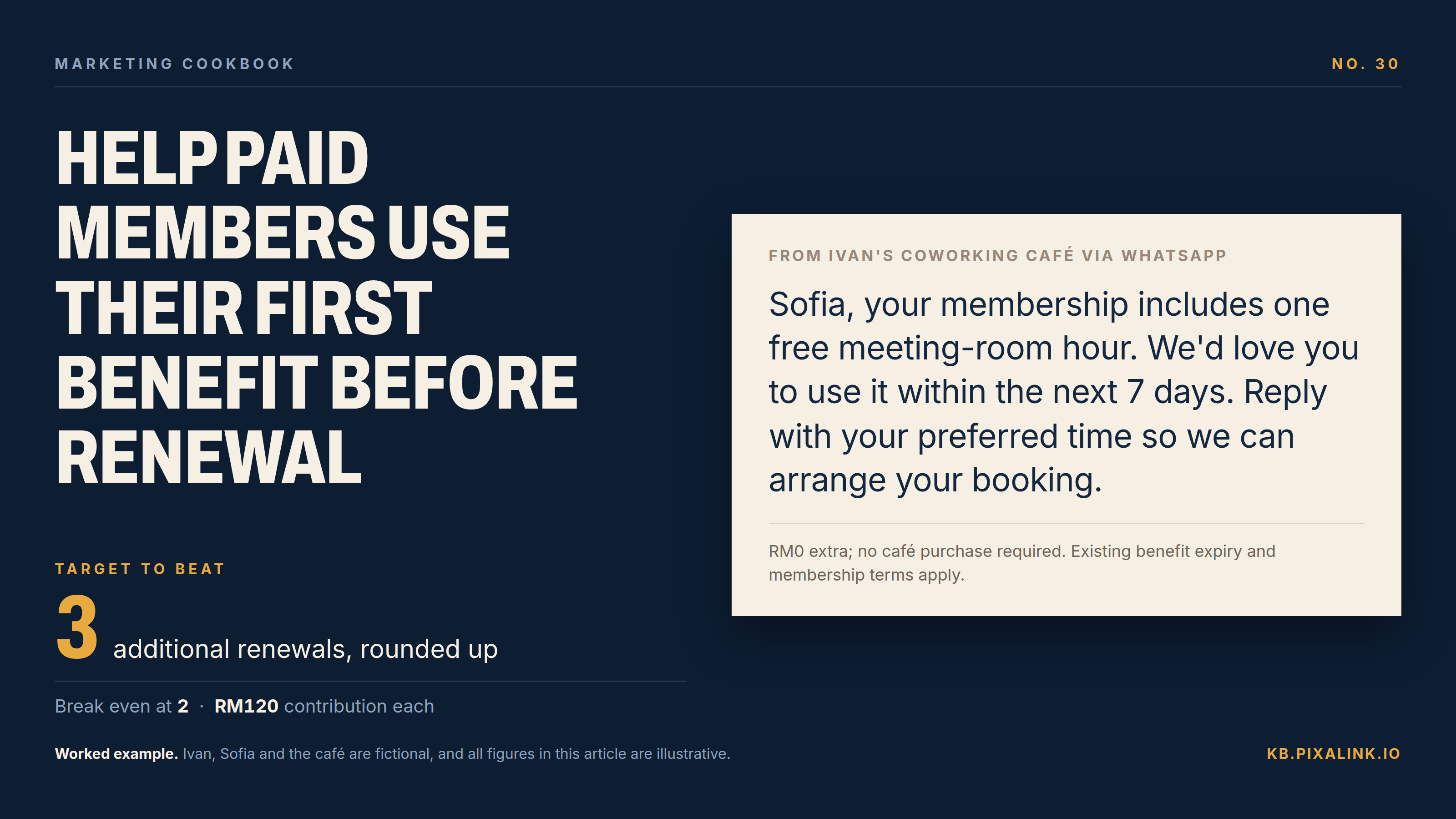
The same card at four sizes. Every figure on it comes from this article, and the message is the one written above — nothing on the card is generated.
Alt text for your post
Help Paid Members Use Their First Benefit Before Renewal. At day 45, staff identify members with no benefits used, invite them to book an included free meeting-room hour within seven days, then record attendance. Sofia pays RM0 extra; Ivan budgets RM8 per hour. Ivan, Sofia and the café are fictional, and all figures in this article are illustrative.
Closing invitation
Choose one included benefit that an inactive member could use this week. Follow Ivan and Sofia from invitation to actual attendance, then let the measured renewal difference decide whether the nudge deserves another run.