
Referral & Membership
Reward Referrals When Friends Become Paying Customers
How can she reward the friend who buys without paying for the three who only browse?

A worked example
- RM60
- Contribution per incremental action
- 4
- Break-even actions
- 6
- Minimum target
using cash collected - variable fulfilment cost - reward cost
incremental qualifying purchases, using campaign operating cost / contribution per incremental action
incremental qualifying purchases, rounded up
At a glance
The business problem
At RM20 for each of 300 sign-ups, Janelle's old offer costs RM6,000 before stock and staff costs. RM900 of sales cannot cover that reward bill. Her problem is the event she pays for: a completed registration says little about buying intent.
A referral budget should buy incremental customers: people whose purchases would not have happened without the offer. A longer contact list is useful only if it leads to enough additional contribution.
Why the usual promotion falls short
Paying immediately makes joining the finish line. Moving the reward to a first purchase, with a meaningful minimum, gives the invitation a commercial purpose.
Referred customers churn about 18% less and are worth roughly 16% more over six years; the retention advantage persists while the margin advantage erodes — Schmitt, Skiera & Van den Bulte (2011), Journal of Marketing 75(1). This research supports testing referrals; it does not guarantee Janelle's results.
What you set up in Pixalink
Opening scenario
Janelle watches Melissa and her friends browse the serum shelf at her Kuala Lumpur skincare boutique. Her RM20 referral bonus has brought in 300 names over two months, but only RM900 in sales. Melissa invited four friends; one became a customer, while three joined as a favour.
Janelle, Melissa and this business are fictional, and all figures in this article are illustrative. Paying for registrations leaves Janelle funding goodwill rather than purchases. How can she reward the friend who buys without paying for the three who only browse?
The recipe
The campaign recipe
Start with a small product gift for each side after a qualifying purchase. Each gift has RM10 retail value and RM5 fulfilment cost: RM20 of value costs Janelle RM10 per pair.
| Recipe element | Recommended starting point |
|---|---|
| Suitable industries | Skincare boutiques and other retailers with a useful, low-cost sample gift |
| Primary goal | Acquire genuinely new paying customers |
| Customer segment | Four existing customers as inviters; their genuinely new friends |
| Offer | One sample gift each for inviter and friend after the friend's first qualifying purchase; inviter taps Claim |
| Validity | Qualify during a 14-day sprint; claim and collect gifts within 14 days of qualification, managed by staff |
| Minimum spend | RM100 net on the friend's first purchase; validate its equivalent in points or credit before launch |
| Quantity or budget limit | Five rewarded slots per inviter; 20 qualifying purchases overall; RM200 gift-cost reserve, controlled by staff |
| Main success metric | Refund-adjusted acquisition contribution |
The message your customer receives
This message is fictional, like the merchant and customer. All figures are illustrative.
From Janelle's skincare boutique via WhatsApp
Melissa, your friend's first purchase has qualified you both for one sample gift each. Tap Claim for yours, and claim and collect the gifts within 14 days of the qualifying purchase.
Minimum spend on your friend's first purchase: RM100 net.
The journey
Follow the customer
- Share. Melissa shares her referral link with four friends. Nothing is paid yet, and signing up earns no reward.
- Buy. Three friends join and browse. One buys a RM140 serum, clearing the RM100 net threshold on her first purchase.
- Receive and claim. The friend's reward arrives automatically when she qualifies. Melissa's reward becomes claimable then; she must tap Claim before collecting her gift.
- Continue. Janelle funds one successful referral pair. After gift collection, the buyer can return normally, while the three browsers remain potential customers Janelle may market to where contact is permitted.
flowchart TD
    A[Melissa shares her link] --> B[Friend joins and buys]
    B --> C{First purchase qualifies?}
    C -->|No| D[No referral gift]
    C -->|Yes| E[Friend receives reward]
    C -->|Yes| F[Melissa taps Claim]
    E --> G[Collect gifts and return normally]
    F --> G
Use case: how the merchant applies it
Janelle reserves 40 sample gifts for the 20-purchase pilot and explains the terms to four inviters, including Melissa. Only genuinely new customers qualify, and staff check customer history. Five rewarded slots per inviter are the offer limit, not five payments for registrations.
Staff record qualifying dates and honour each gift for 14 days after qualification, with no further purchase required. They manage the overall cap and collection deadline manually; automatic campaign-wide capping and this expiry arrangement are not verified platform controls. Janelle closes new participation when the pilot ends and tracks outstanding commitments separately, without assuming in-flight referrals disappear.
How the platform helps
How Pixalink supports the strategy
Pixalink tracks referrals, supports slot consumption at signup or purchase, applies a minimum in points or credit, and issues the invitee's reward automatically. Use purchase-based consumption here. The RM100 net business rule must be mapped and checked against the shop's recorded points or credit; do not assume entering 100 always means RM100 of net sales.
Janelle enforces genuine-new-customer eligibility and reminds Melissa to tap Claim. Automatic refund clawback, slot restoration and a campaign-wide purchase cap are not verified for this offer, so staff must reconcile them.
Configure this in Pixalink
Use How to Set Up Referrals for configuration. Keep the purchase condition and inviter Claim requirement beside your customer-facing offer.
The economics
ROI taste test
For Melissa's friend's RM140 serum, assume RM70 variable fulfilment cost and RM10 for both gifts. Budget RM100 for staff and materials, plus RM140 for up to 14 reward pairs on purchases that would happen anyway. This gives a conservative RM240 campaign cost allowance alongside the incremental purchases.
- Contribution per incremental action = RM140 - RM70 - RM10 = RM60, using cash collected - variable fulfilment cost - reward cost.
- Break-even actions = RM240 / RM60 = 4 incremental qualifying purchases, using campaign operating cost / contribution per incremental action.
- Minimum target = 4 x 1.5 = 6 incremental qualifying purchases, rounded up.
At six incremental purchases within the 20-purchase cap, the other 14 gift pairs fit the allowance. Compare with four similar inviters without the offer over the same period, adjusting for refunds and usual referral activity. Names, claims and purchases that would happen anyway are not incremental profit; replace every price, cost and behaviour assumption with your own and recalculate if the mix changes.
Measure it
What to watch
- Refund-adjusted acquisition contribution: additional purchase contribution less campaign costs and rewards on non-incremental sales.
- Qualifying-purchase rate: referred sign-ups whose first purchase meets the threshold, after refunds.
- Inviter claim completion: eligible rewards Melissa and other inviters actually claim.
Common mistake: celebrating registrations as acquired customers. Report paid, refund-adjusted outcomes instead.
Safeguard: review the written offer against Referral Commission and Act 500: What Merchants Should Know before launch. That guide covers a different commission structure too; its monthly cap and reversal behaviour are not evidence for this one-off gift offer.
Keep Janelle's offer only when at least six incremental qualifying purchases, positive net contribution and the safeguard hold. Improve a promising result with one bounded change in a new test; stop the current version if it misses six, contribution is non-positive or the safeguard fails.
Your first test
Try this first
- Choose four inviters and four comparable controls; record their usual referral purchases.
- Reserve RM200 for gifts and track five rewarded slots each, up to 20 purchases overall.
- Fix the offer, 14-day sprint and 14-day collection terms; reconcile after the normal refund window.
- Record costs, refunds and claims, and complete the written-offer safeguard.
- Apply the six-purchase keep/improve/stop rule before expanding.
Questions
Frequently asked questions
Does every friend who registers earn a gift?
No. Janelle rewards only a genuinely new customer's qualifying first purchase.
Do both rewards arrive automatically?
Only the friend's does. Melissa must tap Claim for hers.
What if the purchase is refunded?
Remove refunded value from acquisition results and count any unrecovered gift cost. Do not assume reward reversal or slot restoration happens automatically for this offer.
Can I run the sprint without unlimited liability?
Use the small invited group, reserve stock and maintain a staff commitment log. Confirm how you will close participation and honour existing referrals before promoting a deadline.
Share this recipe
A card you can post
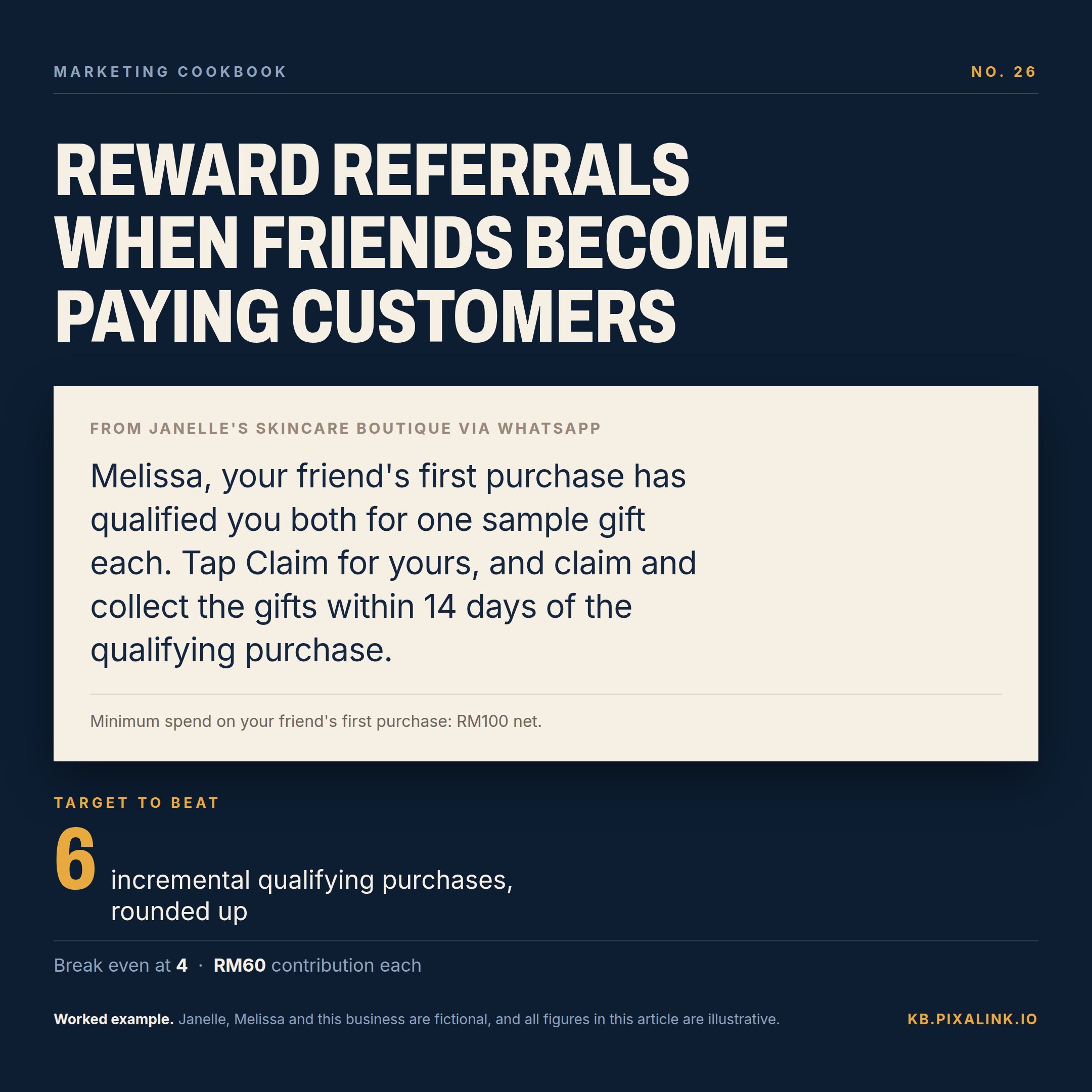
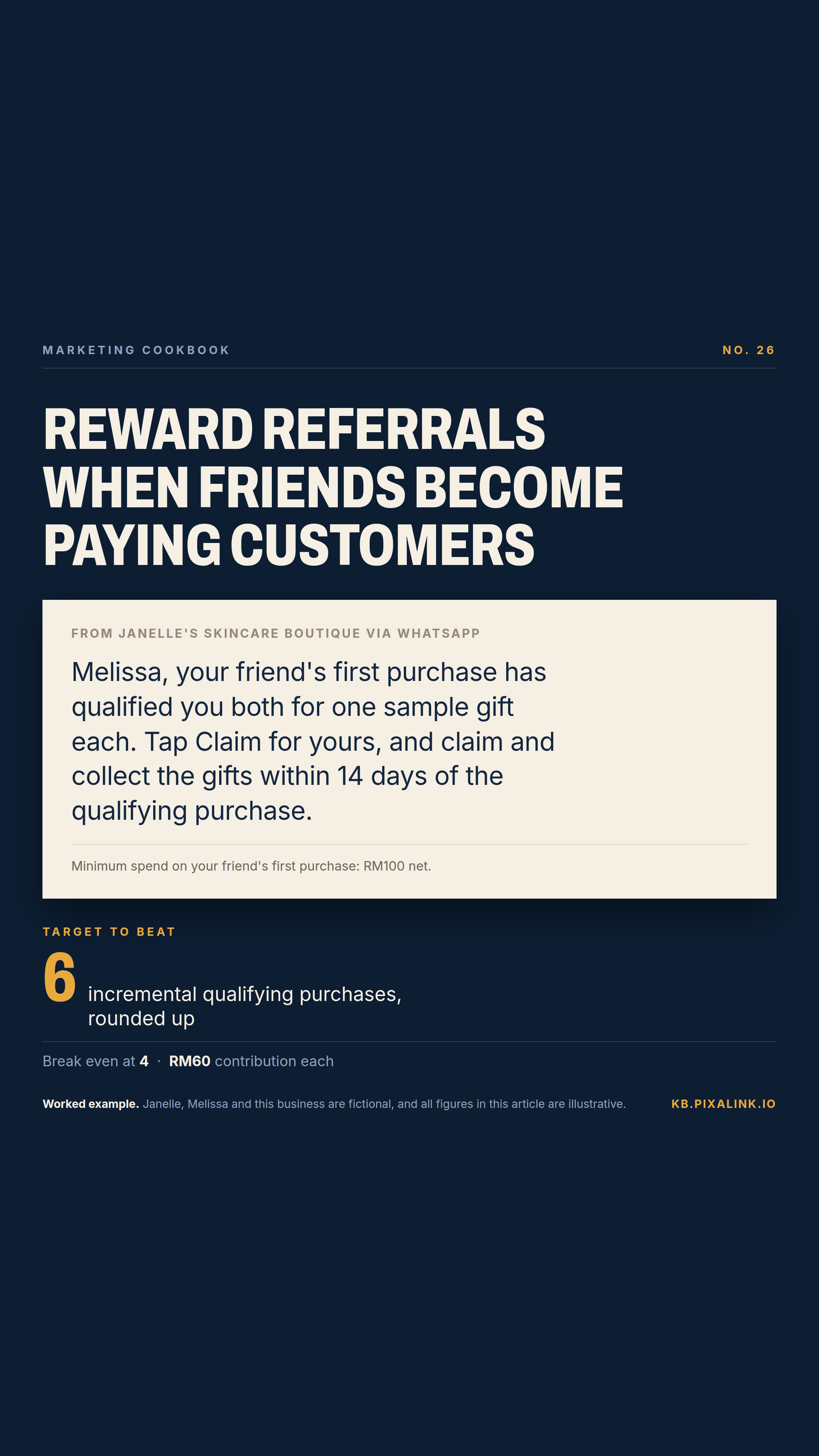
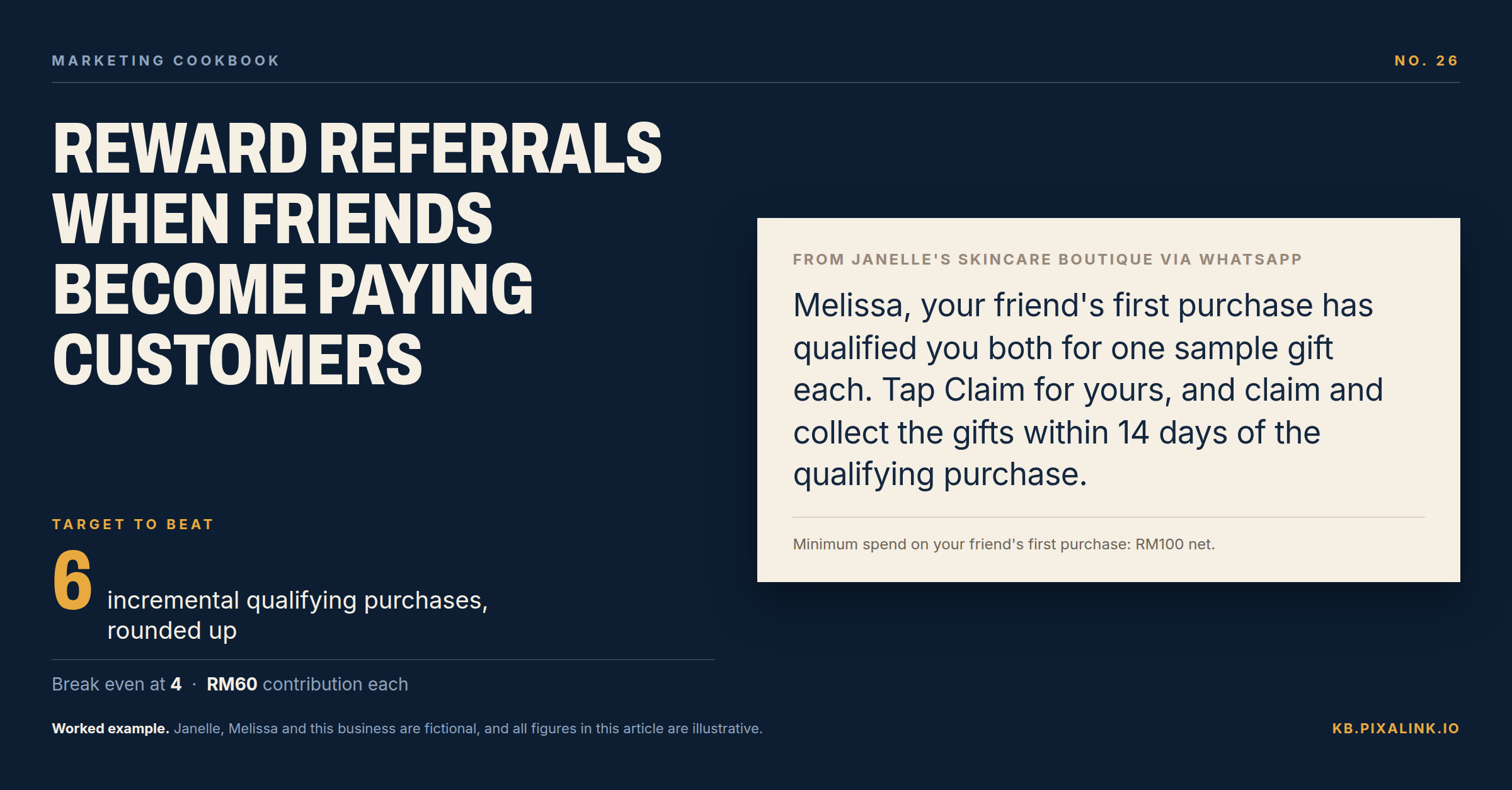
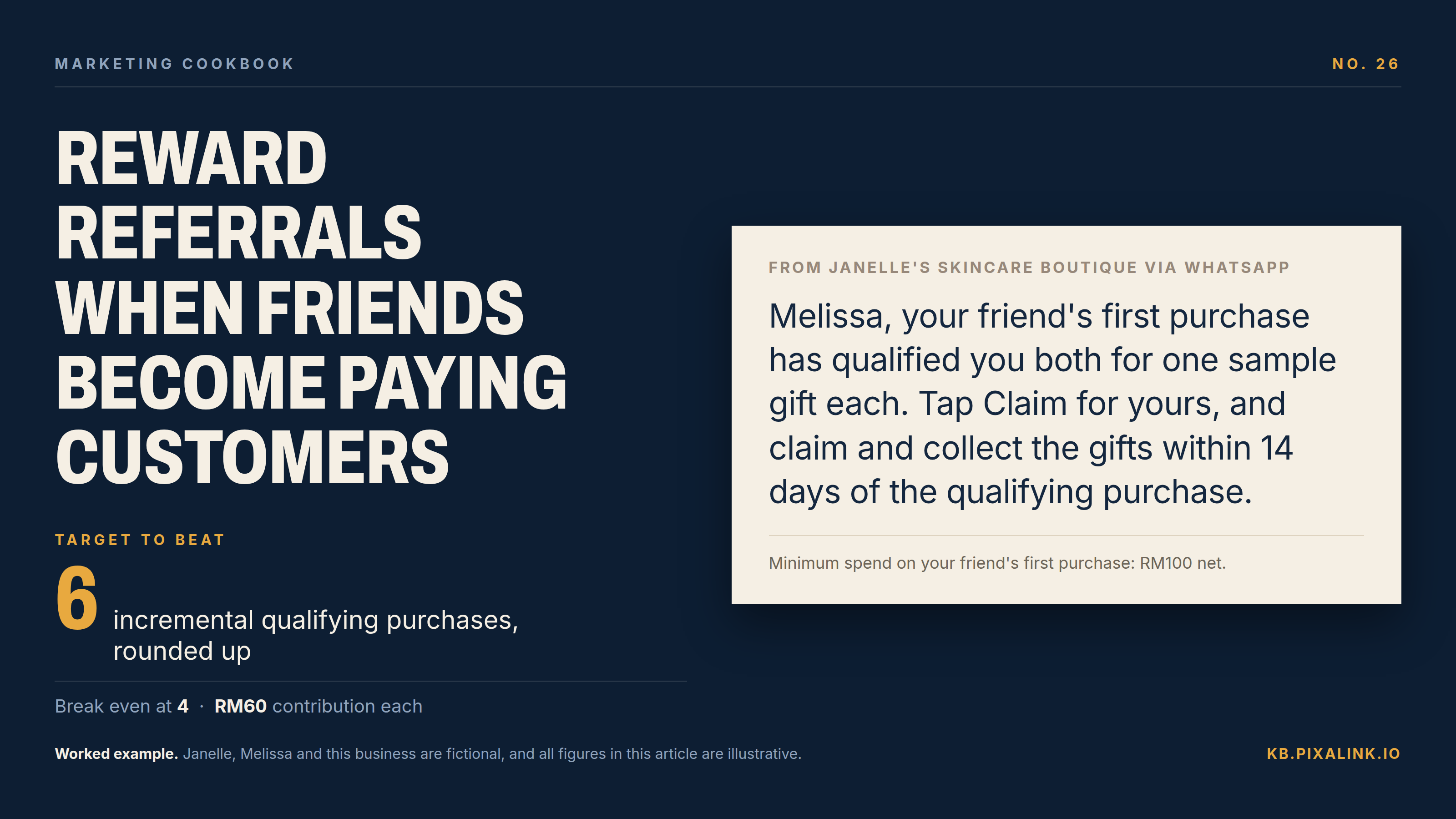
The same card at four sizes. Every figure on it comes from this article, and the message is the one written above — nothing on the card is generated.
Alt text for your post
Reward Referrals When Friends Become Paying Customers. No gift at signup. A first purchase of RM100 net unlocks a RM10 sample gift for each person, costing RM5 each. The friend receives the reward automatically; the inviter taps Claim. Janelle, Melissa and this business are fictional, and all figures in this article are illustrative.
Closing invitation
Choose one small referral offer and test whether it brings genuine buyers like Melissa's friend. Keep it only when the extra customer value pays for the rewards and effort.